Group XII - CTLD with acidic neck / EMBP group







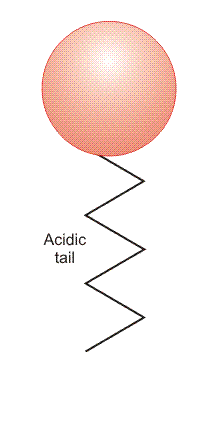 The eosinophil major basic protein (EMBP) group of CTLD-containing
proteins has two members in both human and mouse: EMBP and EMBP homologue (EMBPH). EMBP and EMBPH
are soluble proteins, each with a glycosylated N-terminal region rich in
acidic residues and a C-terminal CTLD rich in basic residues.
The eosinophil major basic protein (EMBP) group of CTLD-containing
proteins has two members in both human and mouse: EMBP and EMBP homologue (EMBPH). EMBP and EMBPH
are soluble proteins, each with a glycosylated N-terminal region rich in
acidic residues and a C-terminal CTLD rich in basic residues.
EMBP is expressed in eosinophils, basophils, and placental X cells. In eosinophils, the protective acidic region is removed and the CTLD covalently polymerizes to form insoluble aggregates that make up the crystalline core of eosinophil granules. EMBP is a cytotoxin deployed against helminth parasites, and possibly also against bacteria, fungi and cancerous or infected cells. EMBP triggers release of histamine from mast cells and basophils, and activates neutrophils and alveolar macrophages. Release of EMBP and its deposition onto tissues is linked to hypersensitivity reactions and causes tissue dysfunction in inflammatory and allergic conditions, including asthma. Towards the end of pregnancy, pro-EMBP circulates in a complex with pregnancy-associated plasma protein A, angiotensin and C3dg. EMBPH is expressed in eosinophils. It is less basic and less potent than EMBP, but has similar biological activities.
The involvement of carbohydrate recognition in the function of EMBP group proteins has not been established. The CTLDs in these proteins do not contain the sequence motifs associated with sugar-binding activity. However, EMBP binds heparin through a novel calcium-independent carbohydrate-recognition mechanism.
DEC-205-associated C-type lectin (DCL)-1 was also formerly classified as a member of this group. However, DCL-1 is a type 1 transmembrane protein with an extracellular CTLD and neck region and may be classified as belonging to a new group of CTLD-containing proteins. DCL-1 was discovered in cells associated with the development of Hodgkin’s lymphoma. Intergenic splicing of DCL-1 and DEC-205 (a CTLD-containing type 1 transmembrane protein of the mannose receptor family) results in production of a fusion protein containing both DCL-1 and DEC-205 extracellular domains, plus the transmembrane and cytoplasmic regions of DCL-1. Non-intergenically spliced DCL-1 transcripts are present in myeloid and B lymphocyte cell lines.
- Structure of human EMBP with bound
- heparin disaccharide
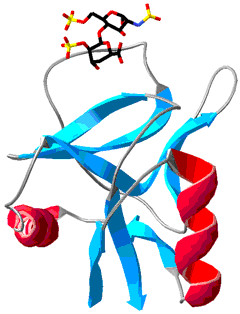
The sugar ligand is coloured by atom: black, carbon; red, oxygen; blue, nitrogen; yellow, sulphur. Protein Data Bank structure ID: 2BRS.


