Group V - NK Cell Receptors






 The natural killer (NK) cell receptor group of
CTLD-containing proteins has around 20 members in human and more in mouse.
Each of these type 2 transmembrane proteins consists of an extracellular CTLD
and a variable-length neck region that in many cases contains cysteine
residues involved in covalent homo- or heterodimerization. The cytoplasmic
tail also varies in length and commonly contains internalization motifs,
tyrosine-based motifs involved in signalling, or binding sites for cytosolic
proteins.
The natural killer (NK) cell receptor group of
CTLD-containing proteins has around 20 members in human and more in mouse.
Each of these type 2 transmembrane proteins consists of an extracellular CTLD
and a variable-length neck region that in many cases contains cysteine
residues involved in covalent homo- or heterodimerization. The cytoplasmic
tail also varies in length and commonly contains internalization motifs,
tyrosine-based motifs involved in signalling, or binding sites for cytosolic
proteins.
The NK cell receptor group includes true NK cell receptors as well as structurally-related proteins which have other functions. The families of true NK cell receptors have undergone differential expansion in human and mouse: the Ly49 group is present only in mouse, whereas the NK receptor protein (NKRP)1 group, NK group (NKG)2 proteins and CD94 are present in both species. Inhibitory NK receptors block NK cell cytolytic activity upon recognition of markers of healthy self cells, predominantly major histocompatibility (MHC)-related molecules. Activating receptors stimulate cytolytic activity upon recognition of infected or transformed cells. Several of the NK cell receptor-related proteins also regulate leukocyte function, but their specific roles are often unclear (eg killer cell lectin-like receptor (KLR)F1, CD69, myeloid DAP12-associating lectin (MDL)-1, C-type lectin-like receptors (CLEC)-1 and -2). Specific functions have been delineated in some instances. Dectin-1 is a phagocytic receptor for fungi and a costimulatory molecule for T cells. Mast cell-associated functional antigen (MAFA) inhibits cell proliferation and immunoglobulin E receptor-mediated mast cell degranulation and is an adhesion receptor for mast cells. CD72 inhibits B cell receptor signalling. Osteoclast inhibitory lectin (Ocil) inhibits osteoclast formation. Lox-1 is an endocytic receptor on vascular endothelial cells for oxidized low-density lipoprotein and is implicated in the development of atherosclerosis.
The CTLD in NK cell receptor proteins does not contain the sequence motifs associated with calcium and sugar binding. Nevertheless, carbohydrate binding has been reported for some members of the group: for example, dectin-1 recognizes fungal beta-glucans, Ocil binds high molecular weight sulphated glycosaminoglycans, and MAFA exhibits calcium-dependent binding to terminal mannose. With the exception of dectin-1, roles for carbohydrate recognition in the function of NK cell receptor proteins have not been established.
- Structure of human CD94 CTLD
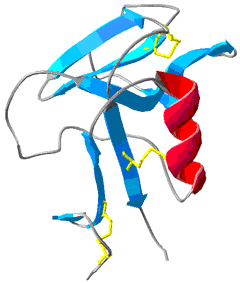
- A novel CTLD fold. Protein Data Bank structure ID: 1B6E.


