
Develop analytical skills in subsurface geoscience and engineering
In preparation for the energy transition, you will study subsurface geoscience and engineering, with a focus on data science and machine learning. You will develop skills that can be applied to carbon dioxide storage, water management, hydrocarbon recovery, geothermal energy and other subsurface processes.
The programme will strengthen your understanding of numerical, analytical and computational concepts, and is taught by experts in these areas. It is aimed at geoscientists and engineers who want to acquire advanced computational, data science, machine learning and numerical skills relevant to working on various aspects of the energy transition.
Find the most recent course information and specifications on the Imperial MSc GEMS course page.
/filters:format(webp)/prod01/channel_3/media/imperial-college/faculty-of-engineering/earth-science-and-engineering/earth-science-general/2000-x-2000-(1).png)
Our Master’s in Geo-Energy with Machine Learning and Data Science will equip you with the cutting-edge skills you need to tackle real-world issues facing the global energy sector. Now more than ever, geoscientists need to gain and apply expertise in Machine Learning and Data Science to problems in subsurface geoscience and engineering. Professor Martin Blunt MSc GEMS Course Director
Course Information
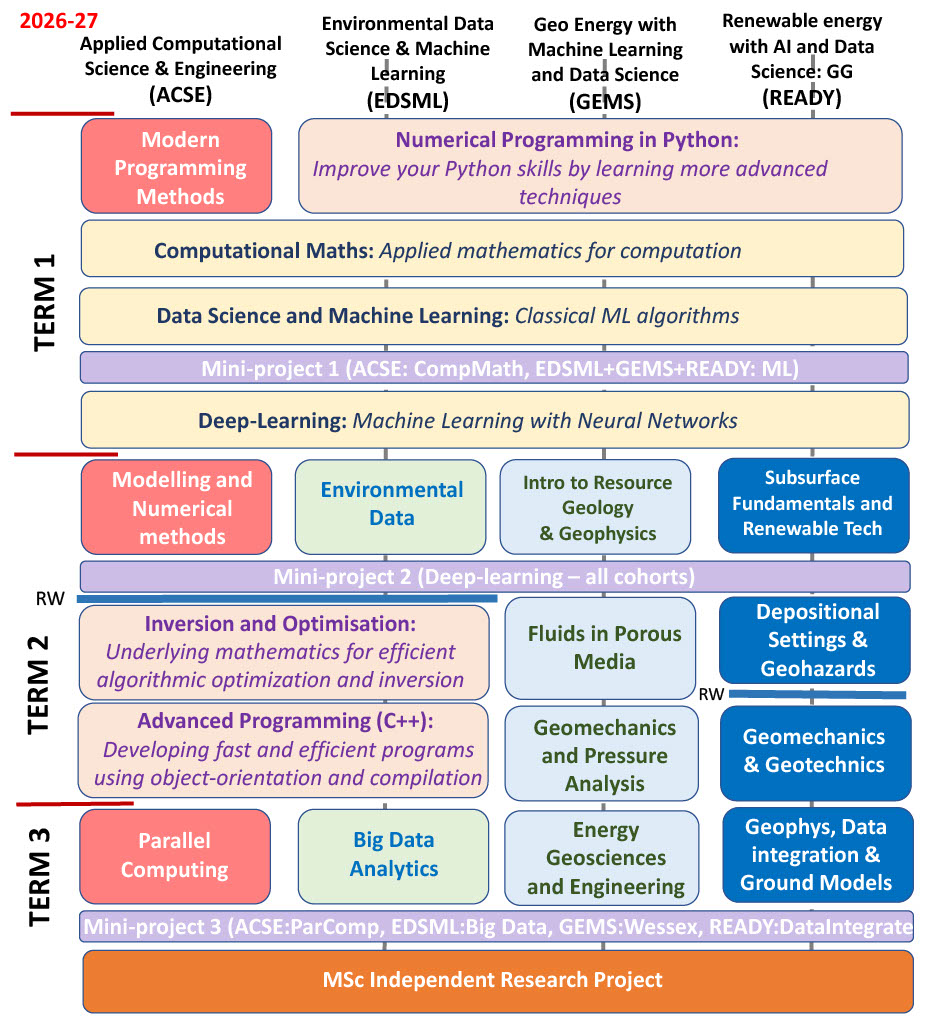
The Geo-Energy with Machine Learning and Data Science MSc programme is one of three computational programmes in ESE. The study programme consists of eight taught modules, three mini projects, and one individual research project. It shares teaching modules with our two other computational MSc courses, as shown in the table below.
You will study the following taught courses:
- Numerical programming in Python
- Computational Math
- Data Science and Machine Learning
- Resource Geology and Geophysics
- Fluids and Flow in Porous Media
- Geomechanics and Pressure Analysis
- Applied Energy Geosciences and Engineering
- Deep-Learning
You can see the teaching schedule represented visually below. If you would like an accessible version of this information, please contact ESE webmaster.
Graduates of this course will go on to work in academia, or go on to work in:
- large data and computer companies including start-ups,
- consultancies offering services to the energy industry and working on natural geo-hazards,
- the energy industry, including oil, gas and renewables,
- companies involved in carbon dioxide, hydrogen and/or thermal energy storage,
- engineering companies involved in the energy transition.