
Inspiring the future crop of experts in Computational Science and Engineering
The Applied Computational Science and Engineering MSc (ACSE) will educate future domain-specialists in computational science.
This course will expand your knowledge of numerical methods, computational science, and how to solve large scale problems by applying novel science and engineering approaches. Graduates of this course will fill the market demand for those with applied, hands-on computational experience who can solve real world problems.
Find the most recent course information and specifications on the Imperial MSc ACSE course page.
ACSE video

Flexible widget
Who is the MSc for?
The MSc is suitable for graduates of disciplines including mathematics and physical sciences, geophysics and engineering, and computer science.
All students should have undertaken some programming in a high-level language (including Matlab, Python or C/C++).
Why should I apply for the MSc?
• Model dynamical processes using numerical methods and advanced programming
• Large scale, big data, machine learning
• Combining mathematics, physical sciences, engineering, and computational science
• Preparing tomorrow’s technologists, entrepreneurs and computational problem solvers
/filters:format(webp)/prod01/channel_3/media/images/square-2000X2000/gerard-gorman.jpg)
Students will learn to solve real-world problems using numerical methods and computational science for a broad range of applications in science and engineering. Dr Gerard Gorman MSc ACSE Course Director
Course Information
Students will have the chance to participate in individual and group research projects as well as to write reports and present technical work, developing the project management and numerical skills that are desired by employers.
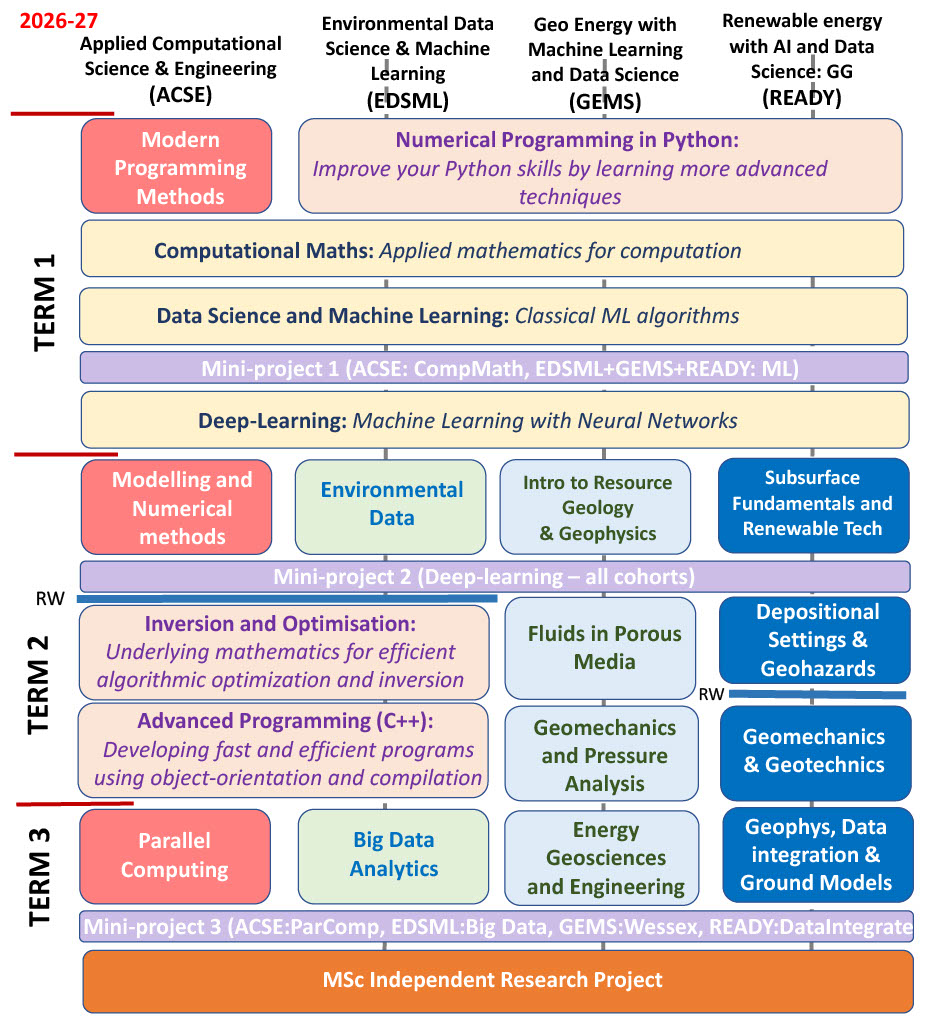
The study programme consists of eight taught modules, and one individual research project which accounts for one third of the study programme.
Term 1
Modern programming methods
Modelling dynamical processes
Numerical methods
Applying computational science
Term 2
Advanced programming
Patterns for parallel programming
Inversion and optimisation
Machine learning
Term 3 (summer)
Independent Research Project, example project titles include:
- Computational fluid dynamics for turbulent flows
- Modelling of wind turbines and their wakes
- Multi-scale tsunami inundation and sea defence modelling
- Adjoint based inversion and optimisation methods
- Interface construction for multimaterial flow modelling in 3D
- Modelling asteroid impact processes
- Generative Adversarial Networks for generating geological models
- Deep Learning applied to the interpretation of subsurface data
-
A numerical study of the interaction between hydraulic fractures and natural fractures
- Computational Methods in Radiation Transport Using Supercomputers
-
Coupled multiphase SPH-DEM simulations of an aerated fluidized bed
- Deep Learning for Solving PDEs
-
Multi-material Interface Tracking in a Three-Dimensional Shock Physics Code
- Offshore wind farm wake modelling using deep feed forward neural networks for active yaw control and layout optimisation
-
Predicting fracture growth on Jupiter’s icy satellite Europa using finite element modelling
- The Space Filling Curve Convolutional Neural Network for use with Multi-Dimensional Unstructured Finite Element or Control Volume Meshes
-
Traffic congestion recognition based on remote sensing images and machine learning
You can see the teaching schedule represented visually below. If you would like an accessible version of this information, please contact ESE webmaster.
Graduates of this course will fill the market demand for those with applied, hands-on computational experience who can solve real world problems.
Through the combination of programming, foundational domain knowledge and advanced numerical literacy that this course provides, graduates will be highly sought after to work as expert analysts in industry, for example, in geoscience, risk management or climate science. Graduates will be in an ideal position to pursue academic careers in fields such as computational techniques, optimisation and inversion, fluid mechanics, and machine learning applications.
We strive to increase and broaden inclusivity and support everyone, regardless of background, in breaking down any barriers to you applying to the Department. If you are unable to pay a course’s application fee, we encourage you to apply for a fee waiver.
If you are interested in an MSc and wish to apply for a fee waiver, please contact adalovelace-admissions@imperial.ac.uk prior to starting your application.
Please note that even if you don’t have prior experience in all of the areas above, but think your background and skills are a good fit for the programme and are excited about developing your skills in computational science with a strong focus on solving real world science and engineering problems, please don’t hesitate to contact the course administrator to find out more and discuss.
Find out more about postgraduate study at Imperial College London, including tuition fees, admissions and how to apply.