Our Research
The Laboratory for Integrated Green Harvesting & Transport, the LIGHT Lab (Cao Group), investigates the fundamental question: How can we engineer the physical systems that enable humanity to prosper within planetary boundaries?
To answer this question, we develop fundamental transport science and engineering solutions that span four interconnected strategic research themes.
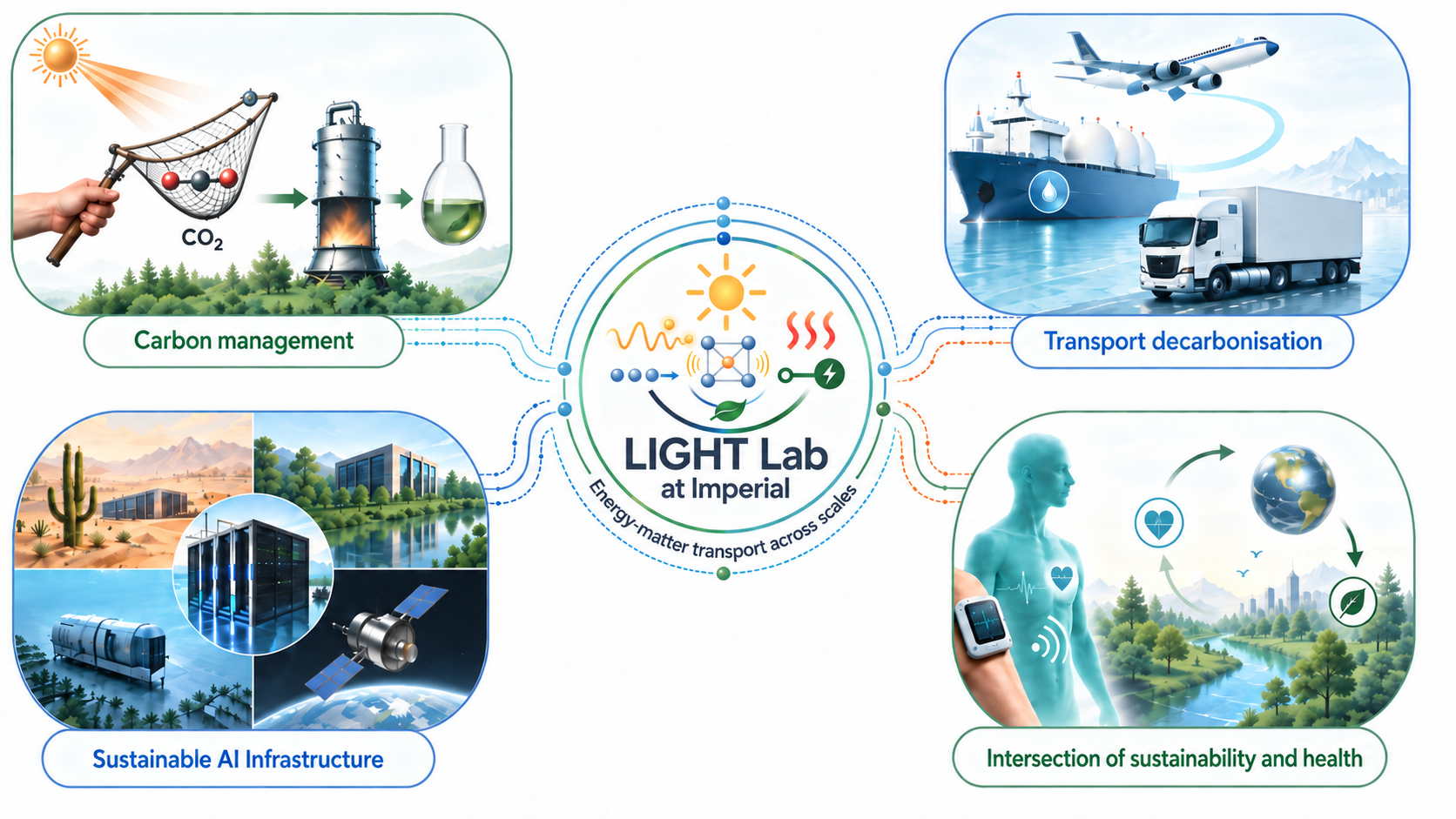
Research Themes
Our four strategic research themes are interconnected by the same vision: Engineering the Physical Systems for a Sustainable Future.
- Carbon Management: We develop adaptive systems for circular carbon management. Our research integrates responsive capture materials, structured contactors, multi-energy regeneration, reactor engineering and thermodynamic performance evaluation to minimise the energy and exergy costs of carbon management. See our relevant work in Joule, Device, Separation and Purification Technology, Renewable and Sustainable Energy Reviews, etc.
- Transport Decarbonisation: We engineer sustainable fuels, onboard capture technologies, and advanced energy systems for hard-to-abate transport sectors, including aviation, maritime shipping, and heavy-duty transport. By integrating photothermal, electrochemical, and thermal engineering approaches, we seek to accelerate the transition towards net-zero mobility. See our relevant work in Matter, Device, Matter, Cell Reports Physical Science, etc.
- Sustainable AI Infrastructure: We investigate how energy, water, carbon and computational workloads interact across emerging AI infrastructure. Our research develops adaptive thermal-management and resource-recovery systems, including the use of stranded low-grade heat for carbon removal, while safeguarding computing performance, water availability and system resilience across conventional and emerging data-centre configurations. See our relevant work in Advanced Materials, Energy, Device, Cell Reports Physical Science, etc.
- Intersection of Sustainability and Health: We explore how sensing and engineering systems can connect environmental sustainability with human and planetary health, including emerging biosensing and environmental monitoring technologies. See our relevant work in EBioMedicine, Analytical Chemistry, etc.
Our Scientific Philosophy
At the heart of our research is a simple belief: The future of sustainability depends on mastering the transport of energy, matter, and information across scales.
Whether capturing carbon from air, producing sustainable fuels, or enabling AI infrastructure, the underlying scientific challenge remains the same: understanding and controlling how energy carriers—such as photons, phonons, and electrons—move through engineered systems.
Our research therefore combines three complementary principles:
- Energy-Matter Carrier Engineering: Understanding and controlling the transport of photons, phonons, electrons, and molecules, while matching energy quality to the requirements of separation and conversion processes.
- Multiscale and Adaptive Systems Engineering: Connecting molecular phenomena with materials, structured reactors and dynamically operated systems that respond to variable energy and resource conditions.
- Responsible Technology Translation: Integrating engineering, economics, environmental assessment and policy to develop technologies that are scalable, verifiably beneficial and compatible with planetary boundaries.