.JPG)
In 2026, Invisible Warrior reached an important milestone – turning five! To celebrate, we’re sharing stories of the people who made the project possible, through our ‘In the Spotlight’ interview series.
For the first interview, we’re starting at the beginning of Invisible Warrior with the two women who created the project: Louisa Thompson, a Sickle Cell warrior who was born with Sickle Cell disease SS, and Linda van Keimpema, who was working as a Teaching Fellow in the Faculty of Medicine when they met.
Can you tell us a little bit about how you two first met and what that experience was like?
Louisa: Jeremy Anderson, my therapist, asked me to speak to medical students to give them an insight into what it's really like to live with sickle cell, not just the medical aspect, but what it's like to live my day to day, how it affects me, my mental health, the ins and outs, my daily routine. At first, I was a bit hesitant because it's very personal and it can be hard to describe what you go through.
But luckily, he caught me in lockdown, so I had plenty of time because I was shielding for six months. I wrote it down and it felt like a therapy session; it was almost like a diary of my whole life. So, I agreed to the talk, and that’s how I met Linda.
I heard Louisa talk and I'm quite sure I was sobbing my eyes out because it's a difficult story, but it's a very important story. Linda van Keimpema
Linda: I happened to be in the talk because at the time I was working as a teaching fellow at Imperial and these were medical students who were on one of the courses I was working on. The organiser told me that there would be a patient living with Sickle Cell joining the session and I asked if I could sit in.
Louisa shared her story, she talked for 20 minutes about her life, basically from her birth all the way till where she was at that point. It's hard to describe how impactful it was. I was completely blown away by how ignorant I was.
I have a molecular biology background, so I know about DNA, I know about genetic disorders, I've learned about Sickle Cell, but I only knew it was a genetic mutation. And very stupidly I never thought about the people living with it. But that changed in that moment. I heard Louisa talk and I'm quite sure I was sobbing my eyes out because it's a difficult story, but it's a very important story.
Louisa, you said you were initially hesitant to share your story. Can you tell us more about that, and what made you overcome those fears?
So even talking about my challenges as a single mum, feeling like a bad mum because I knew I had this illness, it's like exposing your darkest truth to strangers. But I also knew that this is the reality. This is my reality and it's important to not be ashamed of having Sickle Cell. I think for many, many years I was totally ashamed. I wouldn't really tell anybody. And it was quite freeing, when I read my story. It was very freeing to know that, this is who I am. I'm Louisa. I have Sickle Cell. I'm a warrior. And those factors make me the whole Louisa.

After your first meeting in that online teaching session, how did you two get back in touch and what were the initial stages of setting up Invisible Warrior like?
Linda: After the teaching session, I got in contact with Louisa. I emailed her to thank her for sharing her story and to say that I thought her story should be shared more widely. It was lockdown and Louisa was shielding, so I suggested we have a phone call. And we immediately hit it off! We kept having phone calls, discussing ideas for the project. I have experience of going into schools and doing sessions there, so I said I think this is something I think we can do. So that's kind of where it started.
Can you tell us a little bit about the name Invisible Warrior and how you ended up choosing that name?
Louisa: So, I look well. Everyone always says that, “you look really well”. Even when me and Linda first spoke, Linda was like; I would never have guessed, looking at you. It's an invisible disease, an invisible disability. And I mean, we are Sickle Cell warriors — we are definitely that! So, we sort of put the two together.
Linda: Like Louisa said, people who live with Sickle Cell are often called Sickle Cell warriors because they go through so much. It's not just the physical, not even just the mental, your whole life is impacted. Everyone around you is impacted. And we were both very keen to make the fact that it's an invisible disability one of the main focal points of the project.
Sickle Cell warriors [...] go through so much. It's not just the physical, not even just the mental, your whole life is impacted. Everyone around you is impacted.
I think what I've learned throughout the project is that a lot of people who have an invisible disability or who are going through struggles that don’t show on the outside, can relate. Because Louisa is very open when sharing her story, we’ve met many people who then share their personal story [with us] because they feel that they can open up.
Are there any particular moments from the first five years of this project that really stick out to you, that you're most proud of?
Louisa: One of my highlights was when Linda informed me that I had been nominated for a partnership award for societal engagement, and then I actually won! That was amazing. I couldn't believe it. I actually felt like I shouldn't even be there. I was so blown away, but I was so proud of us.
Linda: That was a highlight for me as well. But then the next year we went on to also win the team award for overall achievement and I won the leadership award, at the President's Award for Societal Engagement at Imperial. So having three awards is amazing!
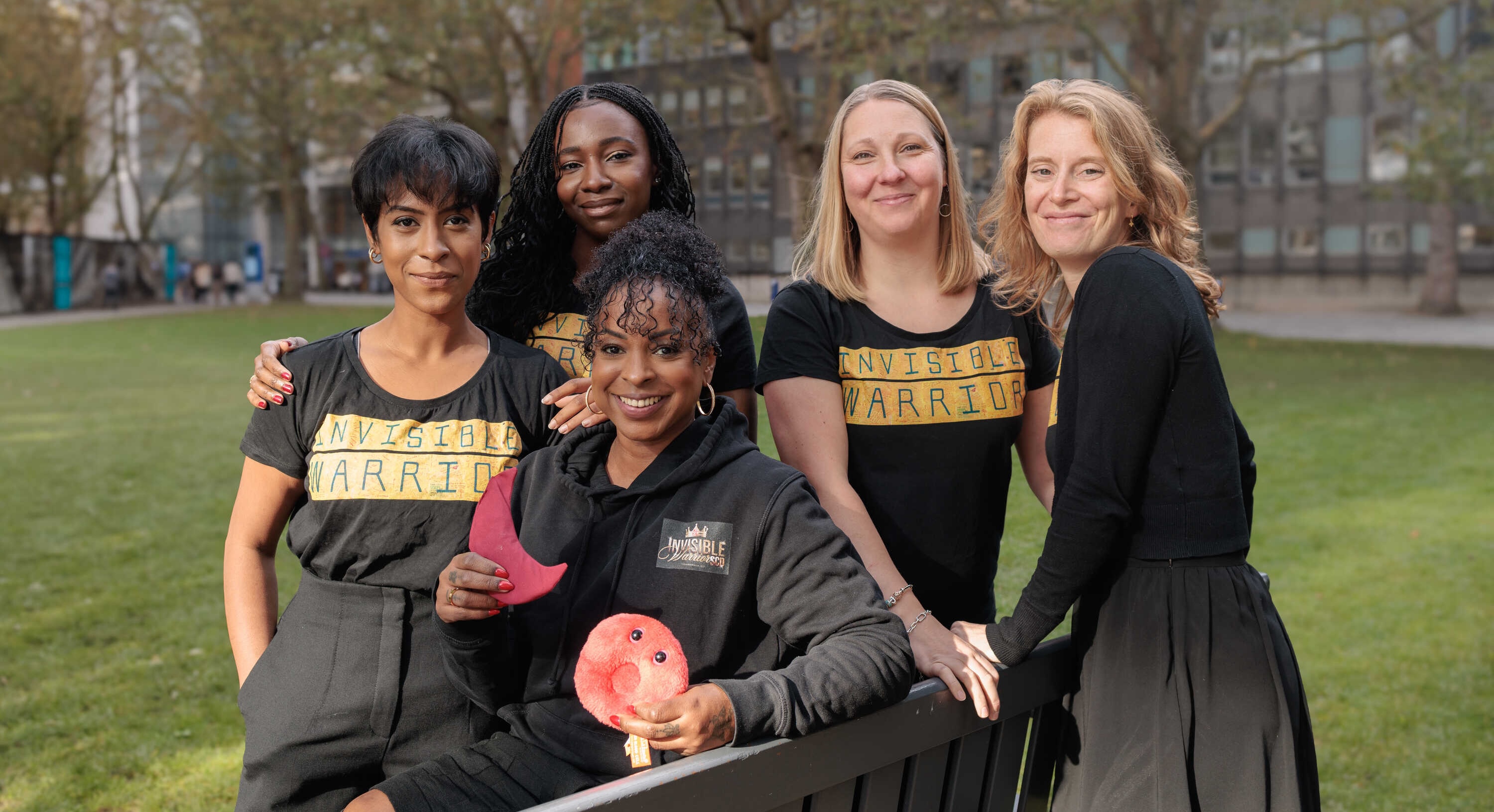
The Invisible Warrior team after winning their President's Award. From left to right: Dr Christina Crossette-Thambiah, Ronnie Oyewole, Louisa Thompson, Dr Josefin Ahnström and Linda van Keimpema.
Any other experiences you'd like to tell us about?
Linda: Another highlight is definitely working with the STEM Futures programme, which is an outreach programme at Imperial run by Hanna Jama, specifically targeting young people from Black heritage backgrounds.
Louisa: It means a lot to me to be working with children from the Black community. To share my story, to encourage the medical students and researchers of the future, to share what we go through as a community. It means everything to me to really tell them from my heart what I experienced with Sickle Cell. I always say to them that I'm so proud to be sitting in front of them. They're so smart, they're so intelligent. And if that is our future, then hopefully we might just be okay!
Invisible Warrior has achieved a lot since you started the project five years ago. Looking to the future, what do you hope to achieve in the next five years?
Linda: The project has developed quite organically. We never really planned for this. When we met, we just wanted to do a school session, maybe two. And Louisa was keen to do something for the [Sickle Cell] community, to host online sessions where we can discuss different aspects of the disease with medical professionals and those living with Sickle Cell.
We've got young children, young adults that are growing up with Sickle Cell. And I don't want the same experience that I went through for them. I want better. Louisa Thompson
Looking back, the amount of school visits and online workshops we’ve now organised is definitely way beyond what we ever imagined. As the project continues, we meet people and then we get inspired to work with them, or there are people I meet that I then want to invite to do an online workshop. So I don't necessarily have a straight plan in mind. I'm just looking forward to doing more and connecting with new people.
Louisa: For me, if I can make more of a difference with medical students. Because I think of the future, we've got young children, young adults that are growing up with Sickle Cell. And I don't want the same experience that I went through for them. I want better.
If I can improve the understanding of Sickle Cell to more doctors and nurses, that would mean everything to me. So that in the future we don't have young adults or children or teenagers saying their experience in the hospital, in the ambulance, in the A&E department, was terrible. If I can try and make that change, then I will be happy.
Our #IntheSpotlight interview series celebrates Invisible Warrior turning five in 2026, highlighting the people who have made the project possible over the years.
Learn more about Invisible Warrior
Visit our main webpage.