AI software to speed up MRI scans wins Imperial’s Venture Catalyst Challenge 2026

A startup building an AI software to make MRI scans up to 90 per cent faster, potentially cutting a 20-minute scan to as little as two minutes, has won Imperial’s top entrepreneurship prize.
GenScan AI, founded by AI and Machine Learning graduate Mary-Brenda Akoda, has been announced as the winner of the Venture Catalyst Challenge 2026, receiving £30,000 in funding for their startup.
They were selected after pitching their business to a panel of experts, alongside four other startups from Imperial’s innovation ecosystem.
"The five ventures that pitched in this year’s VCC Grand Final were a testament to the extraordinary entrepreneurial talent emerging from Imperial." Chantelle Young Head of Entrepreneurship
GenScan AI is aiming to transform medical imaging with its GenMRI technology. The software is designed to improve current scanners by using AI to rebuild and enhance MRI images to diagnostic quality.
Conventional MRIs, which are used to diagnose health conditions such as stroke and cancer, can take 20 to 90 minutes to complete, creating a bottleneck which leads to long waiting lists and delayed diagnosis.
The startup believes its software can help hospitals to scan up to 10 times more patients per day, potentially unlocking increased scanning capacity for hospitals, getting patients diagnosed quicker, and reducing backlogs, repeat scans and sedation.
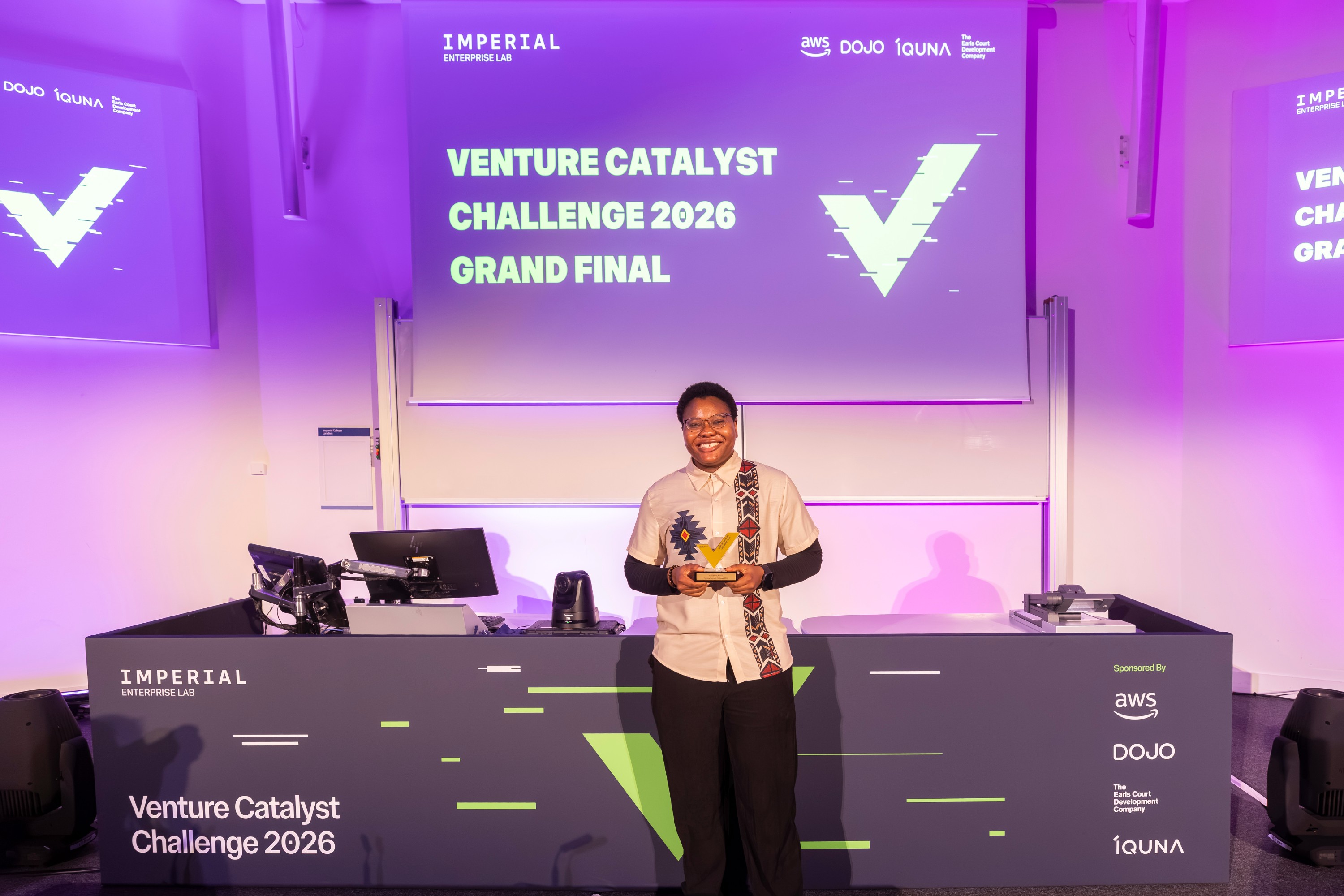
Mary-Brenda Akoda, founder of GenScan AI, at the Venture Catalyst Challenge 2026 Grand Final
The Venture Catalyst Challenge (VCC), run by Imperial Enterprise Lab, is a competition for Imperial students, alumni and early career researchers who are looking to develop their startup ideas for commercialisation.
VCC supports 25 teams with a three-month programme of 1-2-1 coaching, meetings with experts, workshops and pitch training, culminating with a shortlist of five teams who pitch to an expert panel at the Grand Final.
The expert judging panel for this year included:
- Alastair Kilgour, Founder of Parkwalk Advisors
- Asha Haji, Founder and CEO of StayReady Games
- Simon Kim, Co-Founder and CEO of Agnos Biosciences
Chantelle Young, Head of Entrepreneurship, said: “The five ventures that pitched in this year’s VCC Grand Final were a testament to the extraordinary entrepreneurial talent emerging from Imperial. Their innovation, commitment to solving important global challenges, and potential for impact at scale continued to impress me throughout the competition.
“Each venture demonstrated the power of combining world-leading research with entrepreneurial drive and targeted support. They are a credit to Imperial and brilliant examples of what can be achieved when exceptional people, pioneering ideas and the right opportunities come together
“Congratulations to all five pitching ventures for reaching the Grand Final and congratulations to our Grand Final winner, Mary-Brenda from GenScanAI.”
Prize winners
The Venture Catalyst Challenge finalists were split into five tracks: AI & Robotics, Creative & Consumer, Digital & Finance, Energy & Environment, and Health & Wellbeing.
All of this year’s five finalists received £10,000 in prize money each for winning their respective categories, with an extra £20,000 for the top team. Alongside the Grand Prize, GenScan AI won the Digital and Finance category (sponsored by DOJO).
There were also prizes awarded during the Grand Final for startups from the wider cohort of 25 teams, including the Moonshot Prize for a team pushing the boundaries of innovation, the Impact Prize for teams having a positive impact on society, and the Tech for Good Prize for teams building technology with an ethically focused goal.
Miou was awarded the Moonshot Prize, winning £10,000, for their technology which converts waste concrete and surplus CO2 into precipitated calcium carbonate.
Beacon Services and Sitfit were both awarded the Impact Prize, winning £5,000 each. Beacon Services is developing technology to improve electronic monitoring, while Sitfit is building a device to prevent pressure ulcers for wheelchair users and elderly people in care homes.
Passion Bubble and Silica Labs were the winners of the Tech for Good prizes, winning £5,000 each, for developing gamified financial literacy lessons for Indonesian children aged 7-15 (Passion Bubble) and a lightweight, flexible passive-cooling sheet for metal roofs (Silica Labs).
This year’s other four finalists who won their individual tracks were:
- AI & Robotics winner (sponsored by AWS): Veren Surgical
- Creative and Consumer winner (sponsored by Imperial): Byte
- Energy & Environment winner (sponsored by The Earls Court Development Company): Ryza Bio
- Health & Wellbeing (sponsored by IQUNA Ventures): Synaptive
Article text (excluding photos or graphics) © Imperial College London.
Photos and graphics subject to third party copyright used with permission or © Imperial College London.
Article people, mentions and related links
Conrad Duncan
Administration/Non-faculty departments
- Tel: +44 (0)20 7594 6860
- Email: c.duncan@imperial.ac.uk
- Articles by this author