Imperial joins new European initiative for advancing climate-smart aviation
/prod01/channel_4/imperial-news/media/news-images/3000X2000-main-article-images/Flight-at-dusk.jpg)
Dr Sebastian Eastham will lead Imperial College London’s contribution to ZENITIA (Zero-Emission Next-Gen Innovation and Technology Integration for Aviation), a new European consortium developing climate-smart air traffic management (ATM) strategies for sustainable aviation.
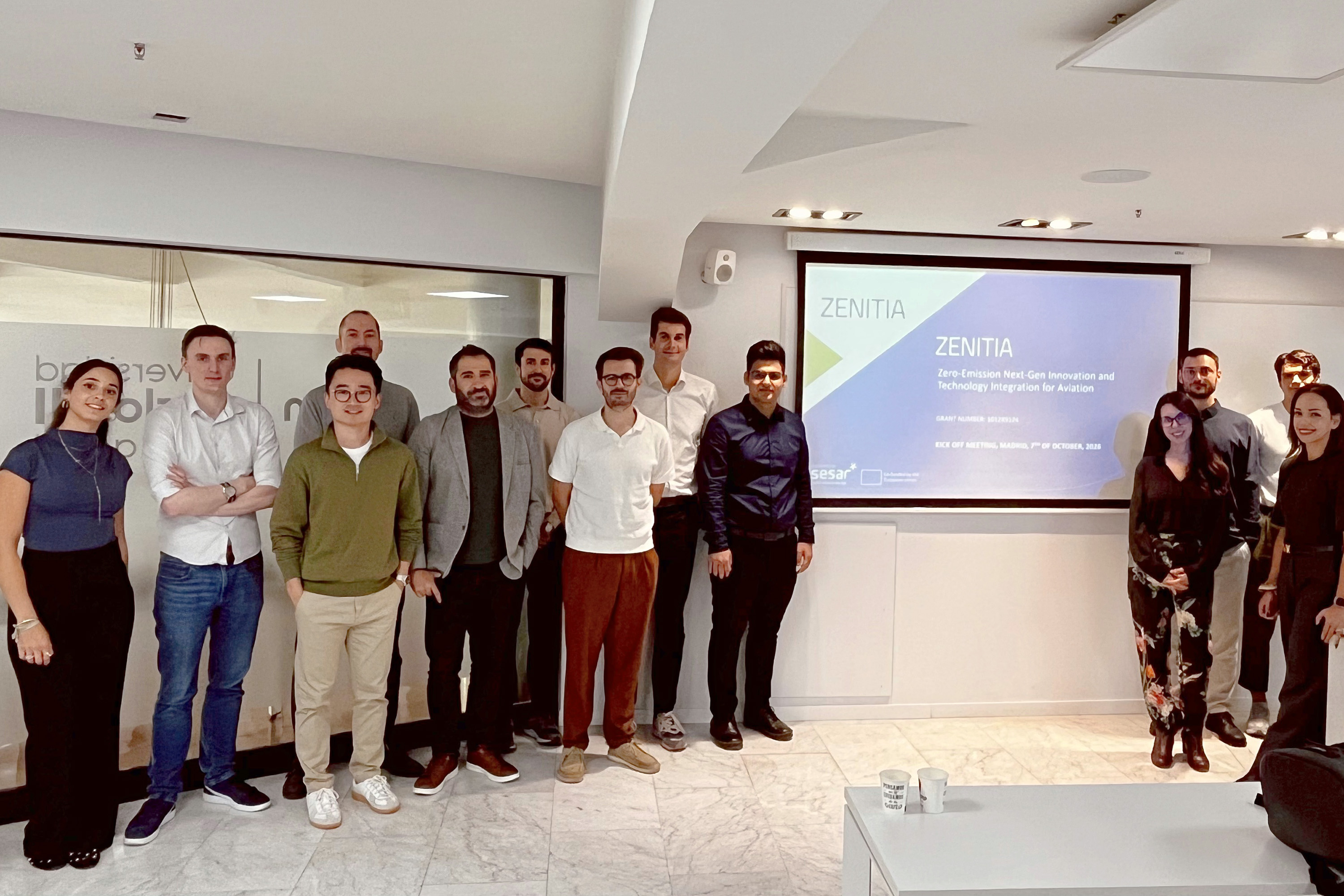
Launched officially on 7 October 2026, ZENITIA brings together leading academic institutions and industry partners to develop new tools and evidence to help the aviation sector reduce emissions and accelerate progress towards net zero aviation.
Over the next two years, the consortium will explore how new aircraft technologies, alternative fuels and advanced climate modelling can work together to support more sustainable ATM. The project is funded through Horizon Europe SESAR 3 Joint Undertaking, the Single European Sky ATM Research programme, which drives innovation in European air traffic management.
Building on Imperial’s sustainable aviation research
Imperial's contribution to ZENITIA is led by Dr Sebastian Eastham, Associate Professor in Sustainable Aviation in the Department of Aeronautics and the Brahmal Vasudevan Institute for Sustainable Aviation.
Dr Eastham said: “We recognised that achieving a truly sustainable aviation sector is a problem which requires both evolutionary and revolutionary change, meaning that all stakeholders’ perspectives need to be integrated at design time. ZENITIA connects experts across sectors in aviation operations, ATM, sustainable technology, and academic research to do exactly that – and hopefully unlock novel options for reductions in aviation’s environmental footprint.”
Dr Eastham and his team will develop advanced computational models of the global atmosphere to quantify the environmental impacts of aviation across European skies. This will support regional and global assessments of aviation's impacts on both the climate and air quality, including the contributions of non-carbon dioxide emissions like contrails and nitrogen oxides.
Dr Eastham will also lead efforts to interpret the results of these assessments and translate them into practical tools for decision-makers. The findings will help inform environmentally optimised flight trajectories and support decisions about future aircraft technologies and sustainable fuels within an ATM context.
ZENITIA connects experts across sectors in aviation operations, ATM, sustainable technology, and academic research to unlock novel options for reductions in aviation’s environmental footprint. Dr Sebastian Eastham Associate Professor in Sustainable Aviation
ZENITIA’s path to climate-neutral aviation
While the aviation sector has historically relied on incremental improvements to aircraft technologies, ZENITIA takes a broader approach by:
- Assessing both evolutionary technologies such as more efficient aircraft and operational improvements, and revolutionary technologies that could fundamentally change how aircraft are designed and operated (known together as evolutionary and revolutionary (E/R) technologies).
- Exploring how future mixed fleets of conventional and next-generation aircraft can operate together effectively.
- Developing tools that connect ATM decisions directly to climate and air quality outcomes.
ZENITIA will also assess a broader range of environmental impacts, including the effects on regional European and global air quality, and the complex trade-offs between environmental performance and operational efficiency.
ZENITIA is coordinated by the Universidad Carlos III de Madrid and brings together nine partners from across academia and industry. The consortium includes Boeing Deutschland GmbH (Germany), Boeing Aerospace Spain (Spain), Estuaire SAS (France), Future Needs Management Consulting Ltd. (Cyprus), Imperial College London, the International Federation of Air Traffic Controllers' Associations (IFATCA) (Canada), TU Delft (Netherlands) and the University of Cambridge (UK).
The project received funding from the SESAR 3 Joint Undertaking under the European Union's Horizon Europe research and innovation programme under grant agreement No 101289124. Views and opinions expressed are however those of the author(s) only and do not necessarily reflect those of the European Union or SESAR 3 JU. Neither the European Union nor the SESAR 3 JU can be held responsible for them.
Article text (excluding photos or graphics) © Imperial College London.
Photos and graphics subject to third party copyright used with permission or © Imperial College London.
Article people, mentions and related links
Sree Jagadeesan
Faculty of Engineering