AI4URBAN-HEALTH launches three innovative projects to improve health in UK cities
by Gege Li
/prod01/channel_4/imperial-news/media/news-images/3000X2000-main-article-images/pedestrian-walk.jpg)
Three new interdisciplinary projects have been funded through the AI4URBAN-HEALTH Network, following a series of collaborative innovation workshops that brought together communities, researchers, industry and policymakers to develop AI solutions for urban health challenges in London and Bradford.
To ensure the perspectives of local residents and stakeholders shaped the development of these projects and our Network, we held workshops in our case study locations… designed to bring out their priorities and most pressing challenges related to urban health. Dr Audrey de Nazelle AI4URBAN-HEALTH Co-Lead; Centre for Environmental Policy, Imperial
For the AI4URBAN-HEALTH Network, a collaboration between Imperial College London and Bradford Teaching Hospitals NHS Foundation Trust, the University of Southampton, and the University of Surrey, this represents the delivery of a key phase of its mission.
AI4URBAN-HEALTH Co-Lead, Dr Audrey de Nazelle of the Centre for Environmental Policy at Imperial, explained: “To ensure the perspectives of local residents and stakeholders shaped the development of these projects and our Network, we held workshops in our case study locations using an adapted Structured Decision Making (SDM) process.
“This guided representatives of these groups through various activities designed to bring out their priorities and most pressing challenges, as well as opportunities and barriers, related to urban health.”
The sandpit model: fostering collaboration
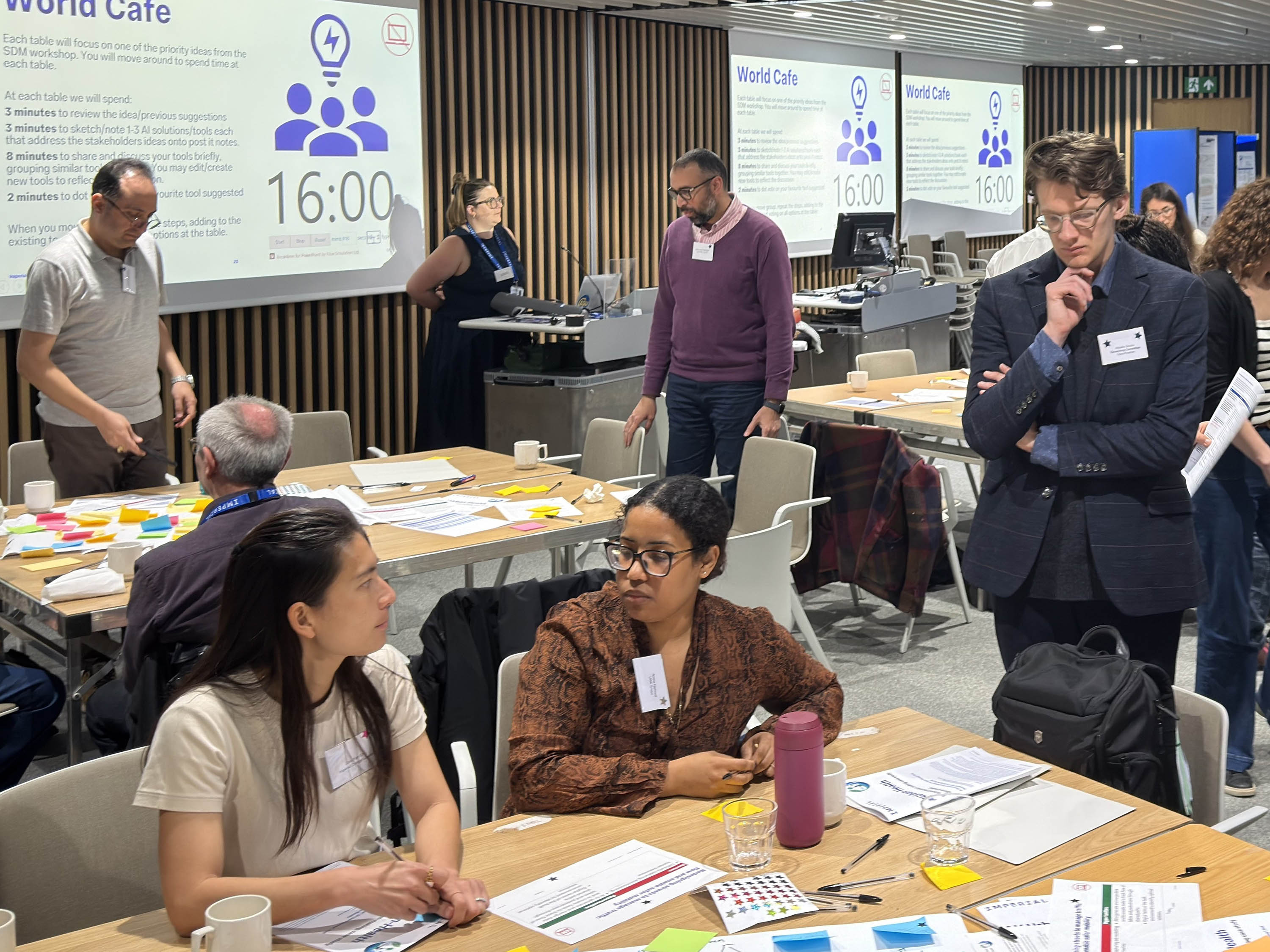
Building on this local engagement in the two case study locations, the AI4URBAN-HEALTH Network hosted collaborative workshops or ‘Sandpits’ to facilitate the development of new ideas by participants including local stakeholders from the SDM workshops, as well as from academia, industry, local and national government, and non-governmental organisations. The aim was to move beyond traditional thinking and develop radical, interdisciplinary approaches to address the priorities and challenges identified by the local communities through the SDMs.
“The Sandpit events were incredibly enjoyable. Participants creatively applied their knowledge and skills to the challenges identified and proposed really innovative applications of AI and machine learning technologies,” said Professor Christopher Pain, AI4URBAN-HEALTH Lead, and Professorial Research Fellow in the Department of Earth Science and Engineering at Imperial.
 AI4URBAN-HEALTH Network Manager, Claire Dilliway, added: “The support we received from the local community, our partners and advisory board members throughout the whole process has been invaluable. The Network will continue to foster and grow these collaborations to apply the latest developments in AI to pressing challenges in urban health, keeping those most affected by the outcomes – the local community and users of these applications – at the centre of our thinking.”
One of the sandpit participants and RE-PAIR project Lead, Dr Tao Bi, Imperial College London, said: “The AI4URBAN-HEALTH sandpit showed the value of bringing together people with different expertise to tackle complex urban health challenges.
“Its open and collaborative approach encouraged a genuine exchange of ideas, while the exceptional support from the organising team created an environment where new partnerships could flourish and innovative projects could emerge.”
Funding awarded for transformative projects
As a result of this process, three feasibility and proof-of-concept projects have now been funded.
The projects are:
‘AI-Enabled Mapping of Health Data Quality for Fairer Urban Health Evidence in Bradford’ (University of Sheffield, University College London, University of York and University of Leeds).
This project maps hidden recording gaps in health data records across Bradford, and the findings will build fairer evidence for urban health research and planning.
Project Lead, Dr Harry Kai-Ho Chan, at the University of Sheffield, said: “The AI4URBAN-HEALTH sandpit event provided an excellent opportunity to meet with collaborators we would not otherwise have found. Its well-structured process, particularly the SDM stage, pushed us to be specific early about what ‘better data’ means for equitable urban health evidence.”
‘RE-PAIR: Respons-able Evaluation of Policy Using AI with Residents’ (Imperial College London, University of East Anglia and University of Newcastle in partnership with the Royal Borough of Kensington and Chelsea).
RE-PAIR combines AI, resident experiences, and housing-wellbeing policy simulation to help local authorities understand what works, for whom, and why, enabling faster, fairer, more responsive and more people-centred decisions that improve health and wellbeing outcomes for households in temporary accommodation.
.jpg) Altin Smajli, at The Royal Borough of Kensington and Chelsea, who supported the structured decision making and sandpit events – including the development of RE-PAIR – said: “Housing and homelessness are complex challenges that require a whole-systems approach to improve health and wellbeing outcomes for those that have no secure and settled housing.
Altin Smajli, at The Royal Borough of Kensington and Chelsea, who supported the structured decision making and sandpit events – including the development of RE-PAIR – said: “Housing and homelessness are complex challenges that require a whole-systems approach to improve health and wellbeing outcomes for those that have no secure and settled housing.
“I really enjoyed being part of the sandpit event, sharing diverse perspectives that helped shape this proposal to support a targeted project that assists long-term residents in temporary accommodation to move into settled housing, testing AI-driven insights to inform interventions and improve outcomes.
"This work aligns with RBKC’s ambition to lead the sector in digital innovation and improve residents’ lives as part of the Council’s ongoing Grenfell response and recovery.”
‘3DRED:A Dynamic Data-Driven World Model for Street REDesign Decisions in London’ (University of Birmingham, University of Surrey, University of Leeds and University of West of England).
3DRED uses AI and integrated urban data to help councils design safer, healthier and equitable streets, testing changes before implementation.
Project Lead, Dr Omid Ghaffarpasand, University of Birmingham, said: “The SDM process helped transform diverse expertise into a coherent project with genuine potential for real-world impact, and I believe 3DRED is much stronger because of that process.”
The insights gained from these projects – which conclude in spring 2027 – will contribute directly to the Network’s broader goals of creating healthier, more sustainable living spaces.
If you are interested in the AI4URBAN-HEALTH Network’s activities and would like to receive communications, you can sign up here.
Article text (excluding photos or graphics) © Imperial College London.
Photos and graphics subject to third party copyright used with permission or © Imperial College London.
Article people, mentions and related links
Gege Li
Faculty of Engineering