Giant canyon on Mars is still tectonically active today
by Gege Li
/prod01/channel_4/imperial-news/media/news-images/3000X2000-main-article-images/valles-marineris.jpg)
Scientists at Imperial College London and Columbia University have found that the largest canyon system in the solar system is still active and shaping Mars today, billions of years after it first formed.
New research presents direct seismic evidence that a marsquake (the equivalent of an earthquake) detected by NASA’s InSight lander had originated beneath the vast Martian canyon, Valles Marineris, and was caused by rocks slipping along a fault deep within the planet’s crust.
The finding suggests that faults established during the formation and early evolution of Valles Marineris billions of years ago can remain weak enough to rupture under stresses acting on Mars today.
Our study opens up exciting possibilities for discovering ongoing seismic activity on other planetary bodies that we might otherwise consider geologically inactive. Jung-Hun Song Postdoctoral Researcher, Department of Earth Science and Engineering at Imperial
“Valles Marineris is one of the most spectacular geological structures anywhere in the Solar System, but until now we didn’t know for certain that its faults are still active,” said Jung-Hun Song, lead author of the study from Imperial’s Department of Earth Science and Engineering.
“What we see is that this is not just a ‘dead’ fossil landscape, as faults deep beneath the canyon can still slip and generate marsquakes, long after the geological processes that originally formed them have ceased.
“Our study opens up exciting possibilities for discovering ongoing seismic activity on other planetary bodies that we might otherwise consider geologically inactive.”
Uncertain origins
Valles Marineris is difficult to comprehend on an Earthly scale. The vast canyon system stretches nearly 3,900 kilometres across Mars, reaches up to 600 kilometres wide and is more than nine kilometres deep. That makes it nearly nine times longer, more than 20 times wider and about five times deeper than the Grand Canyon at their respective maximum dimensions, thus representing the largest canyon system in the solar system.
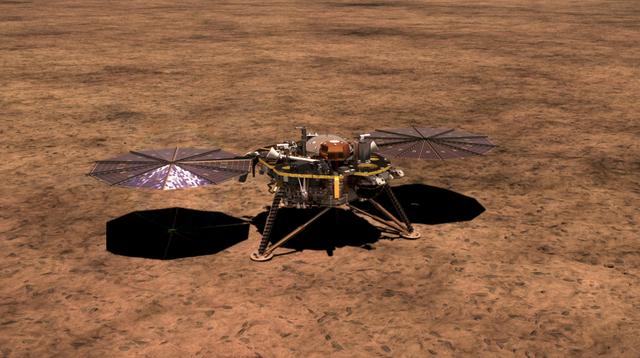
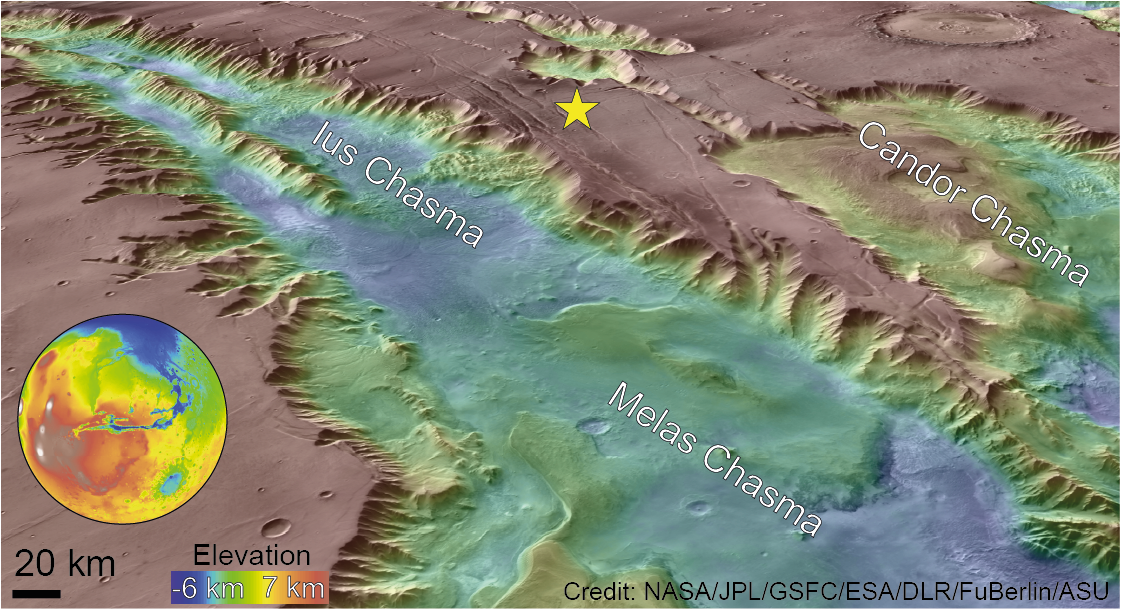
The researchers studied a seismic event known as S0976a, recorded by the InSight lander on 25 August 2021. The event was unusual because it came from the opposite side of Mars from the lander and was the only marsquake detected during the mission that could be located in the planet’s western hemisphere.
Previous work had placed the event in the vicinity of western Valles Marineris, but its cause remained uncertain. On Mars, a seismic signal doesn’t necessarily mean that a fault has ruptured – meteoroid impacts, landslides and other processes can also send vibrations through the planet.
Narrowing down the cause
To determine what produced S0976a, the study, published in Nature Communications, analysed how different seismic waves from the event travelled through Mars and arrived at InSight. From the amplitudes and directions of those waves, the team could reconstruct the type of motion that occurred at the source.
The best explanation was a strike-slip marsquake event, in which blocks of crust move horizontally past one another along a steep, deeply-rooted fault. The rupture occurred roughly 20 to 40 kilometres beneath the surface of western Valles Marineris.
The team tested a wide range of alternative explanations, including meteoroid impacts, landslides and other forms of mass movement, but those models could not reproduce the observed seismic waves. The researchers also examined available satellite images of the likely source region taken after the event and found no fresh impact crater or large new landslide that could account for the signal.
“What makes the result compelling is that several completely different types of evidence point in the same direction,” said Song. “The seismic waves tell us that there was a sideways sliding motion on a fault well below the surface, while the geology seen from orbit shows a region crossed by long-lived fault systems.”
Ancient faults and modern stresses
Unlike Earth, Mars doesn’t have a system of moving tectonic plates that continually creates and reshapes major fault zones. Instead, its outer shell behaves more like a single, slowly cooling lid.
“This makes our new results particularly important as Mars gives us a very different natural experiment,” said study co-author Dr Folarin Kolawole, Assistant Professor at Columbia University. “It shows that on a planet without plate tectonics, structures created billions of years ago can remain important and still control where the crust breaks today.”
The orientation of the S0976a faulting matches what scientists would expect if ancient, pre-existing structures were slipping again today, produced by a combination of the planet’s long-term cooling, stresses associated with the nearby Tharsis volcanic region and more local effects associated with the canyon itself.
Continued insights about Mars
The result adds Valles Marineris to a small but growing set of regions where InSight data have revealed active faulting on present-day Mars. Through the recorded marsquakes, different styles of active faulting have now been identified beneath Valles Marineris, the Cerberus Fossae fissures, and southern Elysium Planitia plain, suggesting that stresses within the Martian crust vary considerably from place to place rather than following one simple planet-wide pattern.
The researchers say the findings demonstrate how much information remains in the seismic recordings returned by InSight, even though the mission ended in 2022.
S0976a has turned out to be an extraordinary event, playing an important role in our understanding of the Red Planet. Dr Doyeon Kim Associate Professor in Earth and Planetary Science, Department of Earth Science and Engineering at Imperial
“S0976a has turned out to be an extraordinary event, playing an important role in our understanding of the Red Planet,” said senior study author Dr Doyeon Kim, Assistant Professor in Earth and Planetary Science at Imperial.
“Its waves travelled through the core and helped us investigate the deepest part of Mars, and now they are telling us what happened at the source itself. From a single marsquake, we can learn both about the centre of the planet and about an active fault beneath one of its most remarkable landscapes.”
Article text (excluding photos or graphics) © Imperial College London.
Photos and graphics subject to third party copyright used with permission or © Imperial College London.
Article people, mentions and related links
Gege Li
Faculty of Engineering