A new angle on practical teaching: EEE and Gracia create 4D masterclass
/prod01/channel_4/imperial-news/media/news-images/3000X2000-main-article-images/gracia3000.jpg)
A soldering video masterclass created by Gracia and Imperial’s Department of Electrical and Electronic Engineering will allow students to watch an expert at work from different viewpoints, using a VR headset or a 2D screen.
Gracia AI, specialists in immersive 4D video, approached EEE to explore how its technology could capture and share a precise manual skill.
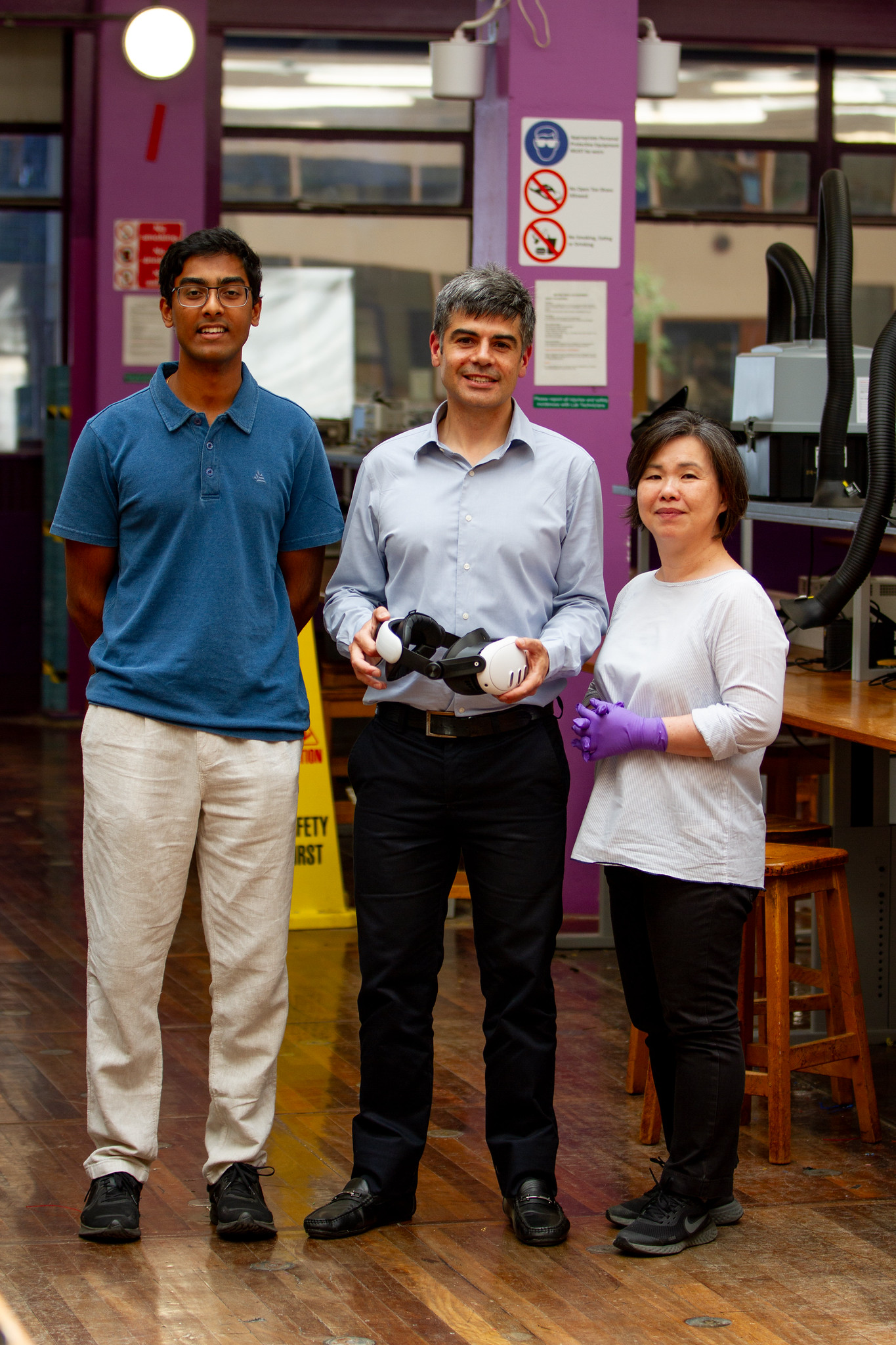 Working with the Gracia team were Electronics Laboratory Technician May Tang, PhD student Tanmay Lad and Associate Professor in Power Electronics Dr Adrià Junyent-Ferré.
Soldering offers a strong practical use for Gracia’s technology. It is an essential electronic engineering skill, but can be difficult to demonstrate to a large group of students.
“Demonstrating to a large group is tricky because only students standing close can see what you’re doing,” says Adrià. “We tried regular video recordings, but they never quite worked because of the poor depth perception.”
The volumetric view
A conventional video presents an action from a fixed or moving camera view, but Gracia’s technology instead creates volumetric video: a three-dimensional recording that viewers can move around as it plays.
Footage from multiple cameras is processed and reconstructed into a 4D Gaussian Splatting, or 4DGS, moving scene using Gracia’s proprietary pipeline. Unlike a static 3D model, it also captures how the scene changes over time.
Adrià explains: “With Gracia’s 4DGS, students can examine the demonstrator’s hands, tools and circuit board from different angles. The hands perform the task in front of you and it really helps you internalise the precise motions involved.”
Capturing the details: a custom challenge
 The demonstrations were recorded at AdventuryXR’s London studio using its volumetric capture rig, which normally uses 78 cameras to capture full-body performances, with space for up to four people at once.
Soldering required a very different scale of capture. For this project, 44 cameras were taken from the standing rig and arranged into a compact dome over the soldering table, where May performed the demonstrations. Some were positioned close to her hands, while others captured the wider scene.
As anything hidden from the cameras would be incompletely reconstructed, May worked with her arms extended and clear of the circuit board. This kept her hands, the soldering iron and the joint visible to several cameras at once, although it was rather more difficult and uncomfortable than working at a laboratory bench.
The unusual close-range camera setup also created a new processing challenge. Gracia normally reconstructs full-body performances at an even level of detail, but here the team needed to preserve both the complete scene and tiny details on the circuit board. It developed a custom solution to align the different views and adapted its processing accordingly.
The resulting level of detail is striking: in the finished clips, viewers can read the Imperial logo and the numbers printed above the solder pads on the circuit board, and even see fumes rising from the joint as the iron touches it.
Using the videos in practical teaching
The masterclass comprises an introductory scene and 13 short videos covering core hand-soldering operations, from using soldering irons and accessories to soldering and desoldering surface-mount and through-hole components. Voice-over instructions recorded by EEE PhD student Tanmay explain how to repeat each step. The videos are designed for learners to watch a specific operation and then practise it independently.
The soldering masterclass videos are available free through the Gracia app in XR and on the Gracia website.
 EEE undergraduate students were the first to try the experience this summer. There has been positive early external reaction – XR developer and blogger Antony Vitillo described the soldering training as the most immersive he had tried, particularly valuing the ability to change viewpoint and get close to the PCB, while also pointing to opportunities for more interactive practice.
The department will introduce the soldering videos this week with a group of incoming first-year students. Starting with smaller groups will allow the teaching team to explore how students use the material and find the most effective way to integrate it with practical teaching. If that works well, the masterclass could later be used with the full cohorts.
May says: “The key is moving away from passive learning and treating the video as an active lesson. Instead of watching a live demonstration straight through, students can prepare beforehand, pause to observe key changes, and apply each step through hands-on practice. It turns watching into doing and helps build genuine practical skill.”
The team has already identified a possibility for future material: showing common mistakes and their consequences, so students can see not only what good technique looks like but what happens when something goes wrong.
A partnership with purpose
Gracia CEO Georgii Vysotskii says the project was an important milestone for Gracia for two reasons.
“First, the challenge of it. The level of detail required to reconstruct was at least 10 times smaller than something we were used to working with. How to organise the capturing, how to solve it later in processing, and make sure it renders real-time on a standalone headset. If we can do that, we can do anything!
“Second, from the first meeting with the Imperial team I loved the fact that using 4DGS we are solving an existing problem for soldering demonstrations to a large number of students. The project was not done as a proof-of-concept or tech demo, we were solving a real problem of demonstrating procedures to students straightaway. Thanks to the Imperial team for believing in our tech and making it happen together!”

Article text (excluding photos or graphics) © Imperial College London.
Photos and graphics subject to third party copyright used with permission or © Imperial College London.
Article people, mentions and related links
Jane Horrell – Department of Electrical and Electronic Engineering
Faculty of Engineering
