A Partnership in Motion: The Rolls-Royce Vibration UTC
by Nadia Barbu
/prod01/channel_4/imperial-news/media/news-images/3000X2000-main-article-images/RR-VUTC-group(1).jpg)
The Rolls-Royce Vibration University Technology Centre in the Department of Mechanical Engineering at Imperial has operated for more than three decades.
Established on 7 February 1990, it was created to formalise and develop an already strong relationship between academia and industry, transforming a series of time-limited contracts into a sustained partnership. Together with the UTC in Oxford, it was the first of what has become an international network, and the blueprint for many other Rolls-Royce UTCs.
Today, the UTC continues to provide the numerical methodologies and experimental validation required to address complex vibration-related challenges in turbomachinery.
Advancing the understanding of vibration
Modern aircraft engines are highly complex machines operating under extreme conditions. They rotate at very high speeds, operate at extreme temperatures, generate enormous power, and must remain reliable across thousands of flight cycles. Within these environments, air flowing through the engine can either interact with structural components, a phenomenon known as aeroelasticity, or can excite resonance behaviour via forced response, both normally leading to large vibration amplitudes. This can lead to loss in performance, higher maintenance requirements due to wear and fatigue, unexpected down times, and in the worst-case catastrophic failure of a component.
The primary role of the Centre is to provide fundamental analytical, numerical and experimental research, usually at low Technical Readiness Levels. It develops models and numerical frameworks capable of anticipating how aerodynamic forces and structural responses will interact long before hardware reaches production. By improving predictive capability and validating it experimentally, the Centre supports the design of engines that are more reliable, more efficient and less costly to maintain. Where unexpected issues do arise during operation, the Centre also provides expertise in root cause analysis and advises the industrial partner in their solutions.
For instance, the UTC’s research has been pivotal in understanding key aspects of the root cause of recent vibration issues with the Trent 1000 engine, relying on its unique capability to accurately simulate blade forced response. This work has enabled much better evaluation of the current fleet, which led to the development of design modifications to eliminate this problem and thus prevent similar issues occurring in the future. The overall cost of this Trent 1000 issue was estimated in the Rolls-Royce plc Annual Report 2019 to be up to $2.4 billion, so the financial savings were potentially vast.
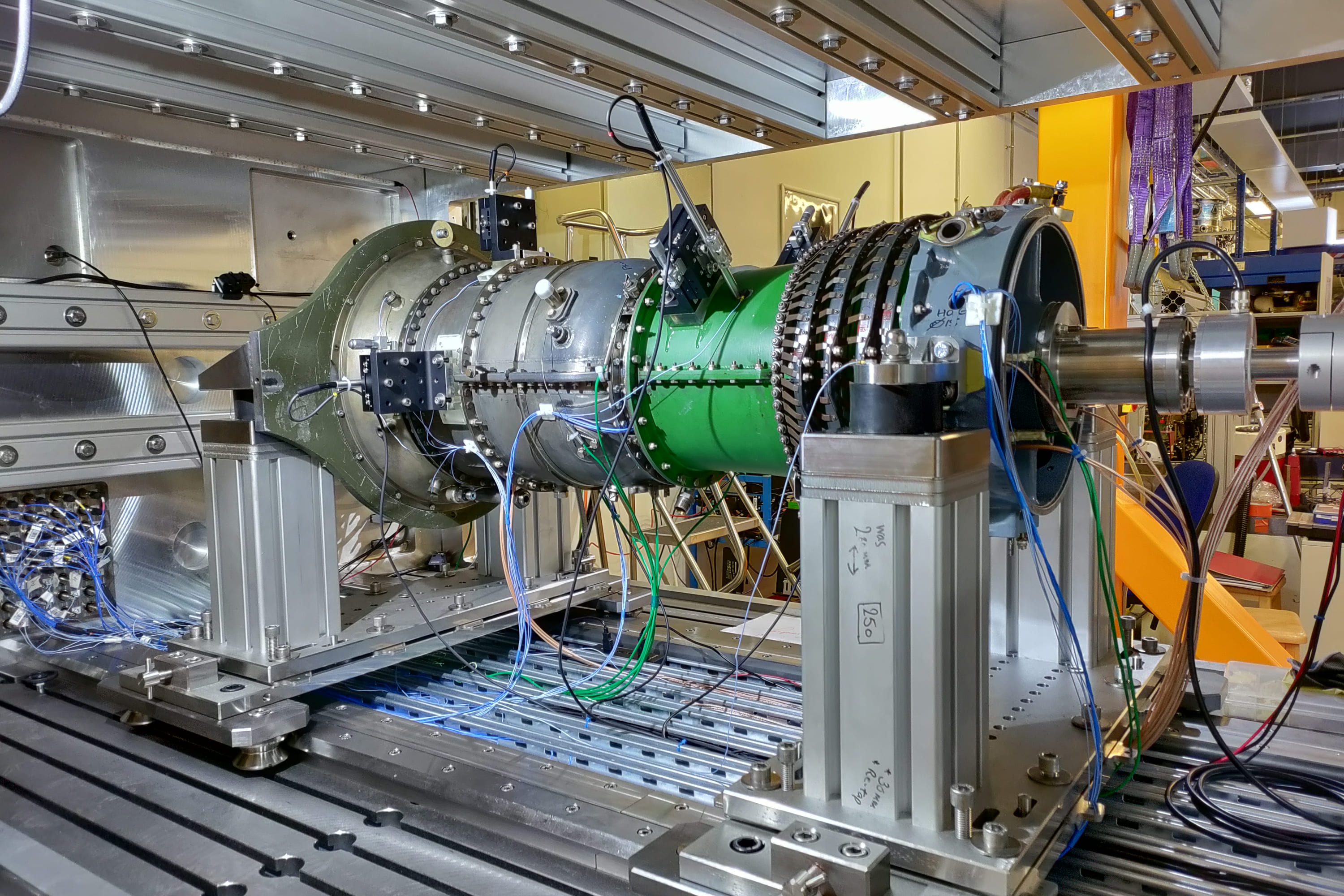
A sustained research ecosystem
The Rolls-Royce Vibration UTC is embedded in the Dynamics Group and led by Professor Christoph Schwingshackl as Director, who specialises in structural dynamics. Two other academics work in the Centre, Dr Sina Stapelfeldt (aeroelasticity), and Dr Ludovic Renson (nonlinear modelling and control development), alongside currently twenty PhD students, five postdoctoral researchers, visiting and emeritus academics and the professional support team. These numbers have been relatively stable for years, which allows the UTC to build and maintain knowledge. The funding model allows for postdoctoral positions to be extended for longer than usual, and researchers often return to the team from industryafter joining Rolls-Royce for a while.
A partnership model for long-term continuity
For the industrial partner, the UTC model offers advantages that extend beyond conventional contract research. The Centre brings together highly specialised researchers operating at the forefront of science with state-of-the-art facilities. It’s also cost effective, since the company can leverage already existing academic infrastructure and talent instead of maintaining large in-house R&D, and the model provides continuity and institutional memory.
“Our strategic partnership with the Vibration UTC has had a significant impact on our product portfolio. Sometimes this is via research into fundamental phenomena, allowing the company to free up design space which leads to efficiency and reliability improvements. In other cases, the software developed is used within Rolls-Royce for design improvements; these have a long-lasting effect as our products can be in service for many decades!”, says Dr Sophoclis Patsias (Manager, University Partnerships &Policy, Rolls-Royce).
The partnership is equally transformative for the academic environment. It provides a sustained stream of strategically aligned research funding, direct engagement with real-world engineering problems and regular impact case studies contributing to REF submissions. The research remains academically rigorous, but at the same time, it is inherently applied: every project is tied to engineering reality.
The Centre’s current director himself started out as a postdoctoral researcher in the Rolls-Royce VUTC. “I always really liked the work environment, you had support you needed, but also the freedom you wanted. I like the flexibility and the wide breadth of topics”, says Professor Christoph Schwingshackl.
Training the next generation of engineers
The Centre’s PhD students form a core part of the partnership. Their projects are defined by real engineering challenges, with direct industrial support and engagement alongside academic supervision. Many graduates and postdoctoral researchers subsequently join Rolls-Royce, contributing directly to the development of next-generation engine technologies. The partnership offers opportunities to visit industrial sites, where researchers can see real engines and applications first-hand. Students can also do internships with Rolls-Royce to gain more experience.
Anna Ducke chose to pursue a PhD to deepen her technical expertise. With a background in aerospace engineering, she was drawn to turbomachinery as a field with broad applications. A key motivation has been the tangible impact of her work. “It’s nice to know that what I’m working on has an application at the end,” she says. Her academic supervisor helps her maintain the balance between the need for innovation in her research and the industrial partner’s needs.
Anna was pleasantly surprised by the collaborative culture of the Centre: “We’re a sociable and supportive team! We help one another work through challenges, we enjoy catching up over lunch, and we also regularly organise things together outside the office.” Of course, studying for a PhD is challenging, takes a long time, and you need to be strongly self-motivated. At the same time, Anna values the independence it offers. “You have to hold yourself accountable, it’s very different from undergraduate studies,” she explains, emphasising the importance of staying focused without comparing your own progress to others.
Balancing academic freedom and commercial alignment
A long-standing partnership requires clear governance. From its inception, the Centre established a structure defining intellectual property, publication rights and research autonomy. While the company benefits from long established IP arrangements, academic independence remains central. This foundation has been critical to sustaining the partnership through economic cycles, including periods when industrial funding pressures affected project volumes.
What advice would Professor Schwingshackl give to other academic leaders seeking to build sustainable industry partnerships? “Make sure that right from the beginning you have a clear understanding of how the partnership is going to work. Find out what’s expected from you and what you expect from your industrial partner and have a good framework in place. Sometimes you have to say thank you, no thank you if your priorities aren’t aligned.”
Looking towards the future
As Rolls-Royce develops the next generation of civil and military aircraft engines over the coming decade, vibration research will remain central. Advances in materials, manufacturing processes and engine architectures will introduce new aeroelastic and structural dynamic challenges and make their reliable prediction even more fundamental.
The core scientific mission of the UTC, understanding and predicting vibration phenomena, remains as relevant today as it was in 1990. As Professor Christoph Schwingshackl says : “No matter what innovations are introduced, there will always be a need to advance our scientific understanding!”
Article text (excluding photos or graphics) © Imperial College London.
Photos and graphics subject to third party copyright used with permission or © Imperial College London.
Article people, mentions and related links
Nadia Barbu
Faculty of Engineering