Kalyb wins Imperial’s undergraduate innovation programme

Kalyb, who created a low-cost, electricity-free device that records the number of freeze events experienced by vaccines during transport, took home the £7,000 prize.
Make-A-Difference! is Imperial College London’s annual year long programme providing undergraduate students with a funded lab placement to develop startup ideas into proof-of-concepts.
Run by the Faculty of Natural Sciences, the Make-A-Difference! Programme challenges students to create impactful, low-cost technologies that address real-world issues. Over an eight-week summer placement, each team gains access to lab resources, funding, and mentorship. The final took place last night.
This year’s panel of judges included Dr Ruth Allan, Professor Sir John Pendry, Dr Allan Samuel, Dominque Kleyn, Professor Lord Robert Winston and previous competition winner Dr Martin Holicky who assessed each team based on originality, societal impact, and technical feasibility.
The winning team
Kalyb is made up of team-mates Flynn Li, Kaiqi Song and Yubo Gao from the Department of Life Sciences, alongside Bella Zheng from the Department of Physics – all first year students.
Asked why they chose their topic of monitoring vaccines during transportation and addressing the issue of vaccines being wasted due to poor cold chains throughout the world every year, Yubo Gao said: “We believe that this is seriously hindering effective immunisation programmes, especially in parts of the world where they don’t have as many resources.”
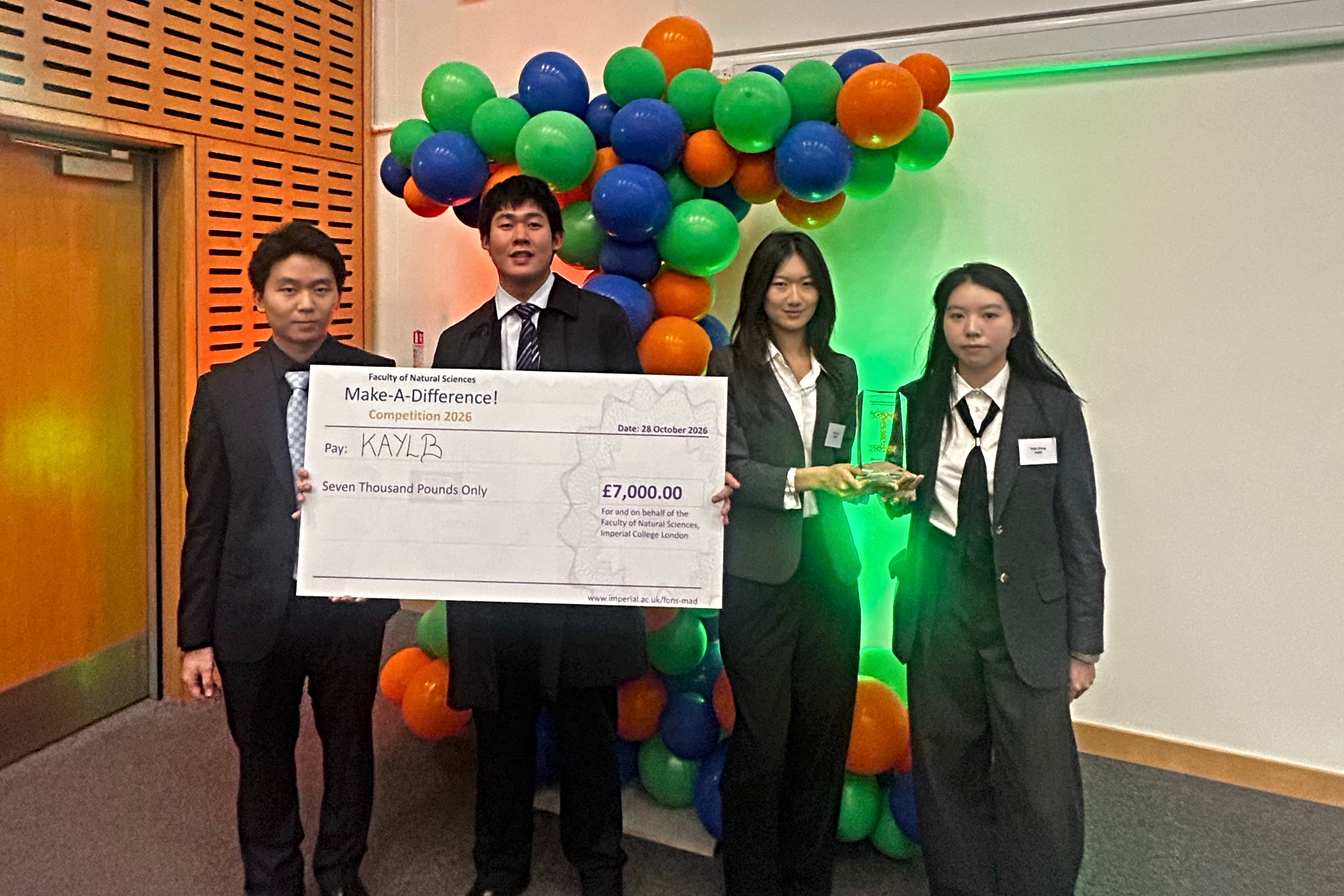
On their win, the team said: "We started with a simple question: how can a health worker know whether a vaccine froze on its way to the clinic? A frozen vaccine looks exactly the same but may no longer protect the person receiving it. Winning Make-A-Difference! shows that a ~$5 idea from four students can help make sure every child gets a vaccine that actually works. We can’t wait to test it in Nigeria next April."
Team Eviso, who designed a low-cost toilet-mounted device that passively tracks women’s urinary biomarkers to deliver hormone and metabolic health insights, were awarded runners up.
Dr Thibault Bertrand, Make-A-Difference! Committee Co-Chair and Associate Professor in Statistical Mechanics in the Department of Mathematics, said: "Selected from a record-breaking pool of applicants, this year's finalist teams demonstrated once again astounding creativity, with Team Kalyb taking the win for an electricity-free vaccine freeze tracker which will undoubtedly make a global difference.
"We were all equally inspired by our runners-up, Team Eviso, who made history as our first-ever all-female team with their pioneering women’s health monitoring device. All together, it was another amazing year for the Make-A-Difference! programme; the judging panel lauded all our teams for their vision, their creativity and their resilience. I, for one, look forward to watching these innovative ideas grow into the future."
Other innovative designs from finalists
This year’s finalists showcased a wide range of ideas with potential to address significant global challenges.
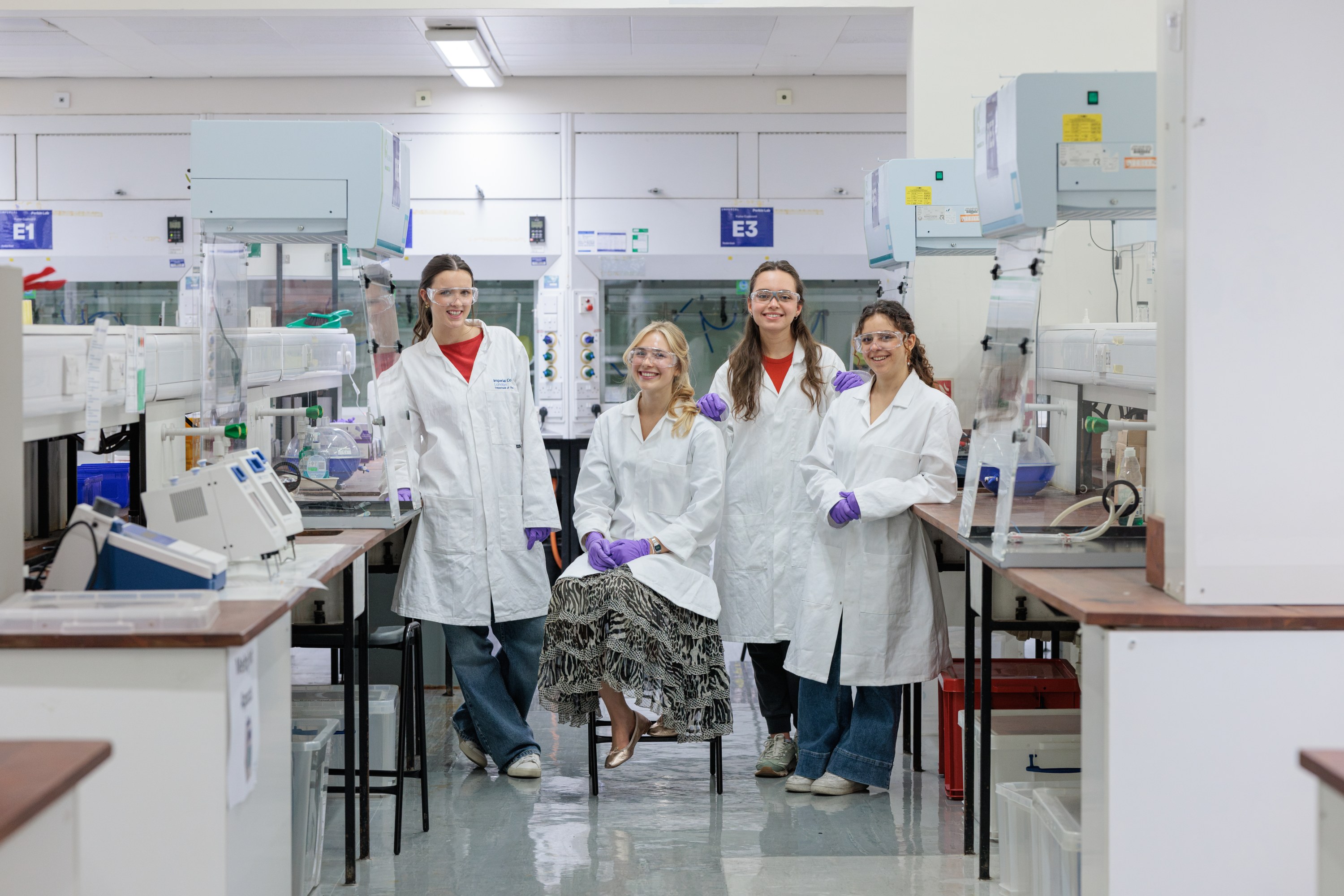
The teams in the final were:
- Winner - Kalyb: A low-cost, electricity-free device that records the number of freeze events experienced by vaccines during transport
- Runner-up - Eviso: A low-cost toilet-mounted device that passively tracks women’s urinary biomarkers to deliver hormone and metabolic health insights
- EcoPrints: Biodegradable, more sustainable and easily recyclable 3D printing filament
- KidniCheck: Lateral flow urine tests that enable rapid, non-invasive early screening for kidney cancer
- OneGarm: A multifunctional vest paired with an app to support stroke survivors with a focus on visual neglect, monitoring of health data and muscle rehabilitation
- Primus: A system that detects likely occupant locations during a fire and shares them with firefighters to speed up rescues
Read more about this year's finalist teams.
Since its inception in 2014, Make-A-Difference! has helped Imperial students bring innovative ideas to life, with past winners like Multus Biotechnology, a cultivated meat startup that went on to raise £7.9m in funding, and Matoha, a device that identifies plastics and textiles. Last year's winners, ARA Search, formerly known as D-View, came up with a device that is trained by AI to listen out for and detect the presence of humans in rubble following an earthquake.
The 2027 competition is scheduled to launch on 11 November, and participants can register for the launch event on the event page.
Article text (excluding photos or graphics) © Imperial College London.
Photos and graphics subject to third party copyright used with permission or © Imperial College London.
Article people, mentions and related links
Alice Sharman
Faculty of Natural Sciences