Birds and humans share fundamental song and speech patterns
by Emily Govan

A new study has identified universal vocal patterns across hundreds of bird species and found that many of the same patterns also appear in human song and speech from cultures around the world.
The findings of the study, worked on by Imperial (Dr Will Pearse) and McGill University researchers, could help identify the biological mechanisms underlying vocal production and auditory processing of communication that are common to humans and other animals.
The patterns include small pitch intervals, regular and predictable rhythms, and phrase-final elongation, in which the last sound in a phrase tends to be longer than the others.
Logan James, first author, from McGill University, said: ‘We propose that shared acoustic patterns among birds and humans may be due to common vocal production mechanisms or biases. For example, birds and humans are unlikely to dramatically change pitch from one note to the next because it is difficult to do. Phrase-final elongation in birds and humans could be due to breathing patterns when we vocalize.’
This study is the first to compare vocal patterns across species of birds that learn their songs and birds whose songs are innate. It is also the first to include a direct comparison of these patterns to a global repository of human speech and songs.
The researchers analysed recordings from more than 350 bird species and then used publicly accessible databases of human vocalizations to compare bird vocal patterns with speech and song in 52 languages.
The researchers analysed the vocalisations of four groups of birds: songbirds and hummingbirds, as well as two closely related groups, suboscines and nightjars. The team downloaded recordings from xeno-canto, a citizen-science website that gathers wildlife sounds worldwide. They then manually annotated the files, resulting in about 70,000 vocal units for analysis.
Professor Jon Sakata, senior author and professor of biology at McGill University, said: ‘Songbirds, hummingbirds and parrots are ‘vocal learners,’ just like humans, meaning that they learn their vocalizations by imitating others.’ Suboscines and nightjars are non-vocal learners, meaning their vocalizations are innate. Because human speech and song are learned, the team predicted that the songs of vocal-learning birds might share stronger similarities with human vocalizations than would the songs of non-learning birds. However, they found very little evidence to support that hypothesis.
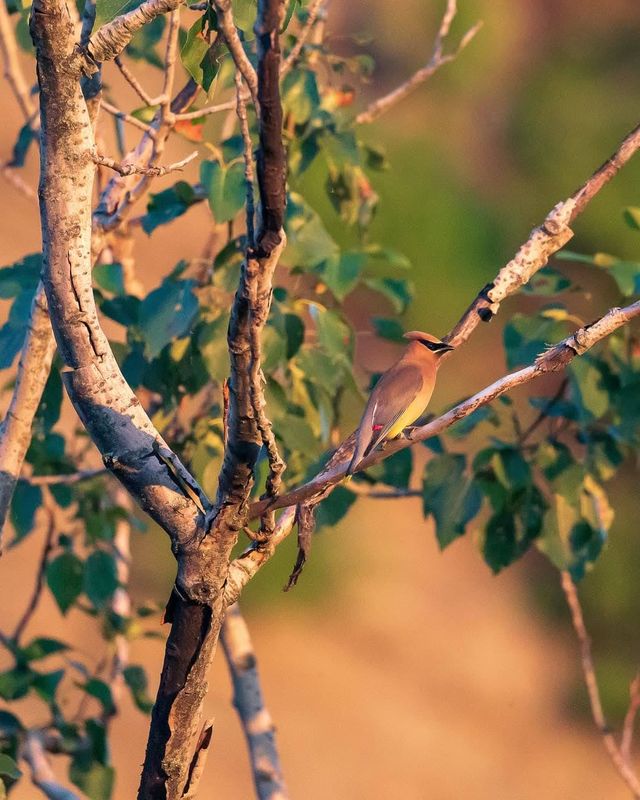
Cedar waxwing. (Photo credit: Raina Fan)
Professor Sakata said: ‘Given the similarities between all these groups of birds to humans, we hope this research will inspire scientists to investigate groups of birds that have historically been overlooked: namely, birds that do not learn their vocalizations’.
Article text (excluding photos or graphics) © Imperial College London.
Photos and graphics subject to third party copyright used with permission or © Imperial College London.
Article people, mentions and related links
Emily Govan
Faculty of Natural Sciences