Hidden genetic switch could unlock stronger disease resistance in crops
/prod01/channel_4/imperial-news/media/news-images/3000X2000-main-article-images/potatoes---tolga-bozkurt.jpg)
Researchers reveal how plants safely activate powerful immune defences, opening new routes for crop protection and sustainable food innovation.
Feeding a growing global population sustainably will depend not only on new food technologies, but also on the resilience of the crops that underpin them.
Nutrient-rich crops such as potatoes, pulses, legumes and cereals are central to future food systems, from plant-based ingredients to fermentation feedstocks. Yet these crops remain vulnerable to disease, creating risks for yield, affordability and supply chain stability.
History illustrates the scale of this threat. Potato late blight, caused by the pathogen Phytophthora infestans drove devastating potato crop failures in the 1840s and contributed to the Great Irish Famine, during which around one million people died and a further one to two million emigrated. Today, it remains one of the world's most destructive crop diseases, causing up to US$10 billion in losses each year through reduced yields and disease management costs, highlighting the continuing threat that plant diseases pose to global food security.
Now, scientists at the Bezos Centre for Sustainable Protein and the Department of Life Sciences at Imperial College London, working with collaborators at Nanjing Agricultural University and The Sainsbury Laboratory, have uncovered a molecular mechanism that helps plants activate immune defences only when they are needed.
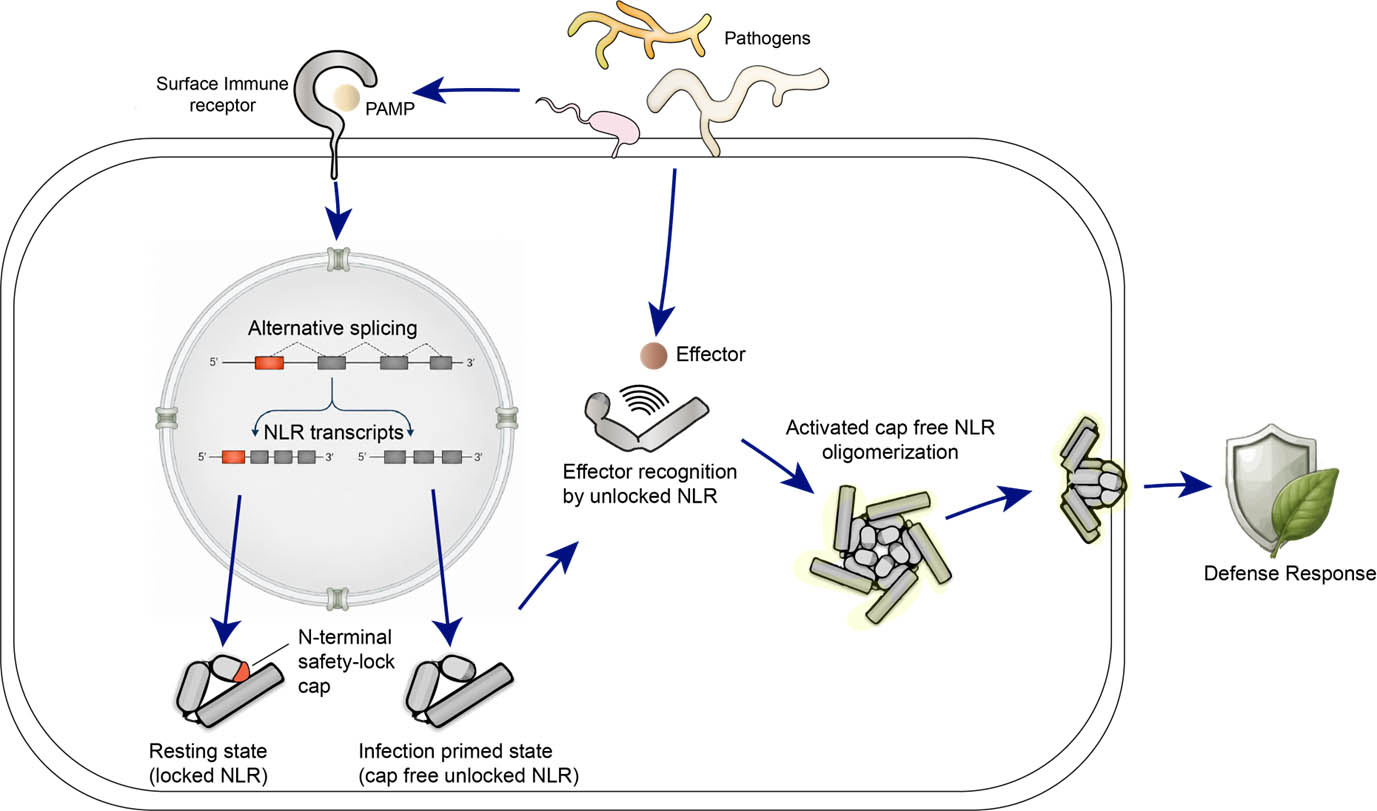
Published in Science, the study shows that plants can use surface immune signals to trigger alternative mRNA splicing, a process that removes a built-in “safety lock” from an intracellular immune receptor. This allows the receptor to activate strong disease resistance while reducing the risk of harmful immune overreaction.
The discovery could inform new strategies for engineering or breeding crops with more durable resistance to disease, helping reduce crop losses, lower reliance on pesticides and strengthen the agricultural foundations of sustainable protein production.
A smarter way to activate plant immunity
Plants use two major layers of defence. The first operates at the cell surface, where receptors detect signs of invading microbes. The second operates inside cells, where immune receptors known as NLRs detect pathogen molecules and activate powerful defence responses.
Until recently, these systems were often studied separately. This new research shows they are closely connected.
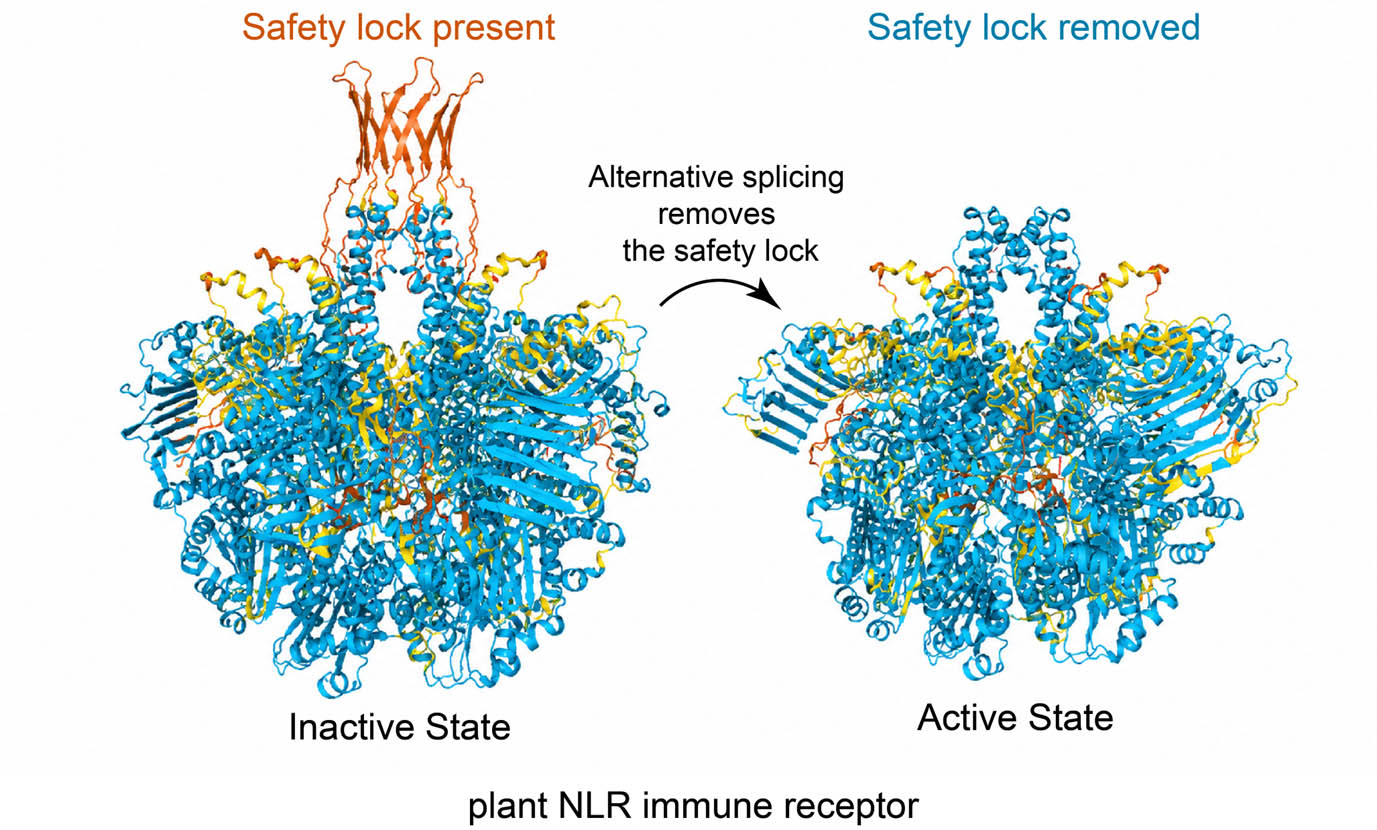
The team found that surface immune signalling can change how the mRNA of a potato immune receptor, Rpi-vnt1.1, is processed. Under normal conditions, the receptor contains an inhibitory segment that prevents it from activating accidentally. When a pathogen is detected, alternative splicing removes this inhibitory element, producing a version of the receptor that can assemble into an active immune complex and trigger defence.
Using AlphaFold-based structural predictions, the team were also able to visualise how this inhibitory segment may act as a molecular “safety lock”, providing a structural explanation for how splicing switches the receptor from an inactive to an active state.
“We found that surface immune signalling does much more than provide an early warning,” says Professor Tolga Bozkurt, lead researcher in the study who is Professor in Host-Pathogen Interactions in Imperial’s Department of Life Sciences and Principal Investigator at the Bezos Centre for Sustainable Protein at Imperial. “It can reprogramme how immune receptor genes are processed, effectively removing a molecular safety lock and preparing plants to mount a stronger defence response.”
Why this matters for sustainable food innovation
For sustainable food systems, crop resilience is not a background issue. It is a core requirement.
Disease outbreaks can reduce yields, increase production costs and make ingredient supply chains less reliable. For companies developing plant-based foods, fermentation platforms or other sustainable protein technologies, consistent access to high-quality agricultural inputs is essential.
This research points to a new design principle for crop protection: rather than simply making immune responses stronger, scientists may be able to make them more precisely controlled.
“Our findings suggest a new way to think about crop resilience,” says Professor Bozkurt. “If we can understand how plants naturally control when immune receptors are activated, we may be able to design disease resistance that is both strong and better regulated.”
This could be especially valuable for industry because overly active immune systems can come with trade-offs, including reduced growth or productivity. A controllable immune switch could help crops defend themselvesmore effectively without compromising performance.
Building on a wider picture of plant immunity
The study builds on another recent discovery from the Bozkurt laboratory, which showed that plant immune receptors can also act inside the cell by targeting membranes around organelles such as chloroplasts and releasing calcium to activate defence.
Together, the two studies are changing how scientists understand plant immunity.
The earlier work showed that plants can trigger immune signals from unexpected locations inside the cell. This latest study reveals how plants control when powerful intracellular immune receptors are unlocked.
“Plants appear to have evolved highly sophisticated ways to balance defence and growth,” says Professor Bozkurt. “They need to respond quickly to pathogens, but they also need to avoid unnecessary immune activation. Understanding this balance gives us new opportunities to develop more resilient crops.”
What it could mean for industry
For agriculture and food innovation, the long-term implications are significant.
More durable disease resistance could help reduce crop losses, improve yield stability and lower dependence on chemical crop protection. This would benefit farmers, ingredient producers and food companies working to build more secure and sustainable supply chains.
It could also support the development of crops better suited to future food production, including varieties grown for plant-based protein, fermentation inputs or other sustainable ingredients.
As climate change increases pressure on agricultural systems and disease patterns become harder to predict, these kinds of discoveries could help industry move towards crops that are not only higher-yielding, but also more reliable, resource-efficient and resilient.
From plant biology to future food systems
While the research is still at a fundamental stage, it opens new possibilities for applying engineering biology to crop improvement.
By revealing how plants naturally unlock immune receptors through mRNA splicing, the study provides a potential blueprint for designing crops with layered, controllable defences.
For the Bezos Centre for Sustainable Protein, this work highlights an important principle: sustainable protein innovation begins not only in the lab or bioreactor, but also in the field.
Stronger, healthier crops can help create the stable agricultural base needed for more affordable, scalable and sustainable food systems.
Article text (excluding photos or graphics) © Imperial College London.
Photos and graphics subject to third party copyright used with permission or © Imperial College London.
Article people, mentions and related links
Roelle Santa Maria
Faculty of Engineering