New genetic insights could help develop climate-resilient coconut palms
by Emily Govan
/prod01/channel_4/imperial-news/media/news-images/3000X2000-main-article-images/A-mature-coconut-plantation-at-Centre-Marc-Delorme-Tilly-Collins-t.JPG)
Researchers have identified a strong genetic basis for drought tolerance in coconut palms, paving the way for breeding new varieties better able to withstand the impacts of climate change.
The study, published in Plants, People, Planet, found that coconut palms vary substantially in their response to drought and that a large proportion of this variation is genetically determined. The findings suggest that genomic selection could help breeders identify individual trees with greater drought tolerance and develop more resilient coconut varieties.
Coconut palms are an economically important crop, with around 65 million tonnes produced worldwide in 2023 across nearly 90 countries. However, climate change is threatening future production by altering rainfall patterns and increasing temperatures, with drought posing a particular challenge for regions where communities and livelihoods depend on the crop.
The research formed part of Dr Theodore Brook’s PhD in the Department of Life Sciences, in collaboration with Imperial’s Georgina Mace Centre for the Living Planet and Centre for Environmental Policy, CABI, and the Centre National de Recherche Agronomique (CNRA) in Côte d’Ivoire.
The team studied drought response in coconut palms by analysing yield variation in relation to climatic conditions. They used data from the CNRA’s International Coconut Genebank for Africa and the Indian Ocean, the world’s largest collection of coconut palms, which contains more than 22,000 trees representing 57 ecotypes from around the world.
Established over 50 years ago, the collection is supported by extensive long-term records, including bi-monthly yield measurements and daily climate data. This unique resource enabled researchers to investigate how individual coconut palms respond to drought over time, something that is particularly challenging in long-lived perennial crops.
The study is the first to investigate the genomics of drought tolerance in coconut palms and among the first to examine this trait in long-lived perennial plants.
The researchers found that drought tolerance in coconut palms has a strong genetic basis. Following further validation, genomic selection could allow breeders to identify individual trees with desirable traits and develop new coconut lines better suited to drought-prone conditions.
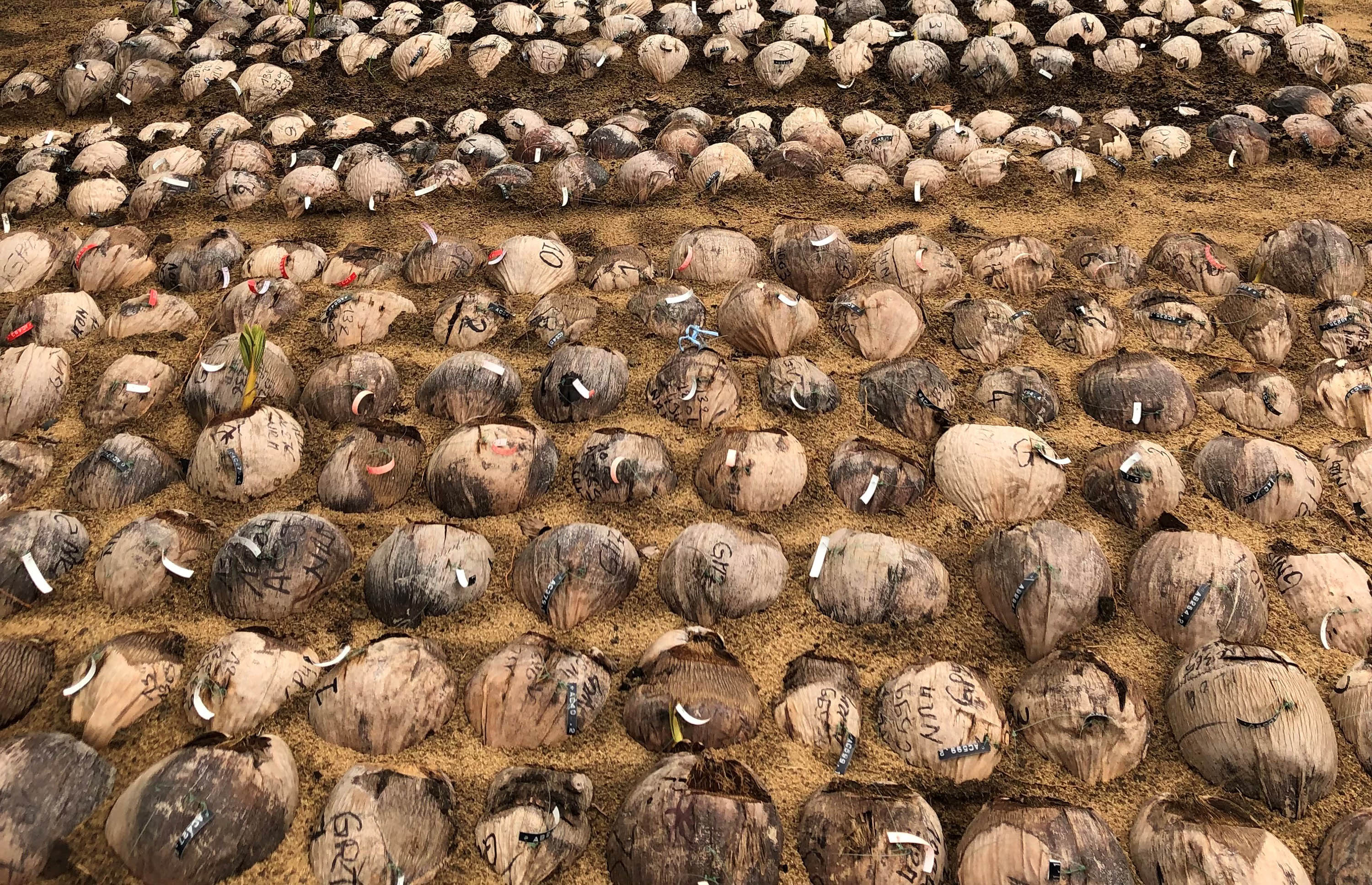
Germinating coconuts (credit: Dr Tilly Collins)
Dr Brook said: ‘Having the opportunity to support a globally important industry in maintaining sustainable production in face of climate change has been very exciting and fulfilling. I am looking forward to seeing where this work will lead, with validation through further genome sequencing and implementation in designing more drought tolerant varieties anticipated in the near future.’
The next step will be to validate the findings by sequencing an independent set of coconut palms. If successful, genomic selection could help breeders develop new lines with improved drought resistance, potentially allowing production to expand into more marginal or arid areas where conventional varieties may struggle.
The researchers also identified a trade-off between drought tolerance and yield, meaning drought-resistant varieties may be most valuable in regions where maintaining production under increasingly challenging conditions is difficult.
Professor Vincent Savolainen from the Georgina Mace Centre for the Living Planet, who supervised the research, said: ‘This collaborative work was instrumental in laying some of the first important stones toward producing new coconut palm varieties that can thrive despite climate change, which Côte d’Ivoire CNRA can now take to the next level of development.’
Co-author Dr Tilly Collins, Senior Fellow and Deputy Director of the Centre for Environmental Policy, praised the principal funder and the Royal Society for their support which helped bring together researchers from multiple institutions and countries to address a key challenge for sustainable agriculture.
Article text (excluding photos or graphics) © Imperial College London.
Photos and graphics subject to third party copyright used with permission or © Imperial College London.
Article people, mentions and related links
Emily Govan
Faculty of Natural Sciences