Science
/prod01/channel_4/imperial-news/media/news-images/3000X2000-main-article-images/mod-190124-LZ-lower-PMT-array-0104-Pano-HDR-Edit-5953-x-5953px-resize-3.jpg)
Imperial researchers help analyse a mysterious particle interaction, the most intriguing seen to date in the search for dark matter by the LUX-ZEPLIN experiment.
Although dark matter is thought to make up most of the matter in the universe, scientists still do not know what it is.
Now, researchers working on the LUX-ZEPLIN (LZ) experiment have reported an unusual result that has left them intrigued. During a recent search, the experiment detected a single particle interaction that is difficult to explain using known signals from the ordinary particles we know about.
While the result falls well short of the threshold required to claim a discovery, it represents the most compelling potential dark matter signal reported by the experiment so far.
The finding was presented at the 2026 TeV Particle Astrophysics conference in Japan. The paper will be released on arXiv and and has been submitted to Physical Review Letters.
LZ is the world’s most sensitive dark matter detector, designed to search for one of the leading candidates, weakly interacting massive particles (WIMPs). Located nearly a mile underground at the Sanford Underground Research Facility (SURF) in South Dakota, the detector uses liquid xenon to search for the rare collisions that could reveal the presence of dark matter.
The collaboration identified the event in data collected over 220 live days between March 2023 and April 2024. Unlike previous LZ searches, which focused on lower-energy interactions expected in the simplest dark matter models, the latest study explored higher-energy signals.
The result is surprising because researchers had expected any potential signal from WIMPs to appear first at a lower energy. Instead, they identified a single particle interaction in a region where the signals are larger and background activity is expected to be extremely low.
If the event were caused by dark matter, it would point towards a heavier type of WIMP than many researchers originally expected.
Rick Gaitskell, a professor at Brown University and the spokesperson for LZ, said “We’re very intrigued to see this event in the data, in the region where we expect dark matter to show up and the competing backgrounds are very low.
With only one event, we don’t want to get ahead of ourselves. We are not claiming to have seen dark matter. But we have seen something interesting that we want to share with the scientific community for their input.”
The statistical significance of the result currently stands at 2.6 sigma, meaning the collaboration remains cautious about interpreting the finding.
The LZ collaboration employs multiple layers of active shielding and sophisticated analysis tools to eliminate signals caused by ordinary matter, including cosmic rays, neutrons and other background particles. Even so, rare-event experiments can occasionally encounter unexpected backgrounds that mimic the signals researchers are looking for.
Professor Henrique Araújo, from Imperial and STFC, said “We shouldn’t be too surprised that rare event searches are also sensitive to rare backgrounds, so we need to analyse more data to be sure. But these are certainly interesting times!”
The experiment is supported by an international collaboration of 250 scientists and engineers from 39 institutions, and is managed by the US Department of Energy’s Lawrence Berkeley National Laboratory. The UK team brings together researchers from ten institutions and is led by Professor Araújo.
Sam Eriksen, a senior research associate at the University of Bristol, and the lead author on the paper that will soon appear on arXiv, said “This was a detailed study in a region we hadn’t explored within this dataset, and we spent months of additional effort to understand all the possible causes of background events. We understand our detector and the backgrounds so well that even a single outstanding event, like the one we found, is important. We expect dark matter events to be extremely rare, so only a handful could mark the first detection of WIMP dark matter.”
Imperial scientists made key contributions to all aspects of the LZ experiment, from development to analysis, and helped scrutinise the unusual interaction. Imperial President’s Scholar Elisa Jacquet is part of the team; she said “I had developed a whole new framework to analyse LZ waveforms in a different area, and I was thrilled when I was then able to apply this technique to confirm some basic facts about this event -and even more excited when I realised I had actually been on site in South Dakota in 2023 when it had been recorded.”
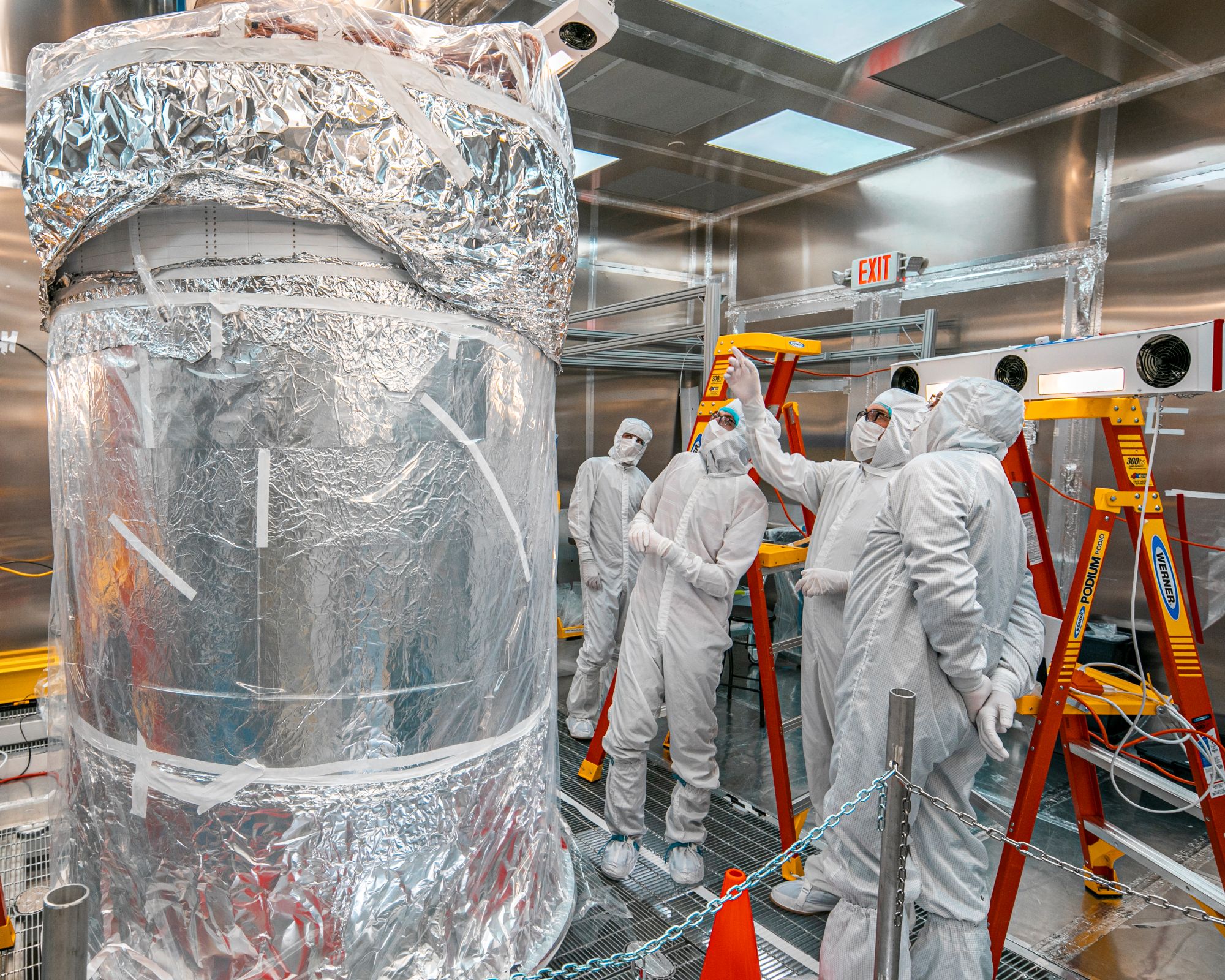
Researchers assess LZ’s central detector while it is wrapped in foil. (Credit: Matthew Kapust/Sanford Underground Research Laboratory)
LZ has already collected substantially more data than was used in the current analysis, and researchers will now examine these observations to determine whether the signal grows stronger, fades away or can ultimately be explained by a previously unidentified background process.
The collaboration is also exploring ways to extend LZ’s operations beyond 2028, allowing it to gather even more data in the search for dark matter.
Looking further ahead, researchers expect that a much larger detector will be needed to fully understand signals of this kind. The proposed XLZD Rare Event Observatory would contain around ten times more liquid xenon than LZ and could detect hundreds of similar interactions over its lifetime, helping scientists determine whether unusual signals are evidence of new physics. “XLZD is already being designed and could be operating by the mid 2030s, with one of the candidate host locations being the Boulby Underground Laboratory in the UK”, said Professor Araújo, who is also Co-Spokesperson for the international XLZD collaboration.
For now, the LZ collaboration remains cautious. While researchers stress that the finding is not evidence of dark matter, it represents the most intriguing signal seen by LZ to date.
Professor Tim Sumner, who was founder member of the Imperial dark matter team in 1980’s: “This is certainly an exciting observation; if we confirm this to be new physics, it would be the culmination of several decades of underground experiments and the start of a new era of exploration.”
Based on a press release by the Berkeley National Laboratory.
Article text (excluding photos or graphics) © Imperial College London.
Photos and graphics subject to third party copyright used with permission or © Imperial College London.
Faculty of Natural Sciences