New ‘shape-shifting’ architecture brings versatility to photonic quantum computing
/prod01/channel_4/imperial-news/media/news-images/3000X2000-main-article-images/Clavina-photo-icl-resized.jpg)
Researchers have developed a flexible optical computing system capable of tackling problems beyond the reach of previous designs.
Using light to process quantum information is one of the most promising approaches to building future quantum computers. Light particles, known as photons, are excellent carriers of quantum information, but their lack of natural interactions has created a major challenge for researchers seeking to build systems capable of performing a full range of computations.
Now, researchers from Imperial’s Department of Physics and external collaborators have developed a new architecture, called Clavina, that overcomes this longstanding limitation.
Published in Nature Photonics, the study demonstrates a programmable platform that combines both linear and nonlinear quantum operations within a single system, expanding the capabilities of quantum computers that utilise light.
A quantum computer inspired by modern processors
Traditional photonic systems are often designed to perform a specific task. Adapting them to tackle different problems can require substantial changes to the underlying hardware.
To address this challenge, the researchers drew inspiration from classical computer processors. Much like a modern computer can combine specialised components for graphics, artificial intelligence and data processing, Clavina can be reconfigured to perform different types of computations without changing the underlying hardware.
The design uses a central control unit to direct information between a programmable optical network and specialised nonlinear modules, allowing new functions to be added without redesigning the entire system.
Dr Shang Yu, lead author of the study and Marie Skłodowska-Curie Fellow at Imperial, said, “We set out to build a photonic quantum processor that provides a step change in functionality over our previous designs.
Our new architecture ‘Clavina’ is scalable, modular and extensible, allowing different functional modules to be used depending on the computational task we wish to perform.”
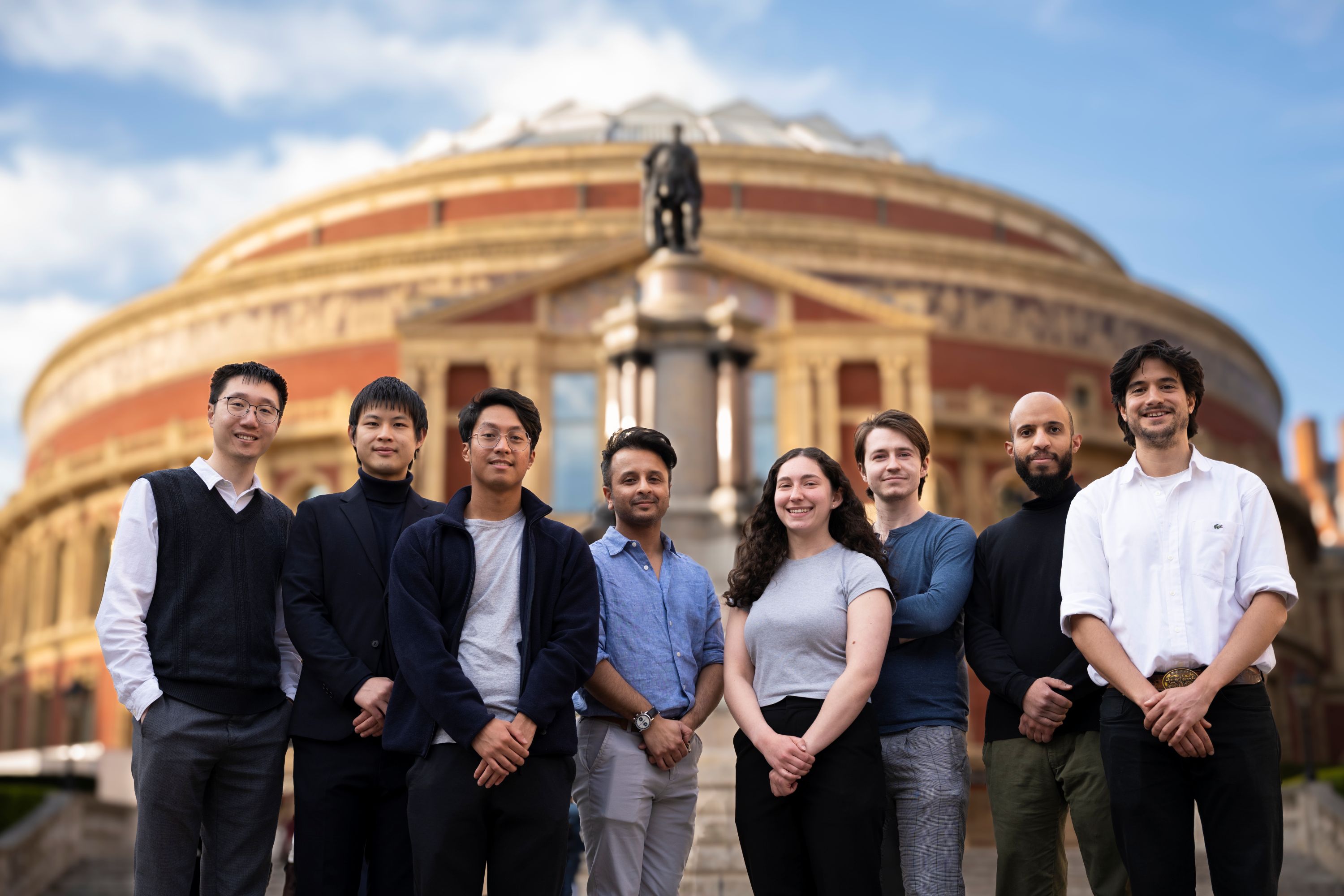
Team members of RUQu lab at Imperial College London, led by Raj Patel (Left to right: Shang Yu, Zhenghao Li. Dayne Marcus Lopena, Raj Patel, Shana Winston, Ewan Mer, Yazeed Alwehaibi, Gerard Jiminez Machado)
Putting Clavina to the test
To demonstrate the platform’s capabilities, the researchers applied Clavina to two complex tasks.
First, they used the system to simulate the Bose-Hubbard model, a well-known problem in condensed matter physics that describes interactions between quantum particles.
Dr Jinzhao Sun, Queen Mary University of London, said, “The versatility of our hardware enables us to integrate nonlinear operations and linear operations. We use these operations to perform simulations involving many-body interactions which are also restricted on superconducting quantum computers.”
The team then demonstrated a much more reliable way of generating Gottesman-Kitaev-Preskill (GKP) states, an important resource for error correction. These specialised states allow information to be encoded in a way that helps protect it from noise and errors, one of the central challenges facing future computing technologies.
Previous photonic approaches generated these states only probabilistically, meaning they could not be produced reliably on demand. Producing them in a far more consistent manner removes a major barrier to their practicality.
Dr Raj Patel, UKRI Future Leaders Fellow and leader of Imperial’s photonic quantum computing programme, said “Our architecture allows the generation of exotic quantum states such as Schrödinger cat states and Gottesman-Kitaev-Preskill states, which are valuable resources for fault-tolerant quantum computing.
The nonlinear operations in our architecture provide a universal gate set at the physical level which is required for the
Previously, researchers would have to build photonic hardware tailored to a specific task. The ability to switch in different functional modules in our architecture enables a single set of hardware to perform multiple functions without overhauling the design. Ying Dong Co-author, China Jiliang University
future implementation of bosonic error-correcting codes.”
In practical terms, this means the system provides key building blocks for computers that can detect and correct their own errors.
The flexibility of the system is another advantage.
Co-author Ying Dong, China Jiliang University, said “Previously, researchers would have to build photonic hardware tailored to a specific task. The ability to switch in different functional modules in our architecture enables a single set of hardware to perform multiple functions without overhauling the design.
Clavina can solve graph problems, simulate quantum systems or generate large entangled states and resource states for error correction.”
As quantum computing systems continue to grow in scale and complexity, platforms such as Clavina could provide a framework for developing photonic processors that can adapt to new computational challenges without requiring entirely new hardware designs.
Article text (excluding photos or graphics) © Imperial College London.
Photos and graphics subject to third party copyright used with permission or © Imperial College London.
Article people, mentions and related links
Eleanor Barrand
Faculty of Natural Sciences