World’s first trial to test if flightpath changes could cut aviation’s climate impact
/prod01/channel_4/imperial-news/media/news-images/3000X2000-main-article-images/Contrails-resized.jpg)
Imperial researchers will help evaluate a major North Atlantic trial investigating whether small, AI-guided flightpath adjustments can reduce global warming from aeroplane contrails.
The white wispy trails that sometimes form behind planes, known as contrails, are an increasingly important focus for climate researchers. While they may look harmless, they are thought to have a substantial near-term warming effect, making them an important target in the effort to reduce aviation's climate impact.
A unique trial starting in late 2026 supported by the UK government will test if it’s possible to reduce or totally eliminate contrails. Imperial experts in atmospheric science and aerospace engineering will test the theory that altering the altitude at which planes fly can reduce warming from aircraft contrails across the North Atlantic.
Operation Blue Skies, a project led by global tech company Google and involving the UK Department for Transport, the Met Office, NATS, Contrails.org, the University of Cambridge and Imperial College London, will use AI models to identify when and where small altitude adjustments could reduce warming from contrails, specifically focusing on the NATS-controlled Shanwick Oceanic airspace to the north west of Ireland.

(Photo credit: Google)
In the winters of 2026 and 2027, when contrails are most prevalent, airlines flying in this area will alter their flight paths in line with the trial and scientists at Imperial and Cambridge will measure the impact.
This is the world’s first government-backed effort to evaluate contrail avoidance at an oceanic airspace scale. The team hopes to establish whether altering flightpaths at a global scale would have a benefit for fighting climate change.
What are contrails?
Contrails form when aircraft exhaust mixes with cold, moist air at high altitude. While many disappear quickly, some persist and spread into thin cloud layers that trap heat in the atmosphere, contributing to global warming.
Atmospheric modelling suggests that Shanwick airspace accounts for approximately five per cent of global contrail warming. Much of this occurs during a relatively small number of evening hours between November and February, making the region an ideal place to test the approach.
Over 30 months, the programme will conduct two operational trials across Shanwick airspace, using small altitude adjustments within normal flight operations to assess both the practicality and environmental benefits of contrail avoidance.
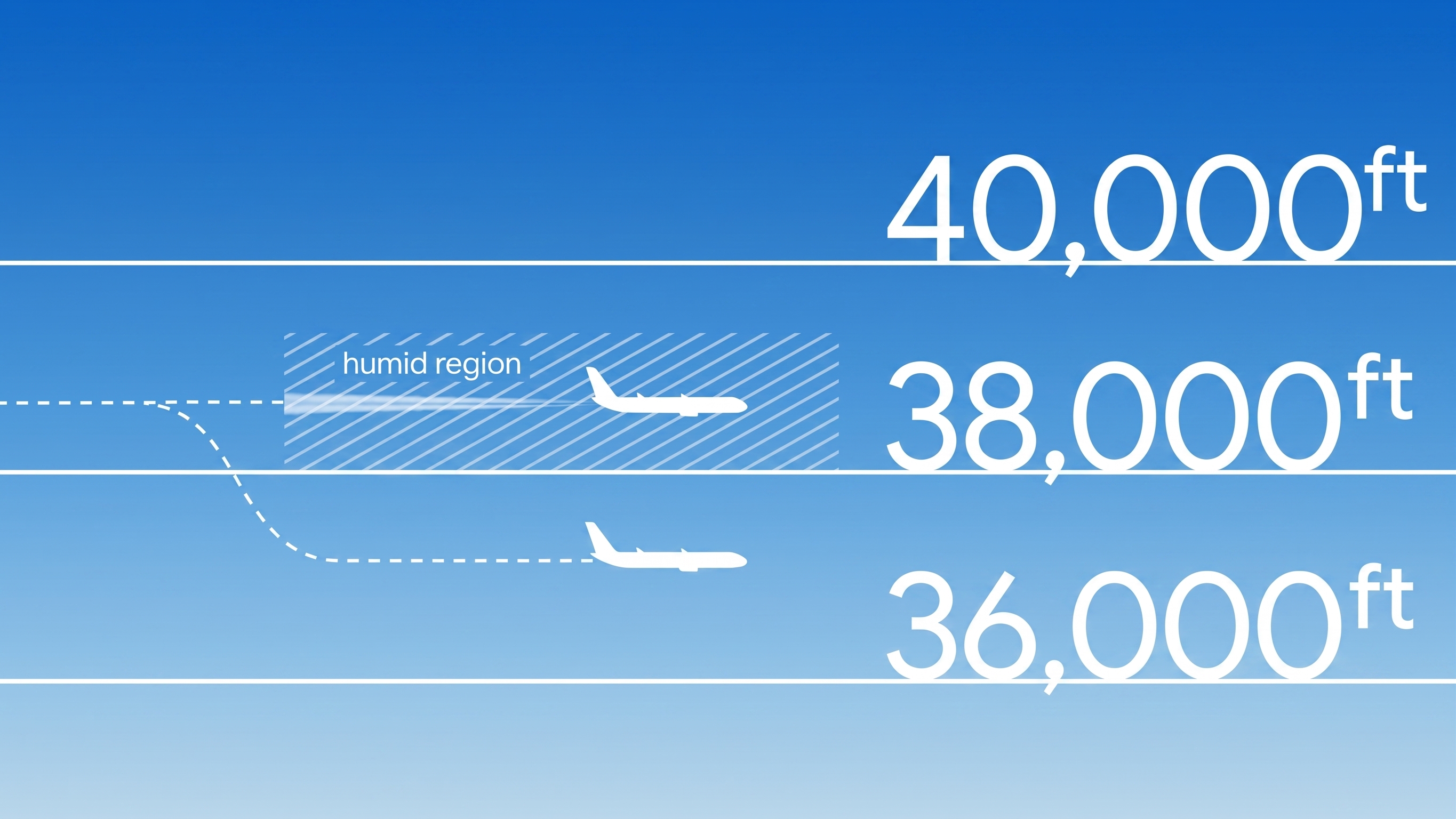
Example of moving from different altitudes to avoid contrails (photo credit: Google)
Can Imperial’s theory take flight?
The trial builds on research led by Imperial scientists, which demonstrated in 2020 that changing the altitude of fewer than two per cent of flights could reduce contrail-related climate warming by 59 per cent.
Operation Blue Skies provides the first opportunity to test this concept across a major transatlantic airspace region under real-world operating conditions.
Imperial’s contribution to the project is led by Professor Marc Stettler from the Department of Civil and Environmental Engineering, alongside Dr Sebastian Eastham from the Department of Aeronautics and Dr Edward Gryspeerdt from the Department of Physics.
Professor Marc Stettler, Professor of Transport and Environment, said "In 2020, our study found that small changes to flight paths could reduce the climate impact of contrails. Operation Blue Skies is a chance to test that idea in the real world and on a scale we've never seen before.
“At Imperial, our role is to independently assess what happens, from the effects on airline operations to the benefits for the climate, and provide the evidence needed to decide whether this approach could become part of everyday aviation. It's exciting to see Imperial’s research helping to shape practical solutions to one of aviation's biggest climate challenges."
This project is an opportunity to advance both understanding and capability in aviation sustainability. Navigational contrail avoidance has been receiving growing attention, but we need empirical proof that the tools we have available to us are up to the challenge. Dr Sebastian Eastham Associate Professor in Sustainable Aviation
Dr Sebastian Eastham, Associate Professor in Sustainable Aviation, said: "This project is an opportunity to advance both understanding and capability in aviation sustainability. Navigational contrail avoidance has been receiving growing attention, but we need empirical proof that the tools we have available to us are up to the challenge.
"One big question in this regard is whether model-based predictions of contrail formation are accurate enough, far enough in advance, that we can then successfully navigate to avoid contrail-forming regions. Operation Blue Skies brings together the pieces needed to do just that, using satellite imagery to monitor whether the predicted benefits actually materialise when we perform small flight plan adjustments based on contrail formation predictions."
Dr Ed Gryspeerdt, Associate Professor in Atmospheric Physics, added “Both the weather and global aviation are hugely complex systems, making contrail avoidance a challenging task. This trial is an important step forward, testing how these systems can work together at a large scale.
“It is very exciting to see how scientific research on aviation, clouds and satellite remote sensing can be used to address climate change and build a more sustainable future.”
Collectively, the team’s research is helping advance understanding and mitigation of aerosols and aviation contrails, one of the most promising opportunities for reducing aviation’s climate impact.
For Operation Blue Skies, they will play a key role in evaluating trial outcomes and independently verifying the programme’s climate impact alongside colleagues at the University of Cambridge.
Operation Blue Skies forms part of Imperial's wider research into sustainable aviation, bringing together expertise in aviation emissions, atmospheric science and transport systems. Researchers from across the university are developing technologies and evidence to support aviation's transition to net zero, from sustainable aviation fuels and aircraft technologies to approaches that reduce the climate impact of contrails.
Alongside its work on contrail mitigation, Imperial researchers have contributed to major initiatives such as the Virgin Atlantic-led Flight100 project, which delivered the world’s first transatlantic flight powered entirely by sustainable aviation fuel.
Looking ahead
The first operational trial is expected to take place during the winter of 2026-27, with a second following in winter 2027-28. Changes to flight paths will be incremental and barely noticeable to passengers, requiring only small adjustments to aircraft altitude.
Operation Blue Skies programme is co-funded by its industry partners and the Department for Transport (DfT) through the ATI Programme, a partnership between the Aerospace Technology Institute (ATI), the Department for Business, Innovation, Science and Trade (BIST) and Innovate UK.
If successful, the trial could provide the strongest evidence yet that routine flight path adjustments can help reduce aviation's climate impact without requiring new aircraft technology or fuels.
Article text (excluding photos or graphics) © Imperial College London.
Photos and graphics subject to third party copyright used with permission or © Imperial College London.
Article people, mentions and related links
Eleanor Barrand
Faculty of Natural Sciences

Meg Orpwood-Russell
Faculty of Engineering

Sigourney Luz
Faculty of Engineering

Simon Levey
Administration/Non-faculty departments
- Tel: +44 (0)20 7594 5650
- Email: s.levey@imperial.ac.uk
- Articles by this author