From ideation to app in four days: CCE researchers take on AI in science education
by Euan Doidge
/prod01/channel_4/imperial-news/media/images/landscape-3000X2000/Benji-and-Rebecca-3000-2000.jpg)
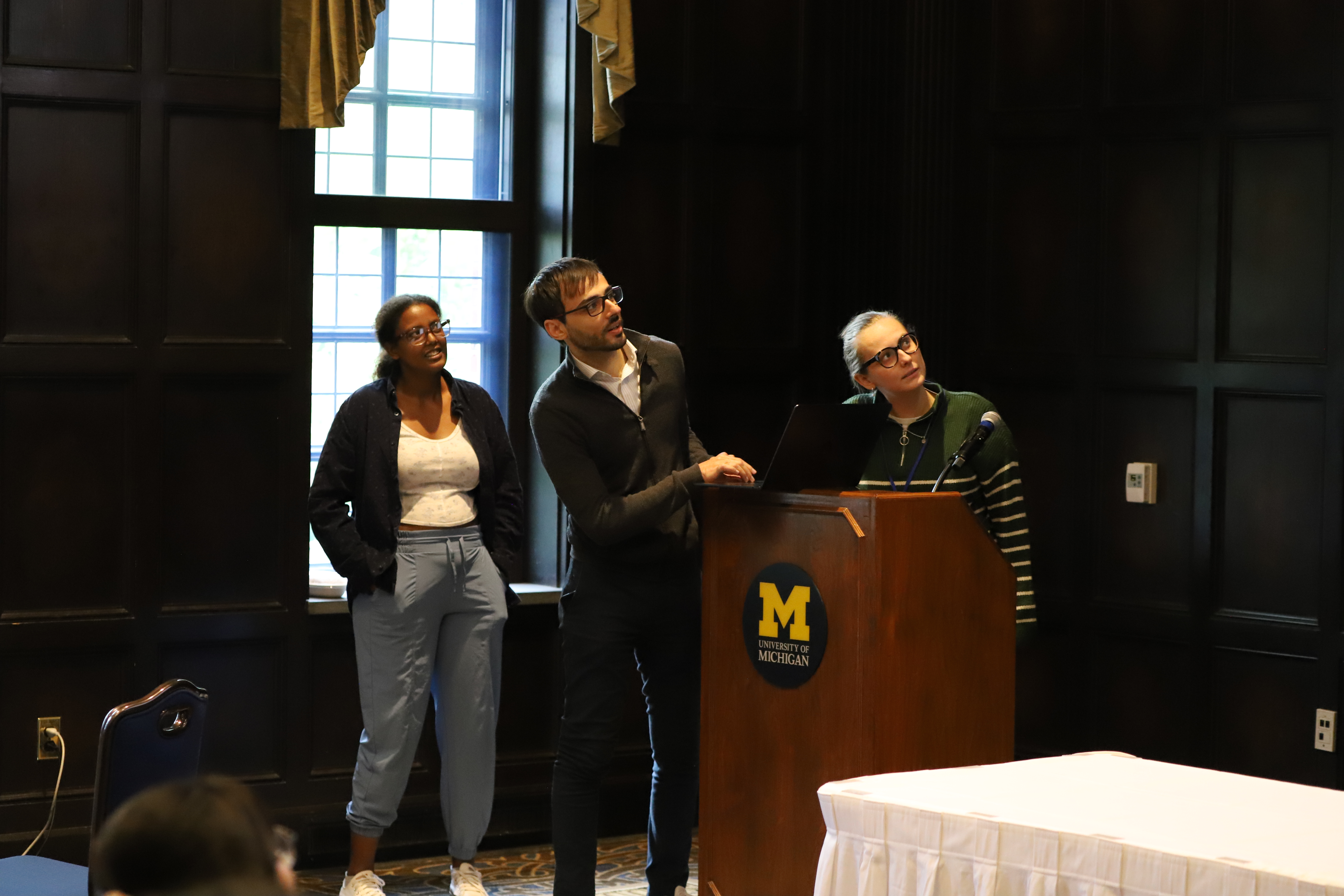
Two of the Centre's researchers, Dr Rebecca L. Jones and Dr Benji Fenech-Salerno, recently travelled to the University of Michigan to take part in the CommunAIty workshop, an intensive four-day programme bringing together stakeholders from across science education to explore how AI can be meaningfully implemented in the classroom. They returned with new skills, new collaborators, and a working prototype app.
An intensive, hands-on format
The workshop was designed to take participants from a blank page to a finished pitch in just four days. "It was quite an intense workshop, and basically started from scratch," Benji explained. "We were given the opportunity to ideate on what sorts of ideas we could see being implemented within a middle school or high school setting."
A highlight of the early sessions was a rapid "speed ideation" exercise: participants paired up, had one minute each to share who they were and the problem they wanted to solve, and then had to land on a compromise idea before moving on. "At the end of this you have fifteen ideas — or something approaching ideas — put together, and then you have to think about who you've met and form teams."
Rebecca described how the thought given to creating groups facilitated collaboration. “I particularly enjoyed that they asked us to fill in a survey before we arrived, evaluating our own abilities”, she said. This meant teams could be balanced between those with extensive AI experience and those coming from a science or education background, and “they encouraged us to mix within our teams as much as possible”.
Subsequent days featured focused workshops on communication, web design, and how complex data science concepts can be made accessible and engaging for younger audiences, alongside plenty of dedicated time for teams to develop their ideas. On the penultimate day, teams presented to a panel of high school teachers, iterated on the feedback, and delivered a final five-minute pitch on the last day.
Introducing Professor Frankfurter
The team's project tackled a problem familiar to anyone who has marked undergraduate exams: students often know distinct fragments of information but struggle to connect them, forgetting material they have covered previously. Their answer was a gamified knowledge tree. This serves as a pilot app that helps students see how concepts are related, rather than learning definitions in isolation.
"You click on a node with a concept title, and it introduces the concept in brief," Benji explained. "Then it asks you a question, which you have to answer correctly in order to unlock the next level of nodes that emanate from that concept." The app remembers which questions a student got wrong a day or a week later and prompts them to revisit their weak points. Once students have worked through a portion of the tree, it disappears and they must rebuild it themselves, testing whether they have genuinely internalised the connections.
The team also built in a playful alternative: a Snake-inspired game starring a sausage dog. Players steer the dog towards bones using the arrow keys, answering a question each time they collect one — get it right and the dog grows. The character's name? Professor Frankfurter!
The pilot lesson was built around an introduction to machine learning, but the template is designed to translate to any topic. "We could foresee it being utilised quite effectively within a university setting," Rebecca said. The app is currently in development behind institutional access, and the team hope to share it with the wider community in due course.
What they took away
For Benji, the workshop offered formal training in the latest techniques and platforms for creating interactive web apps, alongside space to explore them within a genuinely interdisciplinary team, something he described as "hands down accomplished". He was particularly struck by the opening session, in which Dr. Roberto Araya Schulz demonstrated how data science concepts had been gamified for children: "I found the approaches explored to be absolutely brilliant and I could see what they'd done being applicable at all ages."
For Rebecca, the value lay in demystifying the technical side of app development. "I had no experience in back-end design at all. I'd only worked at the front end — user visual design, what does this button do? Having a workshop that walked you through that, and then the time and space to practise it at my own pace, was really cool."
Both highlighted the people they met. Their team spanned PhD students, postdocs, and early- and late-career researchers. "It was a two-way interaction," Rebecca recalled of one Michigan-based teammate finishing her PhD. "She was looking to us for advice on what to do next, while at the same time she was one of the people with the most coding experience and was teaching us." Benji added: "There was some generational bridging as well — different ways of looking at things, different levels of experience. I thought that worked really well."
Overall, it was a rewarding and enjoyable experience using a format that allowed development of meaningful skills and genuine ideation. Rebecca and Benji would like to thank Schmidt Sciences and the organisers of the CommunAIty workshop for enabling their attendance and creating such an engaging programme.
Article text (excluding photos or graphics) © Imperial College London.
Photos and graphics subject to third party copyright used with permission or © Imperial College London.
Article people, mentions and related links
Euan Doidge
Faculty of Natural Sciences