Invited talk at the University of Edinburgh
by Euan Doidge
/prod01/channel_4/imperial-news/media/news-images/3000X2000-main-article-images/LD-slide.jpg)
Dr Luke Delmas presents: “Early Laboratory Learning: Scaffolding Success Through Cognitive Load-Aware Design”
We are delighted to share that Luke Delmas recently had the pleasure of delivering an invited talk at the University of Edinburgh in September 2026. Luke was kindly invited by Dr Richard Kong, Chancellor's Fellow in the School of Chemistry at Edinburgh, and we are grateful to him and the entire Edinburgh chemistry community for being such wonderful and generous hosts. The talk sparked a rich and stimulating discussion around pedagogy, assessment design, and the challenges of supporting diverse student cohorts in the laboratory setting.
Luke's talk, titled “Early Laboratory Learning: Scaffolding Success Through Cognitive Load-Aware Design”, explored how the first-year laboratory experience in the Department of Chemistry has been further developed through the lens of cognitive load theory and schema formation. The central argument was straightforward but important: the chemistry laboratory is one of the most cognitively demanding environments a new undergraduate will encounter, requiring students to simultaneously navigate safety protocols, interpret written procedures, handle unfamiliar apparatus, make precise observations, record data, and engage with underpinning chemistry concepts - all at once, and often for the very first time. For students arriving from varied school backgrounds, this parallel processing of so many interacting elements can quickly lead to cognitive overload, undermining both learning and confidence.
Drawing on Sweller's Cognitive Load Theory (CLT) and Piaget's framework of schema formation, Luke outlined how a carefully sequenced unit of learning can address this challenge directly. Rather than exposing students to the full complexity of a synthesis laboratory from day one, the Department’s approach deliberately spreads that complexity across three interconnected experiences: Chemical Kitchen, a Glassware Workshop, and Introduction to Synthesis.
The Chemical Kitchen uses the context of gastronomy to introduce core practical skills in a low-stakes environment. Working in a professional kitchen rather than a chemistry laboratory, students practice key techniques without the added cognitive demands of hazardous chemicals or formal assessment pressure (see case study on the Chemical Kitchen here).
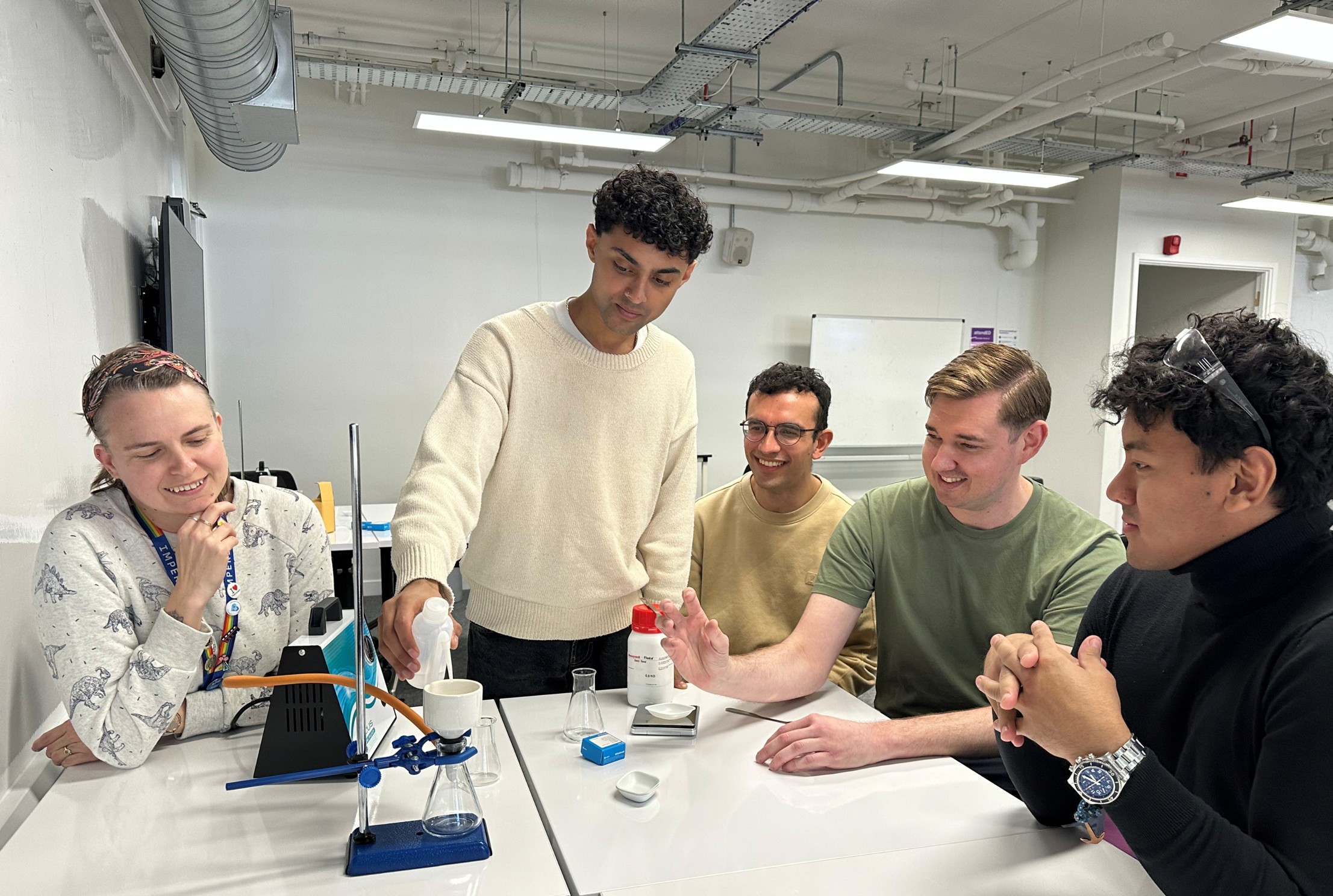
The Glassware Workshop, introduced in the 2025 academic year, builds on this foundation by giving students dedicated, pressure-free time to handle, assemble, and understand the purpose of common laboratory apparatus before they encounter it in a live synthesis setting. By converting unfamiliar glassware into known, schema-supported elements, the workshop reduces the intrinsic load students face when they finally enter the synthesis laboratory.
The Introduction to Synthesis then brings these threads together in a summative context, asking students to apply the skills and confidence they have developed across the preceding experiences. By this point, many of the elements that would otherwise compete for working memory have already been consolidated into long-term memory, allowing students to focus their cognitive resources where they matter most.
Luke would like to extend his warmest thanks to the Edinburgh chemistry community for their generous hospitality and engagement throughout the visit. It was a memorable occasion, and we very much hope it marks the beginning of an ongoing and productive dialogue between our two institutions.
Article text (excluding photos or graphics) © Imperial College London.
Photos and graphics subject to third party copyright used with permission or © Imperial College London.
Article people, mentions and related links
Euan Doidge
Faculty of Natural Sciences