
Health
by Kate Hobson

Senior colleagues from Thailand visited Imperial College London in September 2026 for a day of laboratory engagement, research planning, and discussions on the next phase of the MUT–Imperial SABER Lab partnership
The Semiconductor AI & BioSensor Electronics Research (SABER) Lab at Imperial College London welcomed a delegation of university and research leaders from Thailand on Tuesday 8 September 2026, reinforcing a shared ambition to translate advanced electronics research into meaningful real-world impact.
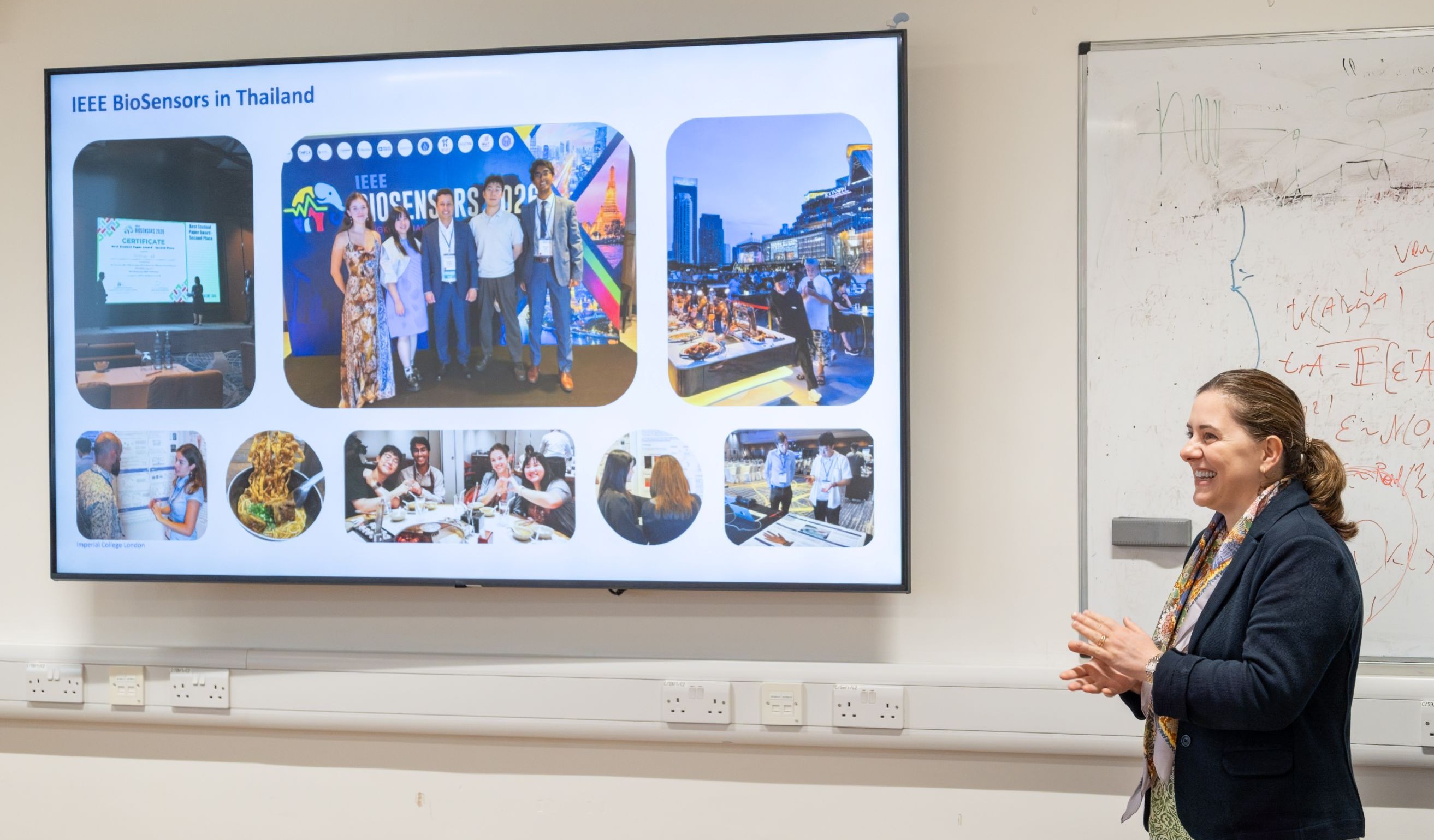
The visit was hosted by SABER Lab Co-Director Professor Pantelis Georgiou, and SABER Director of Healthcare Technology Dr Melpomeni Kalofonou, and brought together representatives from four Thai institutions: Mahanakorn University of Technology (MUT), Thailand Science Research and Innovation (TSRI), Mahidol University (MU), and Chulabhorn Research Institute (CRI).
Led by Associate Professor Dr Panavy Pookaiyaudom, President of MUT and Co-Director of SABER Lab, the delegation also included Professor Dr Vissanu Meeyoo, Vice President of TSRI, Associate Professor Drs Thanapat Wanchanon, Benchapon Lertananatwong, and Surachate Thanapitak, from MU’s Faculty of Engineering, Dr Rapeepat Sangsuwan of CRI, and Miss Pimsiri Hongvitayakorn and Mr Nattapan Chanchomchuen of MUT.
The visit kicked off with a tour of SABER facilities, where the delegates were shown live demonstrations of some of the latest semiconductor-based biosensor technologies being developed in the SABER Lab, including Lab-on-Chip platforms for Organ-on-Chip research and diagnostic technologies for cancer screening.
Later, the group held fruitful discussions on the continuing collaborations between the institutions, and potential future joint research proposals, including a cancer focus session chaired by Dr Kalofonou. In this session, Dr Kalofonou presented the group’s work on semiconductor-based biosensors for cancer screening and detection, along with students Calista Yapeter and Panthira Polcharoen, prompting productive discussions on the use of these technologies to tackle liver and lung cancers – areas with significant potential relevance for Thailand.

Another focus of discussion was the development of organ-on-chip technologies for biomedical and medical research, with a wide range of potential healthcare applications.
Following lunch and networking, the group were joined by a prospective SABER PhD candidate, who was invited to tour the facilities and give a presentation as part of an interview. The visit concluded with a review of the day's progress, and discussion of priorities, research and training ambitions for the SABER Lab, along with next steps for the partnerships.

Reflecting on the visit later, Associate Professor Pookaiyaudom emphasised the need for research to extend beyond laboratories and publications to technologies that can help patients and improve people’s lives.
By bringing together partners across the two countries, the September visit underlined SABER Lab’s commitment to developing research collaborations that support innovation, international capability-building and impact for communities in Thailand and beyond.
Article text (excluding photos or graphics) © Imperial College London.
Photos and graphics subject to third party copyright used with permission or © Imperial College London.
Faculty of Engineering

Health

Health

Campus and community

Cross-faculty
Imperial Global
Campus and community
Engineering
Discover more Imperial News
Search all articlesDiscover more Imperial News
Search all articles