The group bringing together scientists to understand human hearing
by Press Office
Learn about the Aural Assessment By means of Binaural Algorithms (AABBA) group, whose goal is to promote exploration and development of different models of human hearing and their applications.
Developing models of human hearing is an area of research with many applications, from improving hearing aids and implants to creating immersive audio for virtual reality, and connecting researchers working in this space from around the globe is vital to making progress.
Introducing AABBA – not the latest Swedish pop group, but a group of scientists that collaborate on the development and applications of different models of human hearing.
Set up in 2009 by Professor Jens Blauert as a way for himself and other acoustics research colleagues to discuss joint projects and work, the Aural Assessment By means of Binaural Algorithms network has since grown to nearly 30 regular members from across 14 countries.
SONICOM member Dr Piotr Majdak has since taken the reins from Professor Blauert on AABBA’s Executive Board.
“I’m very proud to be taking on the leadership [of AABBA],” said Majdak, “But I couldn’t do it without the help of my colleagues and friends.”
A space for making connections
A core pillar of AABBA is building networks and connections for people working in acoustics research.
AABBA members meet annually in Vienna for open discussions and presentations on their research. They especially encourage members to bring in students and young scientists associated with their projects to the meetings to present the research they’re working on, meet people, and exchange ideas.
Together, the network has resulted in in joint publications and special sessions at international conferences. Recently they have worked together to create a special issue in Acta Acoustica, where, despite an open call, almost all chapters have been contributed by AABBA members.
It has also provided validated (source) codes for published models of binaural and spatial hearing to our collection of auditory models, known as the auditory modelling toolbox (AMT). The AMT has since received an update to the AMT 1.2.0, and contains 60 models and over 40 GB of auxiliary data and cached modelling results are available for download on the fly.
If you are interested in getting involved with AABBA or joining the network, get in touch with Dr Piotr Majdak.
Upcoming session and International Congress on Acoustics 2022
AABBA will be putting on a Special Session titled “Spatial Hearing” at the International Congress on Acoustics (ICA) 2022 in Gyeongju, South Korea.
Find out more about the conference on their website.
UK Hearing, Audiology & Sciences Meeting 2022
by Press Office
Members of the SONICOM team attended and presented at the UK Hearing, Audiology & Sciences Meeting 2022.
Members of the SONICOM consortium had the pleasure of attending and presenting at the UK Acoustics Network (UKAN) sponsored Hearing, Audiology & Sciences Meeting this week on the 12 and 13 September in Southampton, UK.
The conference was open to anyone with an interest in the science of hearing, audio and audiology, with the aim of facilitating a friendly exchange of work and ideas.
Dr Lorenzo Picinali, scientific coordinator of SONICOM, chaired a session on spatial hearing and immersive audio rendering, which saw several members of Imperial College London’s audio experience design (AXD) team present their work in this space.
“It was an excellent venue for presenting some early results from our work, as well as some plans for future works, and get very valuable feedback in a very informal way!” said Dr Picinali.
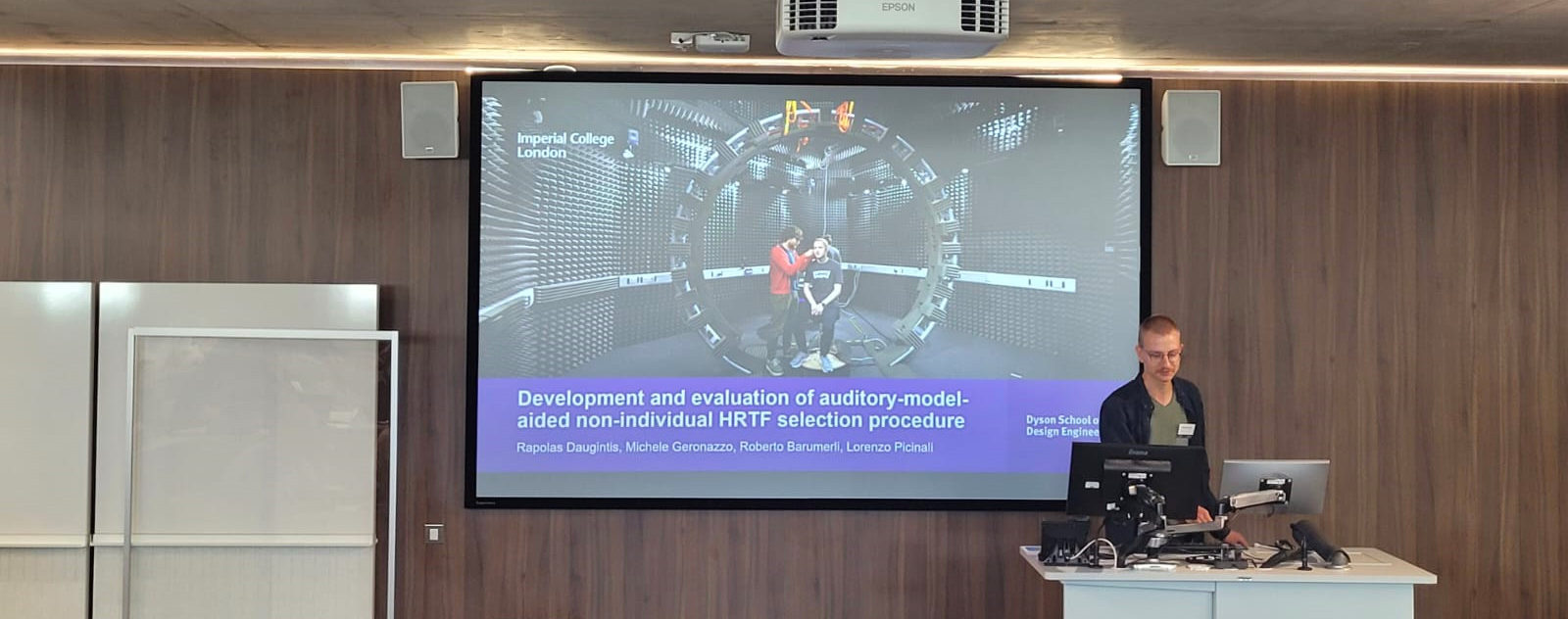
This session included a talk from Rapolas Daugintis, a PhD student in the team, who discussed his work on the development and evaluation of auditory-model-aided non-individual HRTF selection procedure.
“This was my first time presenting my work as a PhD student in an academic conference format. It was a good platform to develop my science communication skills in quite a relaxed environment and meet the academic community,” said Daugintis.
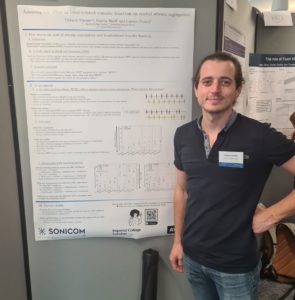
The meeting also had a poster session, which included Dr Thibault Vicente displaying work on assessing the effect of head-related transfer function on spatial stream segregation.
“This poster was a good opportunity to present our pilot study. It is always relevant to have feedback from other researchers at this stage, so that the protocol can be adjusted before the final data collection,” said Dr Vicente.
See the full programme from the meeting on the UKAN website.
Article text (excluding photos or graphics) © Imperial College London.
Photos and graphics subject to third party copyright used with permission or © Imperial College London.
Article people, mentions and related links
Press Office
Administration/Non-faculty departments
Article text (excluding photos or graphics) © Imperial College London.
Photos and graphics subject to third party copyright used with permission or © Imperial College London.
Article people, mentions and related links
Press Office
Administration/Non-faculty departments