Improving vaccine conversations with healthcare professionals during pregnancy
By line: A Research Café case study by Helen Skirrow
Story editor: Lizzie Blunt - MSc Science Communication work placement student
Public Health Research · Patient & Public Involvement · Children & Young People
“It reinforced my commitment to building lasting partnerships rather than one-off consultations”
Helen’s Project
Despite the importance of vaccination in protecting babies and young children from serious illness, not all pregnant women and children get their recommended vaccines. In her project, Helen wants to explore how healthcare professionals can have better conversations with families during pregnancy by working with pregnant women, mothers and midwives about how to make these discussions effective and ultimately increase vaccine uptake. Helen is particularly interested in how women from groups who are less likely to be vaccinated can have better conversations.
Why did Helen go to the Research Café?
“It is essential to involve parents from the outset...hearing directly from the people this work aims to support is the most effective way to ensure it will make a real difference”
Having previously worked for many years to understand inequalities in vaccine uptake, Helen understands the need for trusted and timely vaccine conversations between parents and health professionals, and yet parents' voices are not always heard in research. With an aim of improving vaccine conversations in pregnancy, Helen brought this project to the Café to involve parents from an early stage to shape her research direction.
What did she ask parents at the Research Café?
- Do you think vaccine conversations in pregnancy is an important research topic?
- Are any parts of my project summary unclear?
- To work with pregnant women and mothers, what do I need to think about to make it easy for them to take part?
What Helen heard
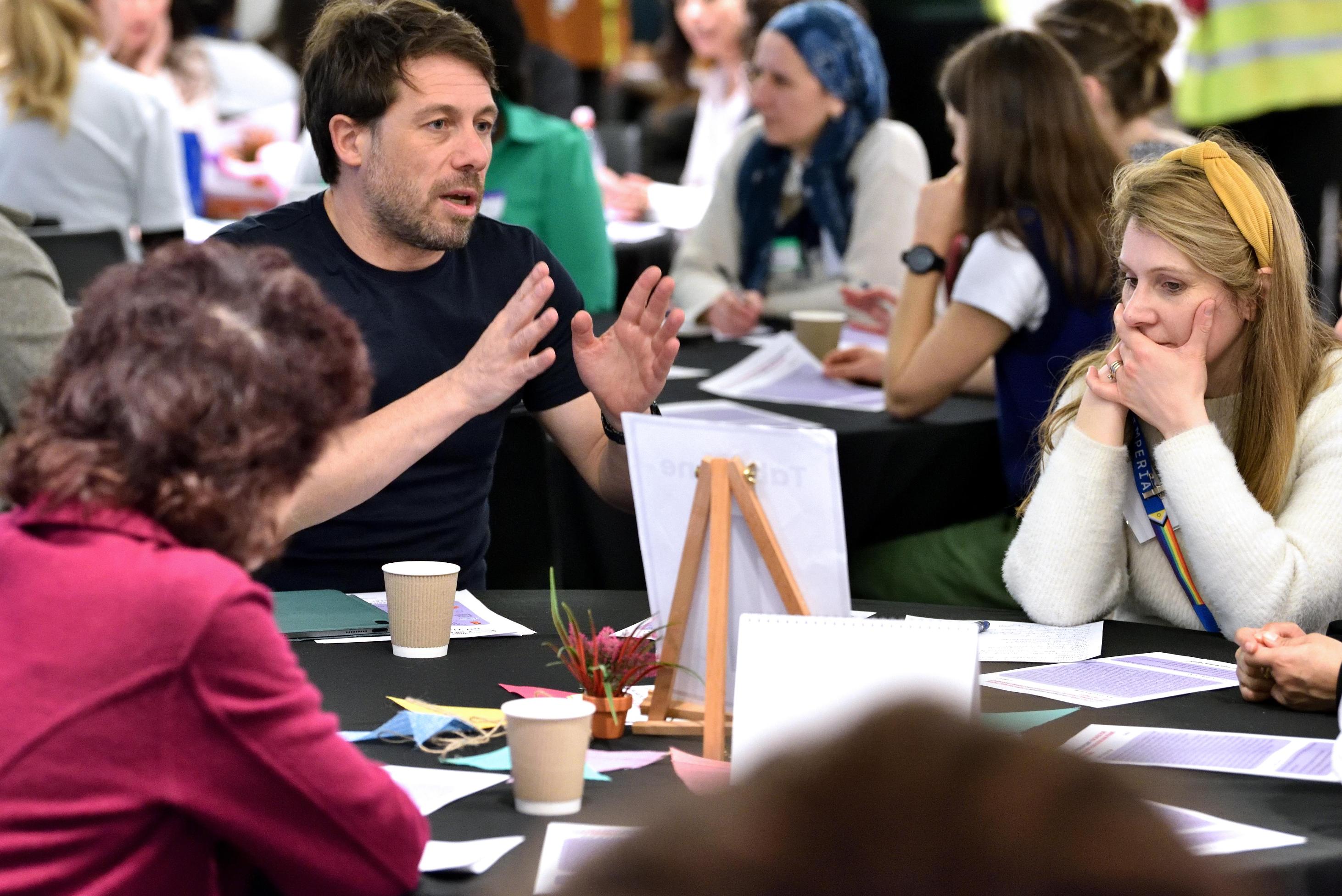
At her table at the Café, Helen heard from parents, midwives, obstetrics and GPs to get valuable insights into her project
- Enthusiasm for the research topic
“It was affirming to have this validation from the people the research aims to support”
From the discussions it was clear the Helen’s topic was important, with both parents and midwives expressing enthusiasm for her project.
- The role of trust
Trust became a central theme in discussions. In particular, they discussed that women who don’t trust the care team around them are unlikely to trust their advice about vaccines. This reinforced the importance of looking at vaccine conversations not in isolation, but as part of a broader trusting relationship between pregnant women and their healthcare providers.
- Broader role of community leaders and trusted figures?
The parents in the discussion also raised important points about vaccine conversations not being the sole responsibility of midwives, but instead other trusted figures such as community leaders and family members who play a vital role in helping women make informed decisions.
- Challenges of healthcare professionals
The midwife and GP present added a valuable clinical perspective and gave Helen an idea of the challenges they face in having these conversations within busy antenatal appointments.
“Hearing directly from parents and healthcare professionals in the same space also strengthened my confidence that this research addresses a real and urgent need”
Impact
The discussions Helen had on the day informed her project in several ways:
- Kickstarting the project with a new grant application
- Broadening the scope of trusted relationships in the co-design process
But it was clear that the conversations with parents and professionals gave her the confidence to proceed with her project.
Speaking about public engagement more broadly, one particular success of the day stood out to Helen:
“Co-leading the table with a mother of three who has participated in two of my previous research projects on childhood and pregnancy vaccines, and who is now a public involvement collaborator on my research, was a highlight of the event. Seeing her take on a leadership role at the table was a powerful reminder of what long-term, genuine community engagement can achieve.”
Read our blog
All postsContact us
PERC Director and Co-Founder
Prof. Helen Ward
h.ward@imperial.ac.uk
For enquiries about public involvement in research and research more generally, please email:
publicinvolvement@imperial.ac.uk