Ten years after his passing, Professor Arttu Rajantie looks back at Tom Kibble’s scientific legacy and the continuing importance of his ideas
June 2nd 2026, Imperial by Prof. Arttu Rajantie
 It is ten years since Tom Kibble passed away, and I would like to share some of my recollections of him and his legacy.
Tom was, of course, best known for his work on spontaneous breaking of gauge symmetries. Together with Hagen and Guralnik, he published a paper in 1964 showing that it gives a massive vector boson but no massless Goldstone scalars, which is now known as the Higgs mechanism. It was also discovered independently by Higgs and by Brout and Englert. Only Higgs pointed out that it also leaves behind a massive neutral scalar, the particle that is now known as the Higgs boson.
However, all these papers were about Abelian symmetries, and the key step of generalising the mechanism to non-Abelian gauge theories was taken by Tom in 1967, as those who have been to my Unification lectures know very well. This was the basis on which Weinberg and Salam built their theory of electroweak unification a year later. As Weinberg put it, Higgs and others showed why weak gauge bosons are massive, but Tom showed why the photon is massless. In 1972, ‘t Hooft and Veltman showed that these theories are renormalizable, referring to this as the Higgs-Kibble mechanism in their paper.
Ultimately, the most remarkable thing about Tom was his deep physical intuition, which guided his work and enabled genuine breakthroughs rather than incremental advances.
After the Higgs boson was discovered at CERN in 2012, the Nobel prize was awarded to Higgs and Englert. Under the Nobel rules, a prize can be shared by at most three people, and while Brout had passed away, it was not possible to include all authors of Tom’s 1964 paper. Many people – including Higgs himself – have said that the Nobel committee could have included only Tom based on his non-Abelian paper, but sadly they chose not to. I remember how after the announcement I walked down to Tom’s office. I am sure he was disappointed, but in a characteristic way, he did not show that. Instead, he said that it would not have been fair to give it to him and not to his collaborators, and that he was happy for Higgs and Englert.
So, even though he never received the prize himself, his work underpinned three Nobel prizes: Weinberg and Salam in 1979, ‘t Hooft and Veltman in 1999, and Higgs and Englert in 2013.
Tom’s other major contribution came in 1976 when he showed that when a symmetry breaking phase transition happens in real time, like in the early Universe, then it can produce topological defects such as domain walls, cosmic strings or monopoles, depending on the symmetry breaking pattern. This is because the order parameter does not have time to align over large distances, leading to a domain structure and defects at the boundaries between domains.
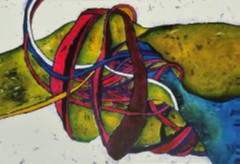 Especially cosmic strings were very exciting, because they were once considered a promising explanation for the origin of cosmic structure. Although observations of the cosmic microwave background later showed that they cannot be the primary source of the observed density perturbations, cosmic strings could still exist, and one of the science goals of the LISA gravitational wave observatory is to search for their signatures.
[Artwork courtesy of Elisa Quevedo]
This phenomenon of defect formation is known as the Kibble mechanism, and it is not limited to cosmology. There are symmetry breaking phase transitions in many condensed matter systems, and if the topology is right, they produce topological defects, too. In fact, perhaps the most familiar example of it is ice cream. If you just put custard in the freezer, you get a big solid block of frozen custard. But if you freeze it fast enough, the Kibble mechanism means that you get only small crystals, and therefore nice and soft ice cream. In practice, one also stirs the mixture to ensure this happens, but rapid freezing is the essential idea.
Indeed, in the 1990s, Tom used this connection with condensed matter physics to pioneer the idea of cosmology in the laboratory, working with low-temperature physicists to test the Kibble mechanism and other aspects of fundamental physics through analogies like this. This is still an active area of research.
This interdisciplinary endeavour is also the reason I got to know Tom and ultimately ended up here at Imperial.
This interdisciplinary endeavour is also the reason I got to know Tom and ultimately ended up here at Imperial. I did my PhD in Finland, on finite-temperature field theory, and in January 1998 I was applying for postdocs. At that time, Tom was working with low-temperature physicists at the Helsinki University of Technology on liquid helium tests of the Kibble mechanism, and they organised a workshop at a remote biological research station in Finland. It is a beautiful place in summer, but in January it is just cold and isolated. But it was great because Tom was there, and I could talk with him about defect formation. In particular, I had been thinking about how it would have to work differently in the case of gauge symmetries.
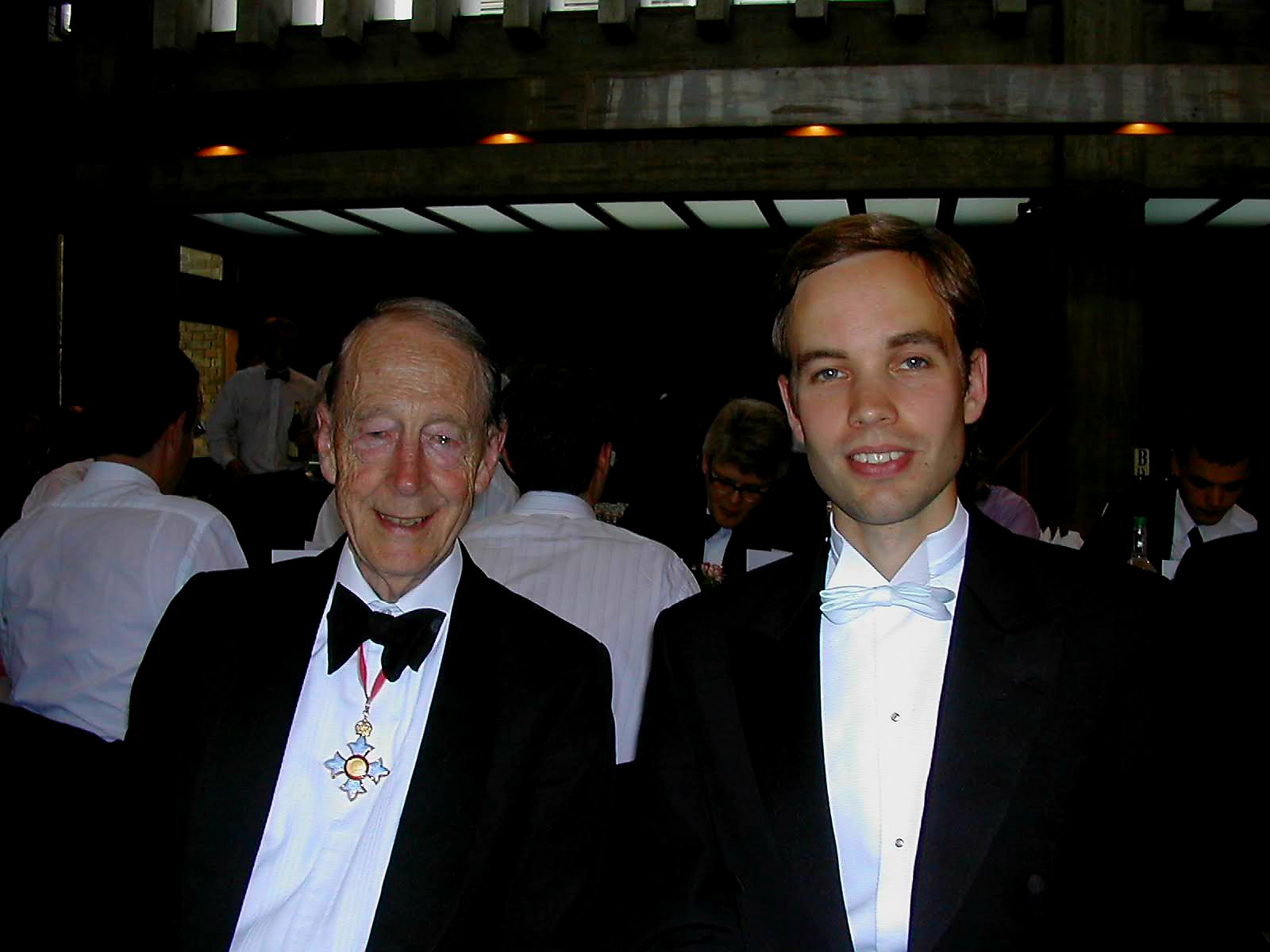 I was struck by how approachable Tom was for someone with his achievements. He was quiet and modest and preferred to stay out of the limelight, and he was happy to discuss physics with a young researcher like me. After that workshop, I was so excited about this area of research that I chose to accept a postdoc offer from Sussex rather than some better-known places, because Sussex was close to Imperial and because there were two of Tom’s young collaborators, Mark Hindmarsh and Ed Copeland, there. After Sussex, I ended up going to Cambridge for five years, and then here to Imperial.
Altogether, I ended up writing four papers with Tom, two of which were on defect formation in gauge field theories. It was characteristic of Tom that he did not have a problem with the idea that the Kibble mechanism needs to be modified in the case of gauge symmetries. Some referees certainly did – even when one of the authors was Kibble himself. Therefore, it took a long time to get one of these papers published.
Ultimately, the most remarkable thing about Tom was not just his mathematical ability, which allowed him to calculate what happens when gauge symmetries break and how particle spectra or topological defects depend on the symmetry breaking pattern. It was his deep physical intuition, which guided his work and enabled genuine breakthroughs rather than incremental advances. Combined with his modesty, generosity and willingness to engage seriously with younger researchers, that is what made him such an exceptional scientist and colleague.