The success of quantum field theory (QFT) framework underlies some of the most successful theories of nature, from Quantum Electrodynamics, to Electroweak symmetry breaking, to the Standard Model of particle physics. And yet, for all its success, QFT remains deeply mysterious in the strongly coupled regime, where the usual tools of perturbation theory break down entirely. In parallel its connections with UV completions remains obscure.
Research at the Salam Centre is driving new powerful methods to probe the strongly coupled regime by exploiting the fundamental principles that any consistent physical theory should satisfy, independently of its precise implementation.
Confinement
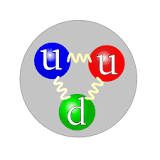
An exciting new direction that the Centre addresses is one of the most fundamental problem of modern physics: what makes the strong force get stronger with distance so that quarks and gluons are always tightly bound into hadrons? This question of confinement is addressed by developing novel tools that shed light on strongly coupled systems, including new string worldsheet descriptions of large N theories in two dimensions and novel techniques for Yang-Mills theories on anti-de Sitter space.
Similar methods also tackle various conjectures about quantum gravity by using AdS/CFT duality to translate them to conjectures in CFTs, and further using CFT methods to complete the proofs.
S-matrix Bootstrap Programme
The S-matrix bootstrap programme relies on the fact that consistency conditions of the theory (crossing symmetry, unitarity, and the operator product expansion) can be so powerful that in principle, they can provide strong bounds on a theory and in some cases completely determine it without any reference to a Lagrangian or a perturbative expansion.
The Conformal Bootstrap
The conformal bootstrap is one of the most powerful ideas in modern theoretical physics. The key ingredient is that in a conformal field theory (CFT) there is no preferred length scale.
The Centre includes world leaders in the application of bootstrap methods to conformal field theories, with applications spanning from condensed matter physics to string theory. Their work has produced a remarkable series of results from superfluid Helium transition that can be compared with lab experiments, to non-perturbative results in non-Abelian gauge theory.
In parallel, work at the Centre on quantum electrodynamics in 2+1 dimensions (QED3) explores novel phase transitions in condensed matter systems making predictions, for example that the theory with two bosons is tricritical, which have then be independently confirmed by lattice studies.
Positivity Bounds
A different non-conformal incarnation of the S-matrix bootstrap puts direct constraints on the amplitudes of low-energy EFTs. These so-called positivity bounds rely on the same principles of consistency: analyticity, unitarity, causality and can be applied more broadly to generic EFTs, including theories of gravity.
The Centre is pioneering new S-matrix positivity bounds for general EFTs including gravitational ones. The key idea is that the low-energy scattering amplitudes of any consistent theory must satisfy certain positivity conditions, derived from the requirement that the theory admits a standard UV completion, ie a well-behaved high-energy theory from which the EFT can be derived.
This programme has spawned multiple directions including exploring the implications of crossing symmetry for gravitational scattering amplitudes, deriving new UV constraints on the slopes of Regge spin-2 residues. These constraints are directly comparable with the detailed string corrections uncovered by string theorists at the Centre.