
Understanding the very first moments of cosmic history is one of the central missions of the Salam Centre.
Constructing consistent theoretical frameworks for our Cosmic Origins and the fate of the Universe, establishing their mathematical and physical foundations, testing them against observation and making new predictions is one of the central missions of the Salam Centre. The imprints of those first moments are carried to us through multiple independent channels, including the Cosmic Microwave Background (CMB), the large-scale distribution of clusters of galaxies, 21cm, weak lensing and the propagation of light and gravitational waves across cosmic times and different structures, and the primordial gravitational wave background, each probing different aspects of fundamental physics in the Early and late Universe, and providing incredibly rich and precise new information.
Mapping Our Cosmic Origins
Some of the world's leading experts in the statistical analysis and theoretical modelling of the CMB and the large-scale structure of the universe are hosted at the Centre. This work develops the sophisticated mathematical and computational tools needed to extract the maximum information from CMB data and connecting the physics of the very early universe to what we can actually observe today.
Working at the frontier of a new era of multi-messenger cosmology, the Centre is developing theoretical frameworks for gravitational wave backgrounds detectable by pulsar timing arrays and other stochastic surveys to deliver a deeper view of the early universe.
Inflation and its alternatives
Inflation is the leading theoretical framework for understanding the large-scale structure of the universe. In this picture, the universe underwent a brief but dramatic period of exponential expansion in its first fraction of a second, stretching quantum fluctuations to cosmic scales and imprinting them as the temperature variations we see in the CMB.
The Centre develops precise theoretical predictions for these fluctuations and confronts them with data from experiments including the Simons Observatory, SPIDER, and future CMB missions.
While a precise fundamental origin of inflation remains elusive, the Centre has explored Higgs inflation — one of the best-developed attempts to embed inflation into the Standard Model through a non-minimal coupling of the Higgs field to gravity.
In parallel, models of inflation with non-trivial or excited initial states or alternative to inflation have also been explored by members of the Centre who have shown how consistent alternatives can reproduce the same scalar power spectrum but different non-gaussianities and gravitational wave signatures.
As another alternative scenario, Varying Speed of Light cosmology proposes that the speed of light was much higher in the very early universe, solving the horizon and flatness problems that inflation was designed to address, though through a completely different mechanism. As another alternative model, the thermal bimetric gravity model replaces inflation with a thermal initial state.
Complementary to these new model buildings, the theoretical consistency of these theories of inflation and their alternatives is being explored through various classes of quantum field theory bounds together with implications on dark energy and the fate of the Universe.
Open System methods for the Early Universe
A fundamental question underlying all models of the early universe is how the quantum fluctuations generated during inflation, or its alternatives, become the classical perturbations we observe today. The Centre has made important contributions to understanding quantum decoherence in cosmological settings, exploring how the quantum-to-classical transition depends on the nature of the interactions and on the cosmological background.
Recent work at the Centre has also made crucial progress in computing non-equilibrium dynamics of gauge theories, providing for the first time the foundational framework to rigorously use the path integral for such open EFTs, which is for instance precisely the setting relevant Gravitational Waves produced during electroweak-scale phase transitions.
Preheating and Phase Transitions
The end of inflation was not gentle. As the energy stored in the inflaton field decayed, it was transferred to the particles of the Standard Model in a highly non-equilibrium process called reheating. The Centre explores how quantum fields behaved in these extreme conditions using a combination of analytical and large-scale numerical methods.
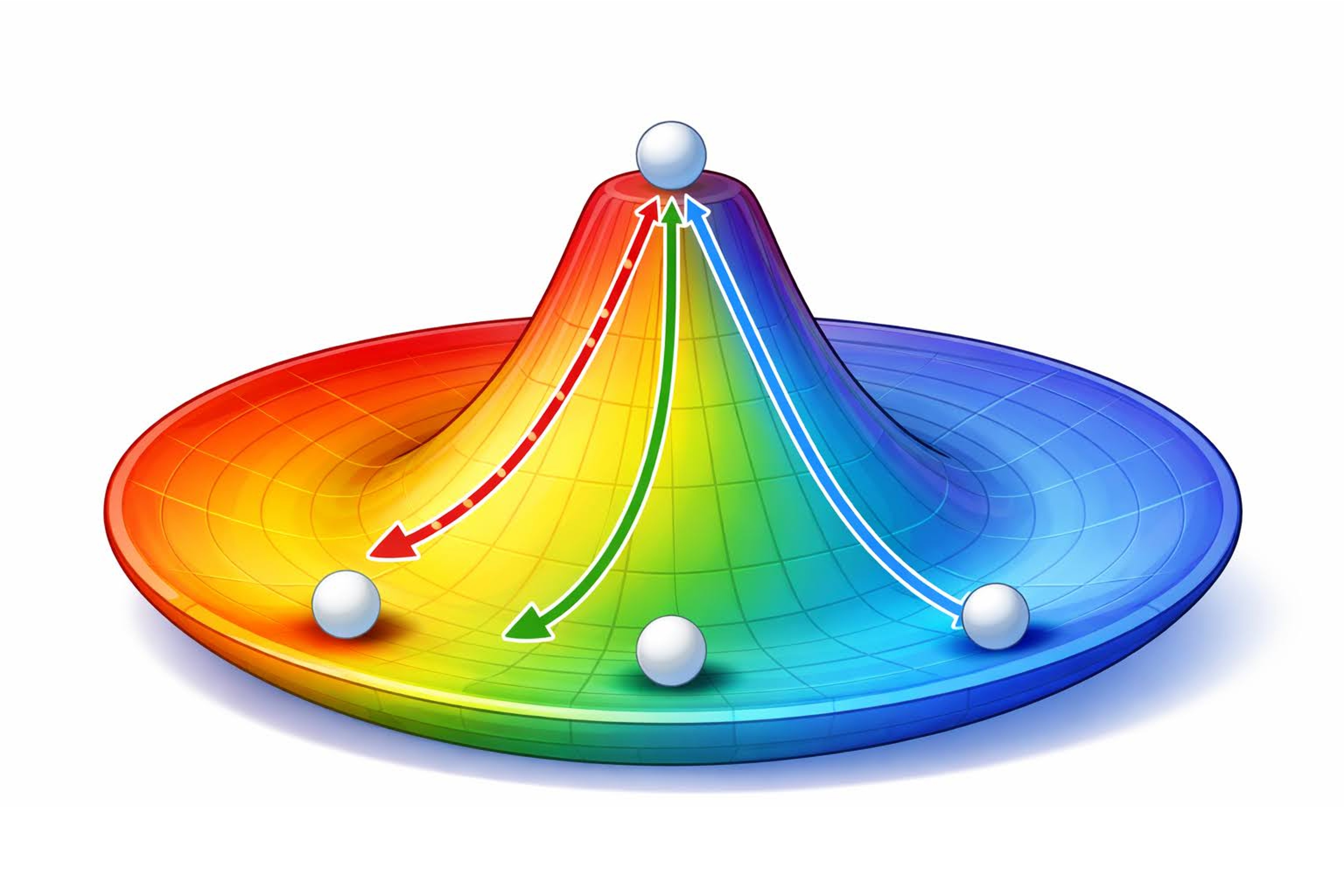
Recent work has shown that preheating, the initial phase of reheating driven by parametric resonance, can produce observable non-Gaussian curvature perturbations in viable inflationary models, leaving a distinctive imprint on the CMB that future experiments could detect. The Centre has also made major contributions to understanding vacuum phase transitions during inflation, showing for instance how the Higgs field’s non-minimal coupling to gravity can be constrained by the requirement that the electroweak vacuum remains stable, hence providing a new observational window on the Higgs sector of particle physics through cosmology.
Magnetic Monopoles: Relics of the Early Universe
Grand unified theories, which attempt to unify the strong, weak, and electromagnetic forces into a single framework, generically predict the existence of magnetic monopoles: exotic particles carrying isolated magnetic charge, analogous to the electric charge of an electron. If grand unification occurred in the early universe, monopoles should have been produced in abundance during the phase transitions that broke the unified symmetry.
The Centre pioneered the dual Schwinger process as a mechanism for magnetic monopole production in strong magnetic fields, a theoretical proposal that has been directly adopted by the MoEDAL experiment at CERN’s Large Hadron Collider, leading to the first experimental searches for monopoles produced via this mechanism and dramatic improvements in model-independent mass bounds.