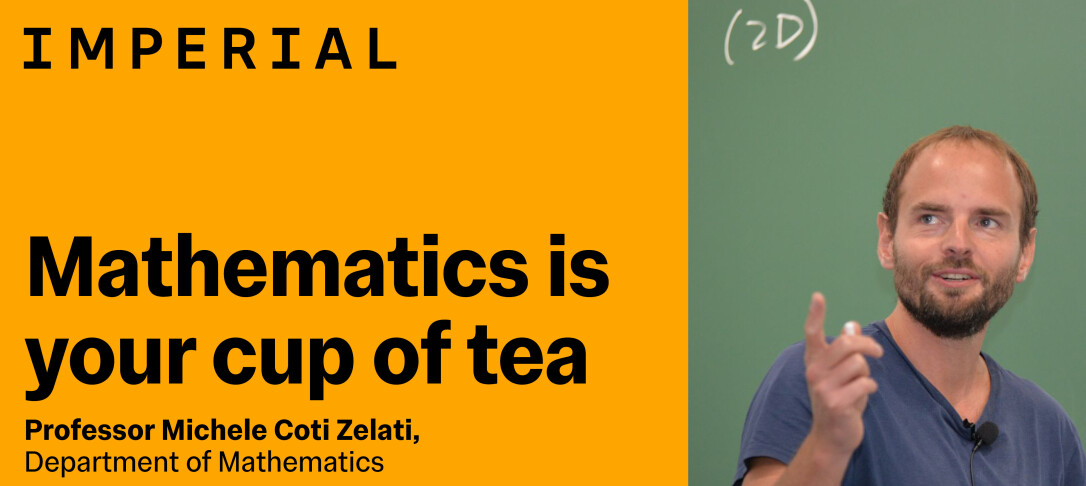
From stirring a cup of tea to the vast dynamics of the atmosphere, Professor Michele Coti Zelati, Royal Society University Research Fellow and Professor of Mathematics, explores how mathematics provides a unifying lens to see the hidden coherence of the natural world.
Please register to attend in person. A live stream link for online attendance is available on this page.
We look forward to seeing you on Wednesday 18 March!
Imperial Inaugurals are term-time lectures that celebrate our newest Professors, recognising their academic journey and showcasing their research.
Abstract
What do hurricanes, plasmas, and cups of tea have in common? At first sight, very little — yet all are shaped by the same fundamental process: mixing. When a cup of tea is stirred, a vortex rapidly forms and milk threads into delicate filaments before blending into a uniform shade. The same mechanisms underlie the birth of atmospheric vortices, the onset of turbulence in fluids, and the dissipation of electric fields in plasmas.
This lecture will explore how mathematics helps unravel the complexity of such phenomena. Through the language of partial differential equations, dynamical systems, and probability, it becomes possible to understand how order and disorder coexist in fluid motion — how stability emerges from chaos, and how turbulence can be both unpredictable and structured. From the simple act of stirring tea to the vast dynamics of the atmosphere, mathematics provides a unifying lens through which to perceive the hidden coherence of the natural world.
Biography
Michele Coti Zelati is a mathematician specialising in analysis, probability, and dynamical systems. Born in a small town on Lake Como, he earned his PhD from Indiana University in 2014 before moving to the University of Maryland as a Brin Postdoctoral Fellow. Since 2017, he has been at Imperial College London. His research focuses on fluid mechanics and kinetic theory, particularly hydrodynamic stability, mixing, and turbulence. He was awarded a Royal Society University Research Fellowship in 2019 and an ERC Starting Grant in 2022 for his contributions to the field.