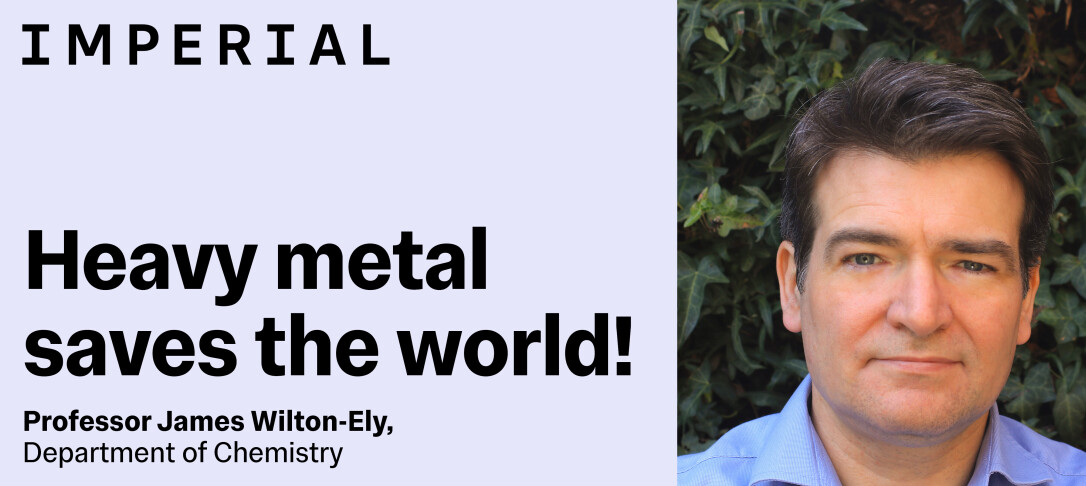
Discover how heavy metals are helping detect diseases, power sustainable chemistry and create innovative materials with Professor James Wilton-Ely, Professor of Inorganic Chemistry.
Please register to attend in person. A live stream link for online attendance will be made available on this page.
We look forward to seeing you on Wednesday 20 May!
Imperial Inaugurals are term-time lectures that celebrate our newest Professors, recognising their academic journey and showcasing their research
Abstract
Heavy metals have had a bad press over the years but the heavier metallic elements are vital in so many applications of chemistry, from catalysis to chemotherapy. This lecture will explore the research contributions we have made using heavy metals that address many of the key challenges we all face. For example, the early diagnosis and treatment (with light!) of disease can be achieved using nanomaterials of gold, while targeted multimetallic gadolinium compounds can reveal the early stages of heart disease. Colour changing molecules containing ruthenium can alert us to chronic carbon monoxide poisoning but can also illuminate the protective presence of carbon monoxide in our bodies. Palladium and gold can be recovered from waste in ‘urban mines’ and re-used as catalysts for major industrial processes, providing a sustainable and globally-accessible way to use rare metals responsibly. Underpinning these discoveries is the design and synthesis of new molecules and materials, all based on the unique and fascinating properties of heavy metals.
Biography
Professor James Wilton‑Ely is a Professor of Inorganic Chemistry at Imperial College London, where he has been a member of staff since 2009 following research leadership roles at the University of Oxford and University College London. His academic background includes a BSc and PhD from Imperial College London, along with prestigious fellowships such as the Alexander von Humboldt Fellowship. He has extensive expertise in coordination and organometallic chemistry, particularly involving metals from groups 8–11, and his contributions to the field were recognised with the Sir Geoffrey Wilkinson Award from the Royal Society of Chemistry in 2021.