The lecture is free to attend and open to all, but registration is required in advance.
This lecture is now fully booked and will be livestreamed to our YouTube channel.
Abstract
Chocolate and paint coatings are not the obvious materials of mechanical engineers. These soft, stretchy polymers are complicated as a slight change in humidity, temperature or rate of loading can completely change their mechanical behaviour. And yet, underlying that complexity is the familiar challenge of understanding how materials deform, flow and break. As a result, by adapting traditional analysis methods, mechanical engineers have the tools at hand to understand, predict and optimise behaviour in a range of materials used in a wide variety of new sectors.
In food production, such approaches are helping uncover what happens to food whilst it is processed on the manufacturing line or even inside the body. This could aid the design of healthier food options, such as reduced-sugar chocolate that still gives the sensory pleasure of your favourite indulgent treat. In the arts world, the characterisation of fracture and deformation in paint layers can explain how cracks form in artwork painted on wood panels and canvases, to aid conservation.
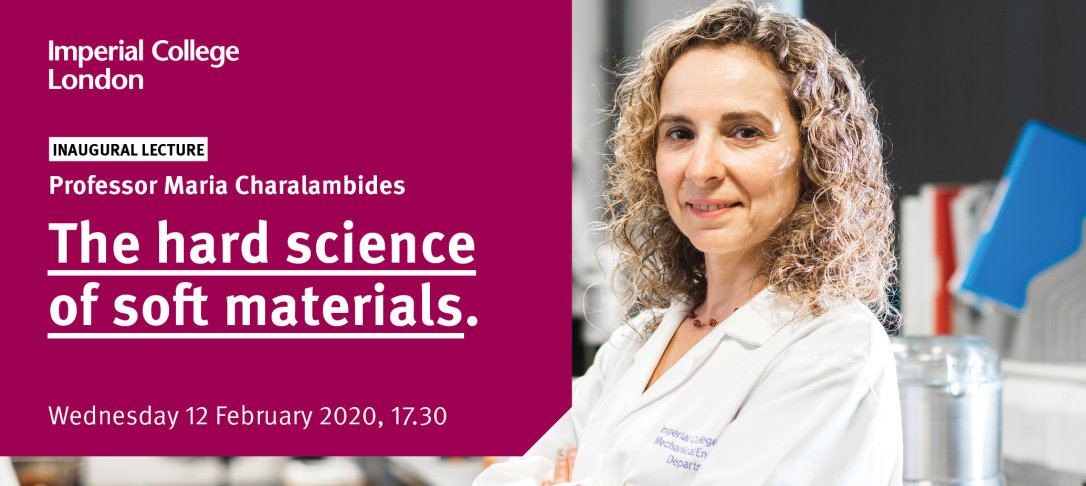
Maria Charalambides is a Professor in Mechanics of Materials at Imperial College London, who analyses the effect of microstructure on the mechanical behaviour of complex soft solids. In her inaugural lecture, she will discuss her varied research career and how it has recently moved into tackling the plastic pollution crisis affecting our land and sea. She will aim to show that mechanical engineering is much more than cars and aeroplanes, and there are many ways to apply fundamental engineering principles to these new materials and applications.
Biography
Professor Charalambides, CEng, FIMechE, is the head of the Soft Solids Research group. She is currently the Head of the Mechanics of Materials Research Division of the Mechanical Engineering Department. Prior to her appointment at Imperial as a Lecturer in 1997, she was a Research Associate in the same Department and a Senior Scientist at the National Physical Laboratory in Teddington, Middlesex.
Her published research includes material modelling and mechanical characterisation of soft polymeric solids and specifically foods, micromechanics models of particulate filled polymeric composites as well as cellular structures, experimental and numerical modelling of industrial food processes such as rolling, extrusion and cutting, development of inverse indentation methods for material characterisation of polymers, and fracture and deformation in paint and adhesive coatings. She is currently teaching Mechanics and Advanced Stress Analysis courses; she has lectured Mathematics and Composites Materials courses in the past.
Maria has published over 100 papers and has received funding from industry and RCUK. Her papers were selected as finalist for the 2013 Cahn Prize and Best paper for the IMechE Food Engineer Awards (2007 & 2011). She is a council member of the British Society of Rheology and a Committee member of the Food and Drink Technical Committee of IMechE. Maria has a First Class B.Eng (Hons) in Mechanical Engineering from Imperial College London. She also holds a PhD in Mechanical Engineering, from Imperial College London, on the Delamination of Fibre Reinforced Polymer Composites.