The lecture is free to attend and open to all, but registration is required in advance
A drinks reception will follow the lecture at 18:30 on the Level 2 Concourse outside the lecture theatre.
Abstract
Almost half a million children still die from malaria disease each year, one child every two minutes. Whilst there have been decades of success in slowly reducing the total burden of death and disease, and even talk of an eventual global eradication of malaria by 2040, in the last few years progress has plateaued. At this juncture, faced with a rising tide of resistance to insecticides by the mosquito that transmits the disease and resistance to front line antimalarial drugs by the Plasmodium parasite itself (the agent responsible), world health authorities are calling for science innovation, new technology and bold ideas to help win the fight against malaria.
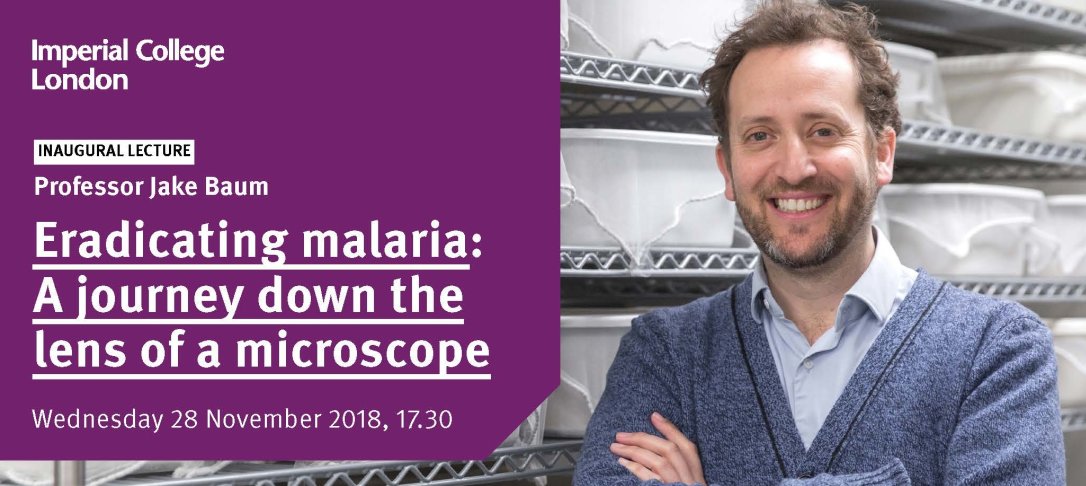
Professor Jake Baum began his career at the macro level of population genetics, sequencing human genes to find evidence of malaria parasite influence on the evolution of our genetic makeup. His path, however, changed tack dramatically when he looked down a microscope and saw the Plasmodium parasite for the first time. Fascinated by its unique cell biology, Professor Baum’s research has since been micro focussed on understanding how the parasite works on its long and winding journey between mosquito and human and how we might use this understanding to stop it.
In his inaugural lecture Jake will discuss his own journey, interfaced with that of the parasite, focussed on how the microscope has become such a central member of his team’s science. From dissecting the biology of the parasite to drug screening for antimalarials of the future and where imaging is revolutionising our understanding from whole cell right down to single atoms. Now, 10 years since becoming an independent laboratory head, he will also lay out his vision for the next decade of science, from shifting focus from red cells to the whole parasite lifecycle, working with physical scientists towards innovation and previewing work on how AI might transform our ability to identify drugs that kill parasites dead in their tracks.
Join him to discuss how these innovations fit in the wider picture of seeing a world without malaria in our lifetimes.
Biography
Following Bachelors (1993-1996) and Masters (1997-1998) degrees at Oxford University, Professor Baum received his PhD from the London School of Hygiene and Tropical Medicine in August 2002, his thesis focused on malaria parasite population genetics. In 2003, he moved to the Walter and Eliza Hall Institute in Melbourne, Australia to work on the fundamentals of malaria parasite molecular and cellular biology. During this postdoctoral tenure under the mentorship of Professor Alan Cowman, Jake worked on several projects relating to parasite invasion of the red blood cell, work that included the discovery of PfRH5, currently the lead-of-field developmental blood-stage malaria vaccine to which he is a named inventor. Following a visiting fellowship at Yale University in the pioneering lab of Thomas Pollard, a global leader in cytoskeletal biology, Jake went on to established his own independent lab at the Hall Institute in 2010, applying super resolution and electron microscopy to the study of parasite invasion and cytoskeletal processes. In 2013, Jake was recruited back to the UK by Imperial College London as a tenured Reader in Parasite Cell Biology and simultaneously awarded an Investigator Award from the Wellcome Trust to fund his work.
In 2017, Jake was promoted to Professor of Cell Biology and Infectious Diseases in recognition of efforts at the cutting edge of malaria science, teaching and leadership at Imperial. Professor Baum’s laboratory has a diverse research portfolio including major programmes in drug discovery, funded by the Medicines for Malaria Venture and Bill and Melinda Gates Foundation, programmes at the interface between biophysics (fundamental science), engineering (digital diagnostics for malaria) and cell biology, funded through the Human Frontier Science Program, Wellcome and the EPSRC and major links with industry (GSK) and field work (MRC-Newton funded collaborative work with Mahidol University) on anti-malarial drug resistance. In addition to running his interdisciplinary lab and coordinating cell biology courses for undergraduates, Professor Baum is also the current co-Director of the Imperial College Network of Excellence in Malaria Research, which he helped found in 2017 representing more than 100 researchers. Professor Baum has published >60 papers and is a recognised leader internationally in cellular parasitology, antimalarial drug discovery and inter-disciplinary cell biology.