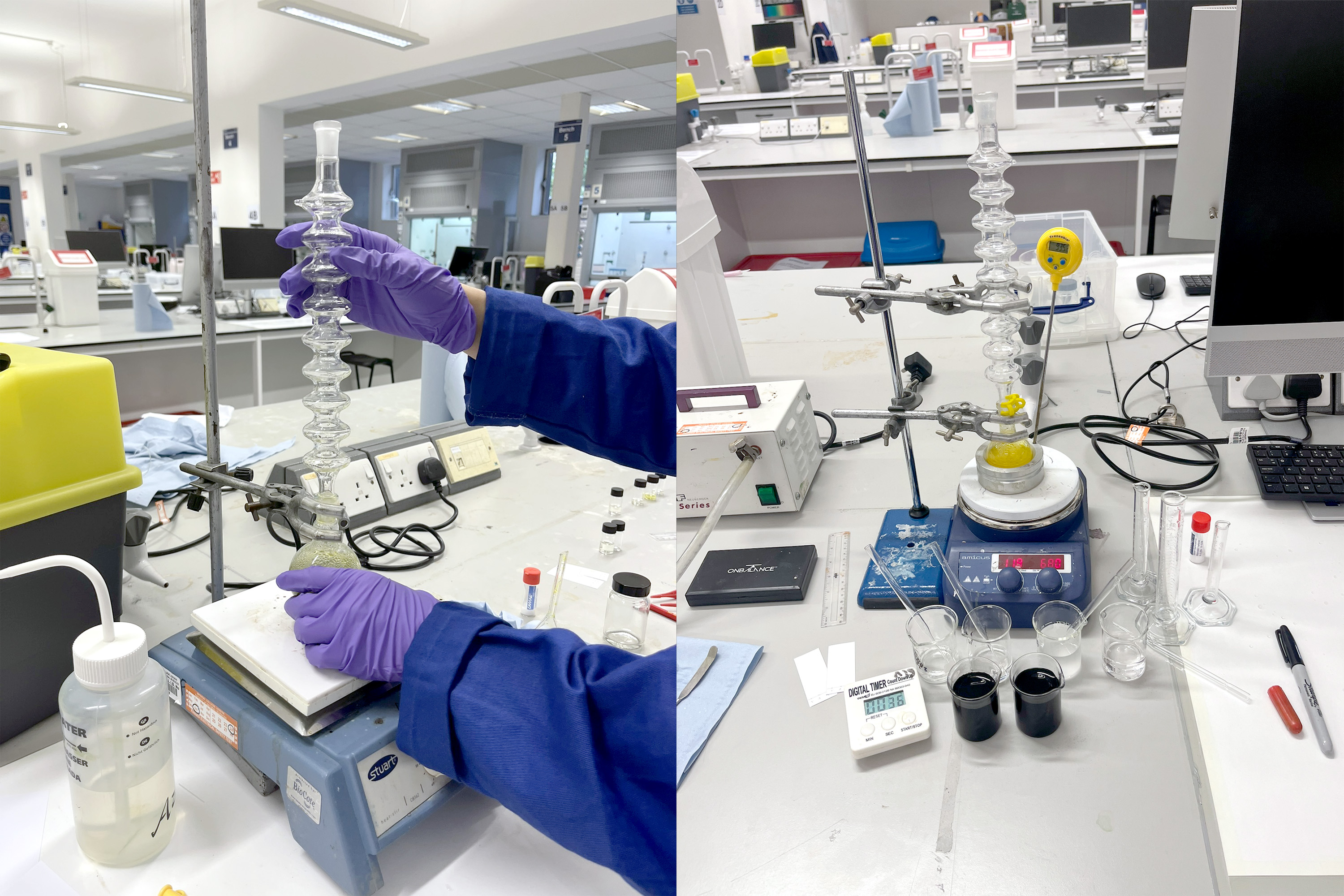
Switching from traditional water-cooled condensers to air-cooled ones dramatically reduced water waste in the undergraduate chemistry teaching labs.
Practical chemistry can be a surprisingly water-intensive activity, particularly in undergraduate teaching laboratories. In our synthetic sessions alone, daily water use – driven largely by water-based experiment set-ups and glassware cleaning – can easily reach hundreds of litres.
With a longstanding commitment to sustainability – demonstrated by all four of our teaching labs achieving Laboratory Efficiency Assessment Framework (LEAF) certification, including two at Gold level – the Teaching Technician team were determined to tackle this challenge. As a result, they introduced several water saving measures, including the installation of recirculating coolers for rotary evaporators and replacement of water-based vacuum suction with electric pumps.
However, these measures were not enough. In-house monitoring revealed that continuously running water-cooled reflux condensers accounted for another significant water draw – approximately 80,000 litres per year. Beyond the obvious environmental impact, a further issue with this type of set-up is that it also carries a flooding risk if joints are left unsecured – a not-uncommon occurrence during large practical sessions.
Air condensers had long been considered as a solution to these problems, but their significantly higher cost – typically four to five times that of a traditional water condenser – had made a full-class replacement impractical. However, the opening of Imperial’s Sustainable Lab Kit Fund, which provides targeted grants to support practical sustainability improvements in teaching laboratories, offered the perfect opportunity to implement this relatively simple technology change for substantial sustainability gains.
Through this scheme, the Technical Team secured funding for ninety air condensers, enabling their immediate introduction across first-year summer synthesis labs and outreach activities, with no compromise to experimental outcomes or student learning. This demonstrates how straightforward equipment upgrades can deliver meaningful environmental and operational benefits.
Beyond direct water savings, this initiative aligns with broader institutional sustainability goals. Reducing water consumption lessens our environmental footprint while supporting the university’s commitment to responsible resource use and operational resilience.
By turning off the tap – quite literally - we have not only saved 80,000 litres of water each year but also created a safer, more sustainable environment for students to learn the fundamentals of practical chemistry.
Case study written with the help of Ms Kat Harris – Teaching Lab Manager