Student Partnership for Sustainability Education
Student Partnership for Sustainability Education
Contact: Dr Laura Patel, laura.patel@imperial.ac.uk
Overview
Over the summer of 2025, six chemistry undergraduates - one 1st year, two 2nd years, one 3rd year and two 4/5th years - carried out 4- to 7-week StudentShapers summer projects ‘Enhancing and extending teaching of sustainability in chemistry’. The projects aimed to review the current chemistry curriculum to identify both where sustainability teaching can be introduced / enhanced, and where teaching can be more sustainable. The student partners researched and produced sustainability content, and developed teaching and learning activities, discussing proposals with staff partners and the wider body of module teachers.
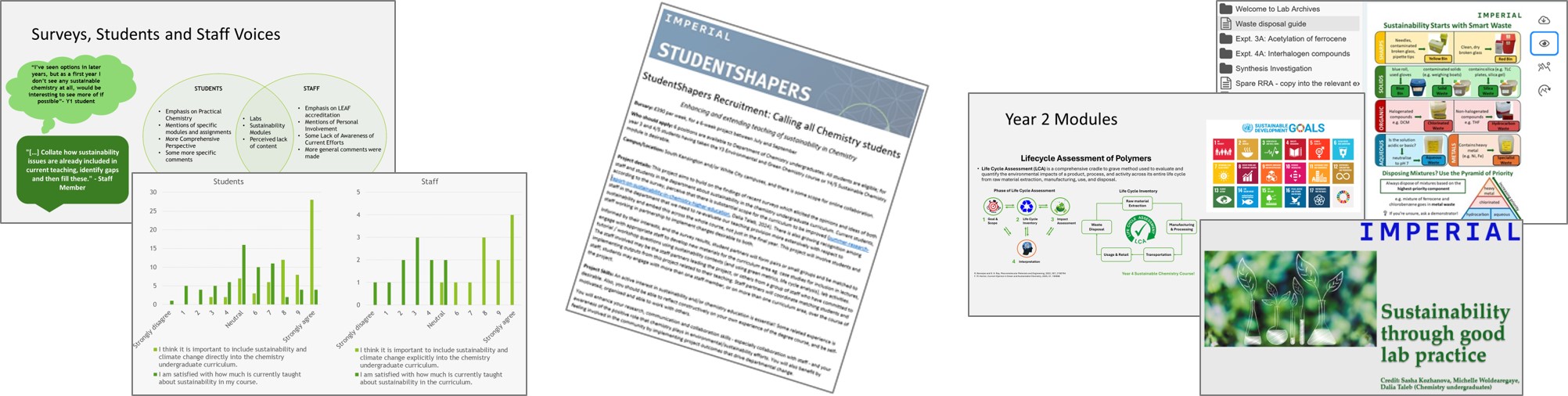
The 2025 project built on a previous staff-student partnership, a 2024 Laidlaw project which researched the opinions and ideas of both staff and students in the department about sustainability in the chemistry undergraduate curriculum. The results from these surveys fed into 2025 projects, and more broadly staff-student partnership was established as an invaluable approach to retain going into the next phase. The 2024 student partner was involved planning and recruitment for the 2025 project.
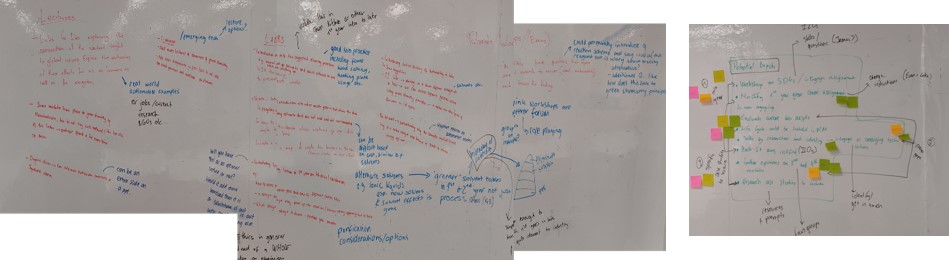
Initial brainstorming at the start of the summer indicated 1st and 2nd year labs modules as the initial focus, then focus expanded organically to lecture modules and other areas as the projects progressed. Students worked in sub-groups of 2-3 and/or on individual interests, and student and staff partners met weekly altogether, with additional ad hoc sub-group meetings as needed.
Sustainability Education Outputs
The project produced a wide array of concrete outputs:
Labs modules
- Intro lecture and workshop: Sustainability through good lab practice*
- Modifications to lab assignments and quizzes
- Year 1: Chemical Kitchen*, Synthesis 1.2*, Synthesis 1.3*, Hack it!*, Intro to Programming*
- Year 2: Synthesis 3S, Synthesis 4A, Synthesis 2S, Synthesis Investigation*
Lectures modules
- Intro lecture and workshop: Sustainable Chemistry*
- Content to be added / linked to specific lectures identified, and slides produced
- Workshop and “Check your knowledge” questions produced*
- Case studies developed
- Year 1: Language of Chemistry*, Intro to Spectroscopy*, Structure and Bonding*, Reactivity at Carbon Centres*, Reaction Toolkit, i-Engage*
- Year 2: Macromolecules and Materials*, Control and Selectivity in Molecular Synthesis, Chemistry of Molecular Systems*
Resources
- Sustainability Assessment form
- Green chemistry metrics practice workbook
- Posters: Lab Waste Disposal*, Acetone Use
- Curated sustainability-focussed SMEs list*
Gathering feedback
- Year 4 Sustainable Chemistry module student survey
- Year 3 Green and Environmental Chemistry course student survey
Proposals for additions or changes were formulated and shared with specific lecturers or lab coordinators. Many have been implemented for this academic year 2025-26 (* above), others are planned to roll in as changes to earlier years’ teaching are embedded.
Staff-Student Partnership approach
Aspects which worked particularly well included self-motivated and independent students being able to work concurrently both with others in sub-groups and on individual projects. Psychological safety was established with different partners’ perspectives always welcomed, and regular meetings to keep communication flowing. Some challenges with initial prioritisation and direction-setting were anticipated, given the open nature of the project without pre-defined outputs specified. Also with growing a pre-existing partnership, where not everyone in 2025 was ‘new to’ the project. However clearly defining the 2025 projects as a new phase, and dedicating the first days to team-building and brainstorming, proved effective.
The partnership defined the direction and outputs of the project, enabling project directions not possible without collaboration and multiple perspectives, including useful staff perspective and experience on ‘what works’ for teaching. The change proposals being student-led had a mitigating effect on the concerns of staff about lack of student interest in new content, and about limited staff time to make changes.
Impact
This project is a major advance towards embedding sustainability and green chemistry as an integrated theme within the undergraduate curriulum in the department. As such, it benefits all students in chemistry by offering more opportunity for students to gain knowledge and skills in a growth area for chemistry and science, and in which many have academic and career interests. The student partners additionally reported achieving all or most of their own personal desired outcomes from the project, while a wider body of staff are convinced of the value of staff-student partnership for curriculum development.
“It is inspiring to see students just as invested in embedding sustainability into our curriculum as we are. Their proactive approach – initiating conversations, developing resources, and presenting their progress – has set a strong precedent for what can be achieved through collaboration. I am genuinely excited to build on the excellent foundation they have established.”
- Dr. Rebecca Jones, Sustainability Theme Lead, Centre for Chemistry Education
The project was presented at the 2025 StudentShapers Symposium. Although very much focussed on the undergraduate curriculum in the Chemisty department, some topic-specific resources produced could be used by postgraduate courses or related disciplines eg. biochemistry, chemical engineering, materials. The introductory green chemistry workshop and Sustainability through Good Lab Practice lecture/workshop could be delivered to broader audiences with some chemistry background and/or who undertake labs involving hazardous chemicals.
Links:
StudentShapers programme
https://www.imperial.ac.uk/students/studentshapers/
Laidlaw Scholars Leadership & Research Programme
https://www.imperial.ac.uk/laidlaw/ , https://laidlawfoundation.com/the-laidlaw-scholars-leadership-research-programme/about-the-programme/
summer-research-report-on-sustainability-in-chemistry-higher-education