The Project
The ERIES-TRUST Project, funded by the European Commission's initiative ERIES, aims to deliver the first large-scale experimental validation of a pioneering damage-avoidance building concept. By combining self-centring rocking action with supplemental inertia, the project seeks to achieve versatile, simultaneous control of displacements and accelerations during earthquakes — paving the way for a new generation of truly resilient, damage-avoiding timber structures.
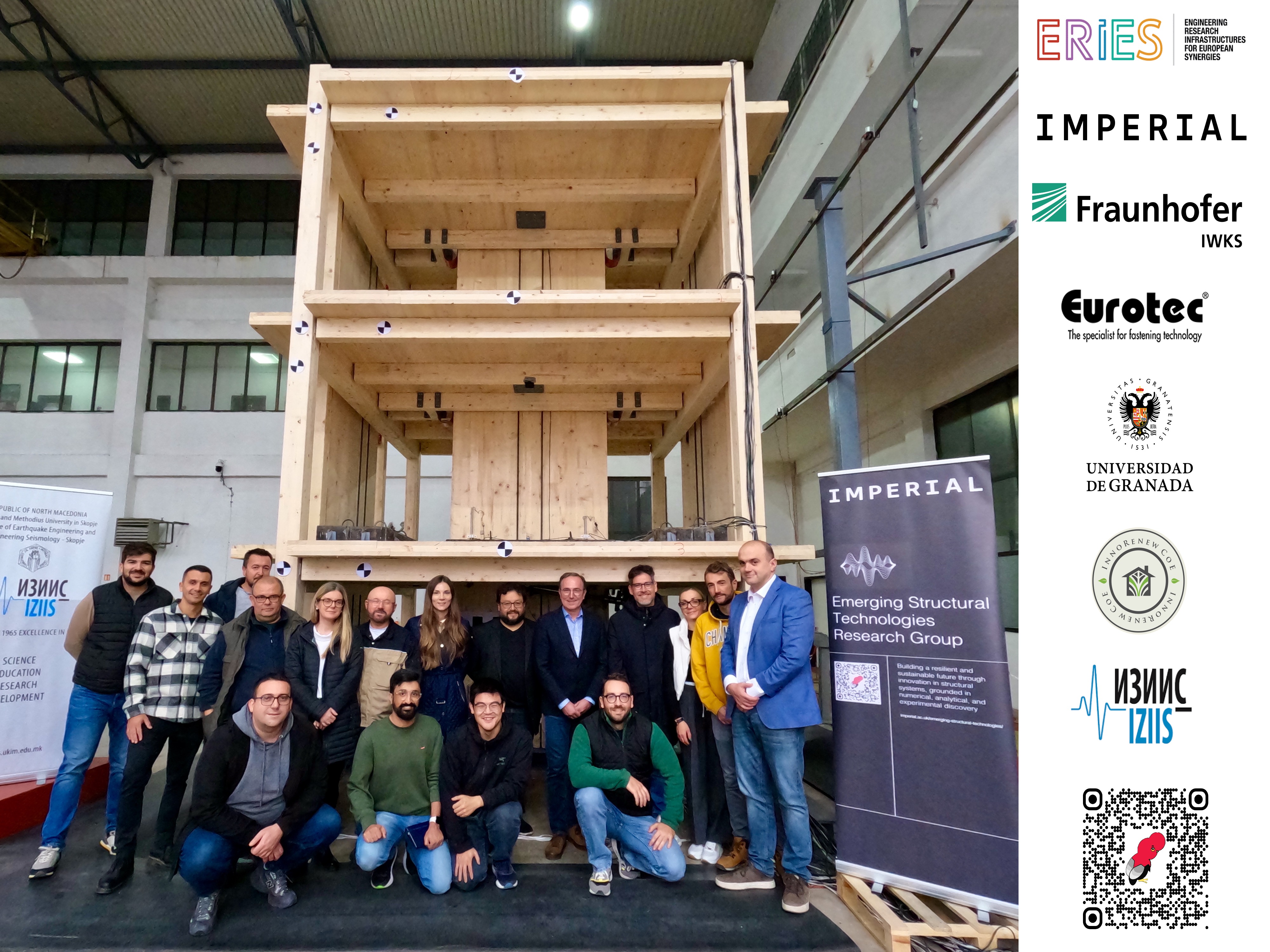
To realise this goal, our Group at Imperial College London is leading an international consortium that includes Prof Bohumil Kasal and Dr Juan Li from the Fraunhofer Institute (Germany), Dr Cagatay Demirci from Eurotec (Germany), Prof David Escolano from the Universidad de Granada (Spain), Prof Andreja Kutnar from InnoRenew (Slovenia), and Dr Hao Wang from Shijiazhuang Tiedao (China) in collaboration with the team at IZIIS (North Macedonia), where the large-scale shake table testing is conducted.
Project Progress

Dec'25: Extensive testing campaign concluded
The extensive experimental campaign on three different configurations of a large-scale, three-storey timber building specimen has been successfully completed, achieving several firsts in advancing knowledge in earthquake engineering. The video on the left presents the last tests conducted under MCE (Maximum Credible Earthquake).
Nov'25: Shaking table testing starts
Large-scale shaking table testing is underway at the IZIIS facilities in Skopje, North Macedonia. Two structural configurations have already been successfully tested under progressively increasing earthquake intensities and performed as intended. The specimen has now been rotated and is ready for the final testing phase. The video on the right offers a sneak peek into the experiments.
Oct'25: Assembly of 3-storey specimen begins
The large-scale 3-storey building specimen is constructed at the IZIIS facilities in Skopje, North Macedonia. This involves the delivery, assembly, pre-stressing and instrumentation of steel and timber components. The carousel shows images of the process.
Sep'25: Inerter testing begins
Dynamic testing of the new clutched inerter devices starts at Imperial's Structures Lab. These tests characterise the device response under different frequencies and acceleration demands providing data on their inertance and energy dissipation capacity.
/filters:format(webp)/prod01/channel_3/media/images/people-list/Image-(2).jpeg)
This project involves the design and testing of a full-scale three-story timber structure equipped with CLT rocking walls and inerter-based devices. It was my first time leading the full structural design and detailing process, which was both challenging and rewarding. This experience not only deepened my technical understanding but also gave me a real appreciation of the physical side of structural earthquake engineering. Yixuan Zhang PhD Student - Emerging Structural Technologies Research Group
Project Background and Deliverables
The concept of combining rocking structures with inerters was first introduced and developed in a series of papers by Thiers-Moggia and Málaga-Chuquitaype in the 2010s and early 2020s, including:
- Thiers‐Moggia, R, Málaga‐Chuquitaype, C. "Seismic protection of rocking structures with inerters." Earthquake Engineering & Structural Dynamics 48.5 (2019): 528-547.
- Thiers-Moggia, R, Málaga-Chuquitaype, C. "Effect of base-level inerters on the higher mode response of uplifting structures." Journal of Engineering Mechanics 147.8 (2021): 04021041.
- Thiers-Moggia, R, and Málaga-Chuquitaype, C. "Performance-based seismic design and assessment of rocking timber buildings equipped with inerters." Engineering Structures 248 (2021): 113164.
Initial small-scale experiments on structures equipped with clutched inerters and their corresponding nonlinear models were presented in:
The challenges of modelling inerto-rocking system, particularly related to impact and clutch nonlinearities, were later explored in:
To address these modelling complexities, a new mixed Lagrangian framework was proposed:
- Zhang, Y, Málaga‐Chuquitaype, C, Lavan, O. "Mixed Lagrangian formulation for modeling structures with clutched inerter devices." Earthquake Engineering & Structural Dynamics 53.14 (2024): 4203-4222.
- Zhang, Y, Lavan, O, Málaga-Chuquitaype, C. "Efficient optimisation of clutched inerter dampers using mixed Lagrangian formalism." Computers & Structures 322 (2026):108121
This powerful modelling tool has been used to inform the design of the 3-storey timber building being tested as part of the ERIES-TRUST Project, representing the first large-scale experimental validation of the inerto-rocking concept.
... watch this space for further updates!
Contact us
Dr Christian Málaga-Chuquitaype
Department of Civil & Environmental Engineering
Email: c.malaga@imperial.ac.uk
Tel: +44 (0)207 594 5007
Find us here