
The Japan Proton Accelerator Research Complex (J-PARC)
The T2K Experiment
The Tokai-to-Kamiokande (T2K) experiment is a world-leading long-baseline neutrino oscillation experiment. The experiment consists of three main components: the neutrino beam, a suite of near detectors, and the far detector, Super-Kamiokande (SK). The beam and near detectors are situated in Tokai, on the east coast of Japan, with SK located 295 km away in the mountains of Kamioka.
Neutrinos are fundamental particles that come in three "flavours": electron, muon and tau. Neutrinos are neutral particles that only feel the weak force and so the chance of a neutrino interacting with matter is exceptionally small—you would need 10,000,000,000,000 km of lead to catch one. Yet, they are exceedingly abundant: you have about 50,000,000,000 passing through an area the size of your thumb every second, coming predominantly from the sun but also exotic places like supernova and distant galaxies. When neutrinos interact with matter, they produce the charged particle corresponding to the neutrino's flavour, so a muon neutrino interaction can produce a charged muon. These charged particles are easy to detect and allow us to identify the flavour of the neutrinos that interact in our detectors.
Given the small probability of a neutrino to interact, we need to use powerful neutrino beams and huge detectors to study them. The T2K neutrino beam is made by bombarding a graphite target with 30 trillion protons every second; measured in power that is over 800 kW which will grow above 1 MW in the next few years. The huge far detector, SK, stands 40m tall (almost exactly the same as the Royal Albert Hall), and contains 50,000 tonnes of ultra-pure water. Even so, after over 10 years of operation, T2K has detected a mere 800 beam neutrinos.

T2K studies neutrino oscillations, the quantum mechanical process by which neutrinos change from one flavour to another as they travel. The discovery of neutrino oscillations proved that neutrinos had mass, something not expected in the Standard Model of particle physics, and won the Nobel prize in 2015. T2K has produced some of the most precise measurements of neutrino oscillations and is now focussing on comparing the oscillations of neutrinos to antineutrinos in the hope of observing CP violation, an asymmetry between matter and antimatter. T2K’s strongest constraints on the amount of CP violation landed it on the front cover of Nature, which the Imperial group made significant contributions to. The Imperial group has also conducted joint analyses with Super-Kamiokande’s atmospheric neutrinos, and with the competing American experiment, NOvA, exploiting synergies and complementarities between the different experiments.
The Hyper-K experiment
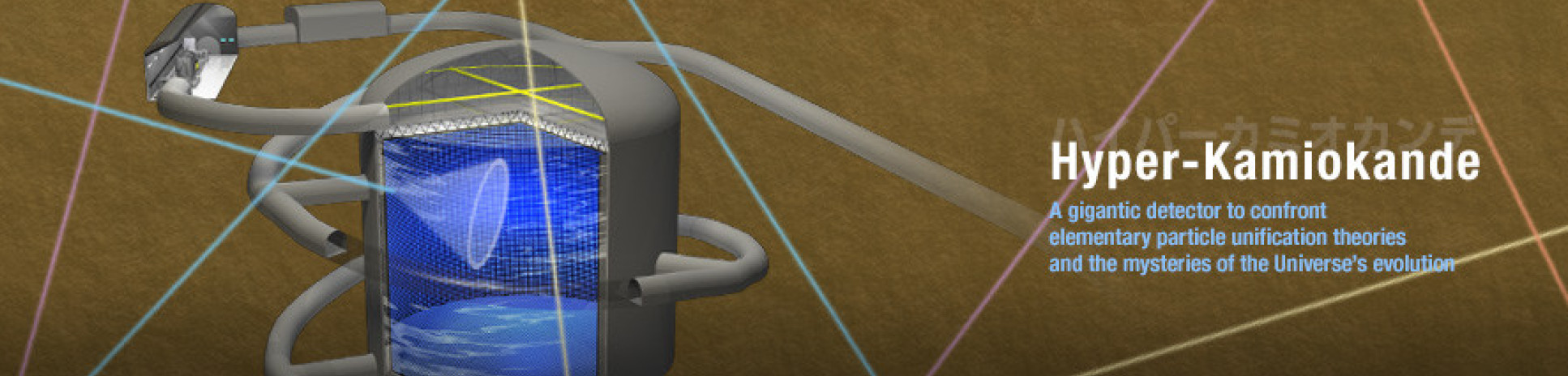
On the strength of a double Nobel prize winning experiment (Super)-Kamiokande and an extremely successful long baseline neutrino experiment, T2K, a third generation Water Cherenkov detector is being constructed in Japan. Hyper-Kamiokande will address the biggest unsolved questions in physics through a multi-decade research programme that will start in 2027.
The Hyper-Kamiokande detector will be hosted in the Tochibora mine, about 295 km away from the J-PARC proton accelerator research complex in Tokai, Japan. HK will be the largest underground water Cherenkov detector in the world with a target mass of 260,000 tons, towering at over 70m with a matching diameter. The existing accelerator used by T2K is being steadily upgraded to reach a power of 1.3 MW by the start of HK. A comprehensive set of near detectors is vital to constrain systematic uncertainties for neutrino oscillation measurements. The existing ND280 detector was upgraded in 2022 and has been taking data since, with additional upgrades planned for the mid 2030s. An additional Intermediate Water Cherenkov Detector (IWCD) placed 1 km from the beam is being constructed, and will utilise the innovative “νPRISM” off-axis technique to measure the systematics critical to making the most accurate measurements of neutrino oscillations.
The science at HK will shape the future theoretical neutrino mixing framework for the next generations of experiments. Hyper-Kamiokande will be able to measure leptonic CP violation that could explain the baryon asymmetry in the Universe, which T2K has already seen indications of but won’t be able to definitely measure. The experiment also has world-leading capabilities in searching for proton decay, providing an order of magnitude improvement in discovery sensitivity. Proton decay is characteristic of most Grand Unified Theories, and the observation of this phenomenon would be revolutionary. Additionally, atmospheric neutrinos allow HK to determine the neutrino mass ordering and, together with the beam neutrinos, will precisely test the three-flavour neutrino oscillation paradigm and search for new phenomena. The huge scale of the detector will make HK the most sensitive observatory of supernova neutrinos, alongside other astrophysical neutrino sources such as black holes and dark matter.
Imperial contribution to T2K and Hyper-K
Imperial has a central role in T2K’s oscillation analysis through leadership of the Bayesian MaCh3 oscillation analysis framework, which is unique in including both near and far detectors, with expertise in both. We have also been critical to both joint oscillation analyses with NOvA and SK. We have a strong involvement in the T2K near detector, ND280, through leadership of the ND280 calibration group, the ECal and Data Acquisition of the detector, the cross section measurement groups, and expertise in neutrino interactions and generators.
On Hyper-Kamiokande, Imperial leads the oscillation analysis group, and are centrally involved in the IWCD and its test experiment at CERN, WCTE. We are leading development of machine-learning based reconstruction through WatChMaL, designing and deploying calibration sources, and are involved with the UK calibration effort with UniConeEx. We are also designing the next generation upgrades of T2K’s near detector, ND280++.
Imperial Contribution
People involved
Contacts
Mark Scott
/prod01/channel_3/media/migration/research-groups/scott_mark--tojpeg_1579447963109_x4.jpg)
Mark Scott
Academic
Yoshi Uchida
/prod01/channel_3/media/migration/research-groups/yoshi--tojpeg_1579448093079_x4.jpg)
Yoshi Uchida
Academic
Group members: Patrick Dunne, Minoo Kabirnezhad, Ken Long, Jaroslaw Pasternak, Mark Scott, Yoshi Uchida, Clarence Wret, Lauren Anthony, Alie Craplet, Oliver Jeremy, Per Jonsson, Anežka Klustová, Ewan Miller, Charles Naseby, John Nugent, Nick Prouse, Koustubh Apte, Kieren Joseph, Jake McKean, Finn Nevill, Marvin Pfaff