Photosynthesis: how life runs on sunlight
Every leaf, blade of grass and patch of pond scum is a solar-powered factory. Plants, algae and tiny microbes called cyanobacteria capture the energy in sunlight and use it to turn water and carbon dioxide from the air into sugars. Oxygen is released as a by-product. This process is called photosynthesis.
Almost everything we depend on traces back to it. The food we eat comes from plants, or from animals that ate plants. The oxygen we breathe was made by photosynthesis. Even coal, oil and gas are the remains of ancient photosynthetic life.
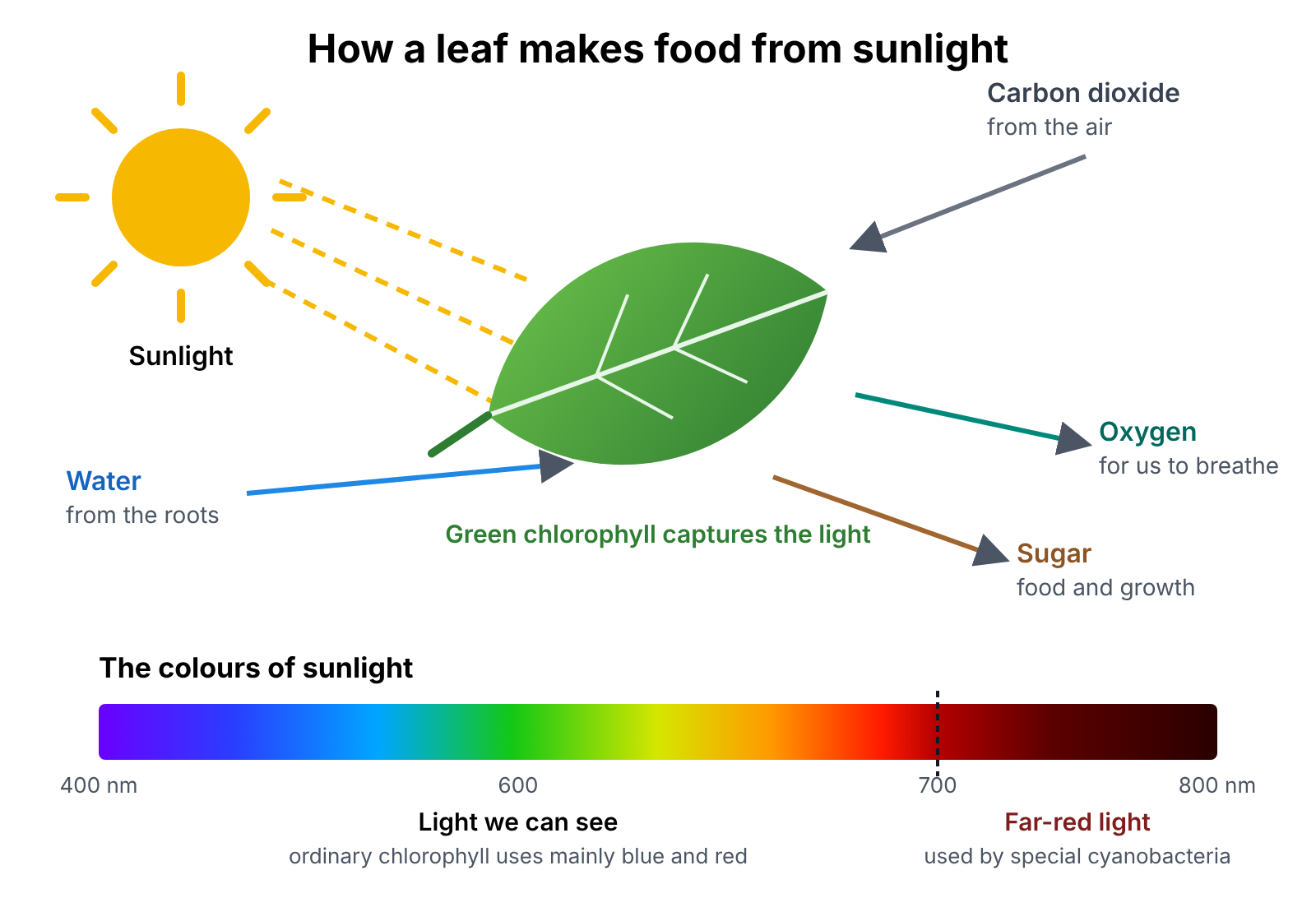
Why are plants green?
Photosynthesis relies on a green pigment called chlorophyll. Chlorophyll soaks up blue and red light and reflects green light, which is why leaves look green to us. But sunlight contains more than the colours we can see. Just beyond red lies far-red light, which ordinary chlorophyll barely uses. In shady places, such as underneath a leafy canopy, in soil or inside microbial mats, far-red light is often what is left.
Microbes that see further into the red
Cyanobacteria invented oxygen-producing photosynthesis more than two billion years ago, and the chloroplasts inside every plant cell are their distant descendants. Scientists have discovered that some cyanobacteria have found ways to run photosynthesis on far-red light, using special forms of chlorophyll. This was a surprise, because far-red light carries less energy and was long thought to be too weak to split water and make oxygen.
Our project asks how these remarkable microbes manage to do the same difficult chemistry with less energy. Understanding this could one day help crops use more of the sunlight that falls on them, and grow better as a result.
How photosynthesis works
Oxygenic photosynthesis converts light energy into chemical energy, using water as the source of electrons and releasing oxygen. Overall, it can be summarised as:
6CO2 + 6H2O + light → C6H12O6 + 6O2
In plants and algae it takes place in chloroplasts; in cyanobacteria it takes place in internal thylakoid membranes. The process has two linked stages: the light reactions, which capture energy and make ATP and NADPH, and the Calvin–Benson cycle, which uses them to fix CO2 into sugars.
Capturing light
Light is absorbed by pigment–protein antenna complexes: light-harvesting complexes in plants, and large water-soluble phycobilisomes in cyanobacteria. The absorbed energy is passed rapidly between pigments and funnelled to the reaction centres of two large membrane complexes, photosystem II (PSII) and photosystem I (PSI). There, a specialised group of chlorophylls uses the energy to drive charge separation: an electron is moved across the membrane, turning light energy into electrochemical energy within picoseconds.
The electron transport chain
The two photosystems work in series, an arrangement often drawn as the “Z-scheme”:
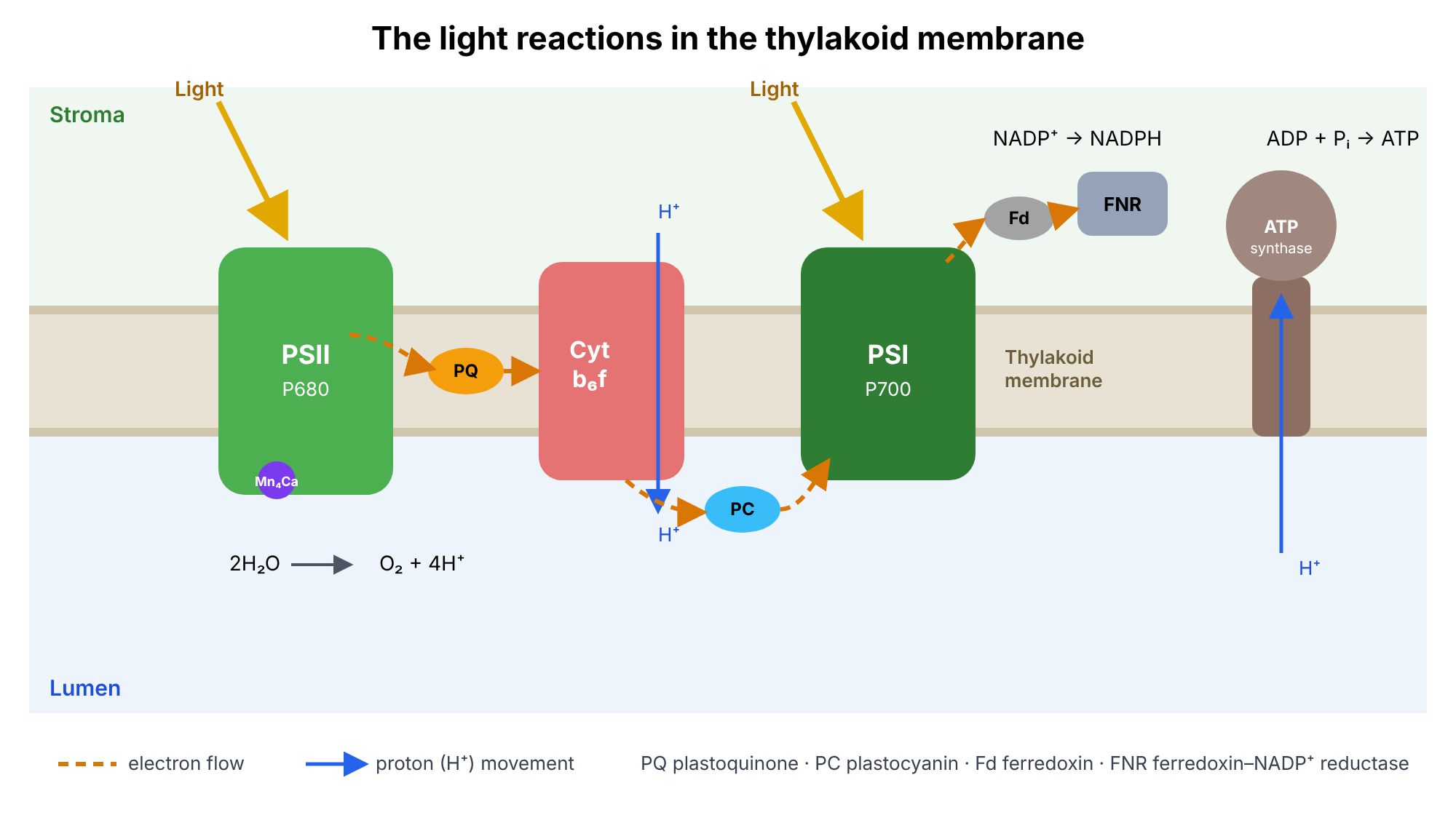
- Photosystem II (primary donor P680) uses light to extract electrons from water at its manganese–calcium cluster, the oxygen-evolving complex. This releases O2 and protons, and the electrons reduce plastoquinone.
- The cytochrome b6f complex passes electrons on to plastocyanin (or cytochrome c6) and pumps additional protons across the membrane.
- Photosystem I (primary donor P700) absorbs a second photon and raises the electrons to a potential high enough to reduce ferredoxin, which in turn reduces NADP+ to NADPH.
- The proton gradient built up across the membrane drives ATP synthase to make ATP.
Fixing carbon
In the Calvin–Benson cycle, the enzyme Rubisco attaches CO2 to a five-carbon sugar. ATP and NADPH from the light reactions are then used to reduce the products to sugar phosphates and regenerate the acceptor.
The “red limit”
Most oxygenic photosynthesis uses chlorophyll a, which absorbs strongly in the blue and red. The photosystems are driven by red photons of about 680–700 nm, which carry roughly 1.8 eV of energy. Splitting water is one of the most energetically demanding reactions in biology, so this energy was long considered the minimum needed. Light with wavelengths beyond about 700 nm was therefore thought to be unusable for oxygenic photosynthesis.
Far-red photosynthesis: breaking the red limit
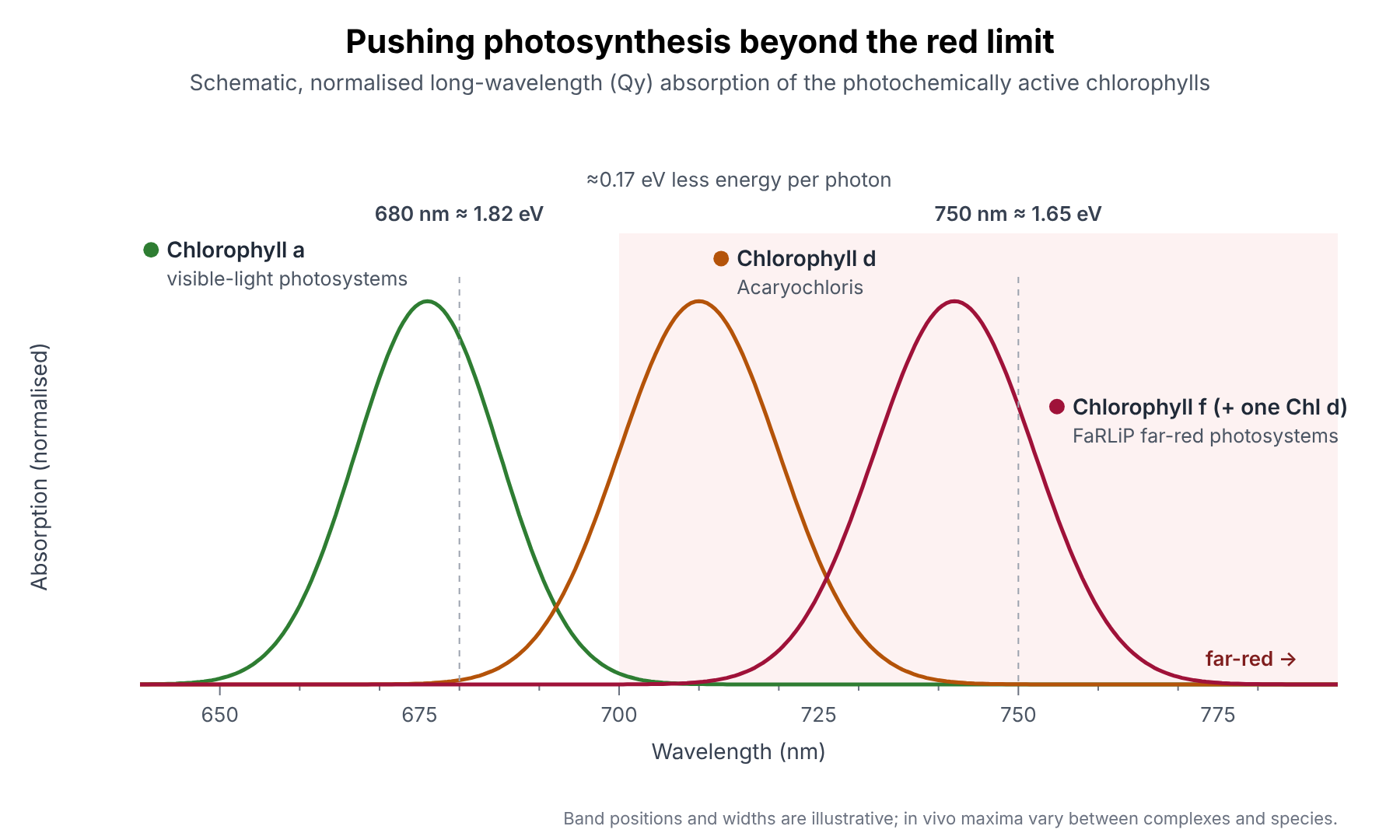
For decades, the energy of a ~680 nm photon (≈1.82 eV) was regarded as a practical lower limit for driving water oxidation by photosystem II with acceptable efficiency and stability. The discovery of cyanobacteria that perform oxygenic photosynthesis using far-red/near-infrared light (≈700–800 nm) showed that this “red limit” can be crossed. A 750 nm photon carries ≈1.65 eV, around 0.17 eV less, yet these organisms still oxidise water and reduce NADP+. Evolution has achieved this in at least two distinct ways.
Chlorophyll d: constitutive far-red photosynthesis
Cyanobacteria of the genus Acaryochloris use chlorophyll d (3-formyl chlorophyll a) as their major pigment, accounting for more than 90% of total chlorophyll. Their photosystems operate constitutively at longer wavelengths. Chl-d PSII in particular has proved difficult to isolate, and recent cryo-EM structures of Chl-d PSI revealed unexpected features. The enzyme that makes chlorophyll d has not yet been identified.
Chlorophyll f: far-red light photoacclimation (FaRLiP)
Many other cyanobacteria, including Chroococcidiopsis thermalis PCC 7203, switch to far-red photosynthesis only when visible light is scarce. A phytochrome-based sensor triggers expression of a large gene cluster, and the conventional PSI, PSII and phycobilisome subunits are replaced by far-red-specific paralogues. This involves pigment–protein disassembly and reassembly on an unprecedented scale. The resulting system has several striking properties:
- Only around 10% of the chlorophyll is replaced by chlorophyll f (2-formyl chlorophyll a), but these molecules occupy specific sites and are spectroscopically resolved.
- Far-red chlorophylls sit at the photochemical heart of both far-red photosystems and are likely to act as the primary donors. They therefore take part in charge separation itself, not just light harvesting.
- Far-red PSII contains a single chlorophyll d, likely to be the primary donor. The enzyme that makes it is unknown.
- Chlorophyll f synthase (ChlF) is a divergent paralogue of the PSII D1 protein. It assembles into a PSII-like complex that does not oxidise water but instead oxidises chlorophyll a to chlorophyll f in a light- and oxygen-dependent reaction. It is the only known case of PSII being re-purposed for a different photocatalytic activity.
Open questions and the sLoLa programme
How do far-red photosystems carry out the same demanding chemistry with less energy, and what does this cost in efficiency, back-reactions and photodamage? sLoLa addresses this through three work packages, comparing chlorophyll-f, chlorophyll-d and conventional chlorophyll-a systems:
- Molecular bioenergetics of far-red photosystems. Site-directed mutagenesis of the far-red chlorophyll binding sites, combined with ultrafast and time-resolved spectroscopy, cryo-EM and computation. Together these resolve energy transfer, trapping, charge separation and recombination.
- Chlorophyll f and chlorophyll d synthases. Determining the structure and mechanism of ChlF, and identifying the elusive chlorophyll-d synthases.
- Far-red photosynthesis as a system. The phytochrome-triggered transition between visible and far-red forms, including subunit and pigment trafficking, assembly, regulation and photoprotection.
The resulting knowledge base will underpin efforts to extend the spectral range of photosynthesis in crops and guide bio-inspired solar energy technologies.