For access to the US market, your product and manufacturer must be approved by the FDA.
N.B. You do not need FDA approval if you only intend to market your product in the UK/EU, instead you will require UKCA/CE marking.
Medical devices are separated into:
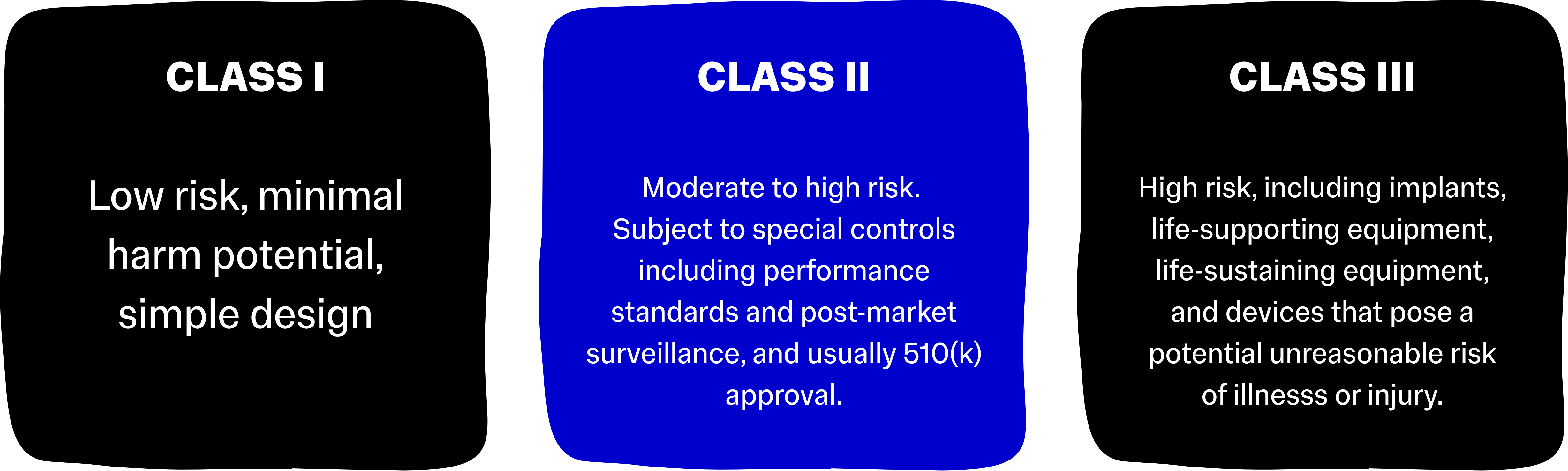
FDA Regulatory Controls include:

N.B. Most Class I and II devices are exempt from 510(k) submission. You can see a list of exempt devices here: https://www.accessdata.fda.gov/scripts/cdrh/cfdocs/cfpcd/315.cfm
Additionally, some devices may be required to go through multiple processes prior to approval.
For devices under clinical investigation, you can apply for an Investigational Device Exemption (IDE) to allow the investigational device to be used in the study to collect the safety and effectiveness data required for a Pre-market Approval application/510(k) Submission. However, clinical studies for Class III devices must be approved by the FDA and by an Institutional Review Board (IRB) prior to study commencement.
The basic regulatory requirements for manufacturers of medical devices on the US market must comply with are:
- Establishment Registration – This applies to both domestic and foreign manufacturers, and importers, of medical devices placed on the US market. Applications are submitted digitally, and must be verified annually between 1st October and 31st December. Foreign manufacturers must also designate a US Agent to act on their behalf. This registration incurs a fee. Check the “Further Reading & Resources” section for links to more detailed information.
- Medical Device Listing – Manufacturers required to list their devices with the FDA include:
- Manufacturers
- Contract manufacturers
- Contract sterilisers
- Re-packagers and labellers
- Specification developers
- Re-processors of single-use devices
- Re-manufacturers
- Manufacturers of accessories and components sold directly to the end user
- US manufacturers of export only devices
Other items related to FDA Device Listing & Registration include:
- Premarket Notification 510(k), unless exempt, or Premarket Approval – The 510(k) approval demonstrates that the device is substantially equivalent to an existing, commercially distributed device; you cannot place your device on the market without a Letter of Substantial Equivalence. Alternatively, high risk Class III devices must have Premarket Approval.
- Investigational Device Exemption (IDE) for clinical studies – For devices under clinical investigation, you can apply for an Investigational Device Exemption (IDE) to allow the investigational device to be used in a clinical trial. Clinical studies for Class III devices must be approved by the FDA and by an Institutional Review Board (IRB) prior to study commencement.
- Quality Management System Regulation (QMSR) – The QMSR covers the regulation of the methods used in, and the facilities and controls used for the design, manufacture, packaging and labelling, storage, installation, and servicing of all medical devices intended for human use. Facilities will be required to undergo inspections to ensure compliance.
- Labelling Requirements – This covers both physical labelling on devices as well as instructions for use and accompanying information provided with the device.
- Medical Device Reporting (MDR) – The mandatory reporting system for events where a medical device has, or is suspected to have, caused or contributed to a death or serious injury. Additionally, certain malfunctions or unexpected device deficiencies need to be reported.

Resource Download / Contact Us
You can download a copy of this section here: Idea to Adoption Part 3 (PDF)
If you would like to contact us, or if there is a resource you would like to see, reach out to us using this form!