Listener Acoustic Personalisation (LAP) Challenge
A benchmarking campaign on acoustic and non-acoustic factors in immersive technologies.
Personalised Head-Related Transfer Functions (HRTFs) have shown promise in enhancing auditory localisation and immersion in mixed realities. However, relevant issues such as the accurate acquisition of user-specific anatomical data, efficient simulation algorithms, and effective user validation do not converge into a common and internationally recognised benchmark for evaluating HRTFs.
The LAP Challenge endeavours to provide a platform where researchers can explore these challenges, advance the state of the art, and contribute to the development of standardised metrics for personalised spatial audio.
The inaugural edition of the challenge will concentrate on two fundamental aspects of HRTF: spatial sampling and interpolation. Teams are challenged to submit their solutions that address one of two tasks:
- Task 1: HRTF normalisation for merging different HRTF datasets
- Task 2: spatial upsampling for obtaining a high-spatial-resolution HRTF from a very low number of directions
Results and Publications
There are two main publications related to the 1st Listener Acoustic Personalisation (LAP) Challenge:
- Listener Acoustic Personalization Challenge – LAP24: Head-Related Transfer Function Dataset Harmonization
- Listener Acoustic Personalization Challenge – LAP24: Head-Related Transfer Function Upsampling
These two publications open the LAP24 Special Topic in the IEEE Open Journal of Signal Processing, which will collect scientific contributions from participants in the LAP Challenge 2024
A draft technical report covering the full results of the challenge is also available here:
Published Approaches for Task 2: HRTF Upsampling
The following papers describe approaches submitted to or evaluated in Task 2 of the LAP Challenge:
Task 2: HRTF Upsampling – Perceptual Evaluation and HRTF Dataset
A perceptual study was conducted to evaluate the HRTFs produced by the Task 2 upsampling approaches. The complete collection of HRTFs used in the evaluation, together with the study materials and results, has been made publicly available.
Associated publication (forthcoming):
Brinkmann, F., Hoyer, A., Hogg, A., Picinali, L., Geronazzo, M., & Weinzierl, S. (2026). Listener Acoustic Personalisation Challenge LAP24: Perceptual Evaluation of the HRTF Upsampling. Forum Acusticum 2026, Graz, Austria, September 2026.
Access the perceptual study, results, and complete HRTF dataset on GitHub
Task description documents
The documents below outline the complete description for each task.
The evaluation code is also publicly available here:
Editorial aspects
Top-ranked solutions will be invited to submit a paper describing their method and result to be published in the IEEE Open Journal of Signal Processing (OJ-SP), a fully open-access publication of the IEEE Signal Processing Society, with a scope encompassing the full range of technical activities of the Society. Article processing charge (APC) waivers will be also available upon request.
Since the challenge provides original data and evaluation processes, participants also have the flexibility to submit already published solutions.
Winners
The winners of the SONICOM Listener Acoustic Personalisation (LAP) Challenge were announced at the 32nd European Signal Processing Conference (EUSIPCO 24) on 29 August in Lyon, France.
Sponsored by the IEEE Signal Processing Society, the LAP Challenge invited members of the auditory research community to tackle key challenges facing immersive audio technology, advance the state of the art, and contribute to the development of standardised metrics for personalised spatial audio.
The inaugural edition of the challenge concentrated on two fundamental aspects of head-related transfer functions (HRTFs): spatial sampling and interpolation. Teams were challenged to submit their solutions that address one of two tasks:
Task 1: HRTF normalisation for merging different HRTF datasets
In this task, teams were given a set of HRTFs measured from different individuals in different labs (i.e. different measurement setups, different equipment, different spaces, and distances, etc.) and challenged to harmonise the sets to compensate for the influences of the measurement setup.
The first prize for Task 1 was awarded to Jiale Zhao, Dingding Yao, Zelin Qiu, Chengzhong Wang, and Junfeng Li for their solution: “Normalisation of Head-Related Transfer Functions Based on Neural Networks”.
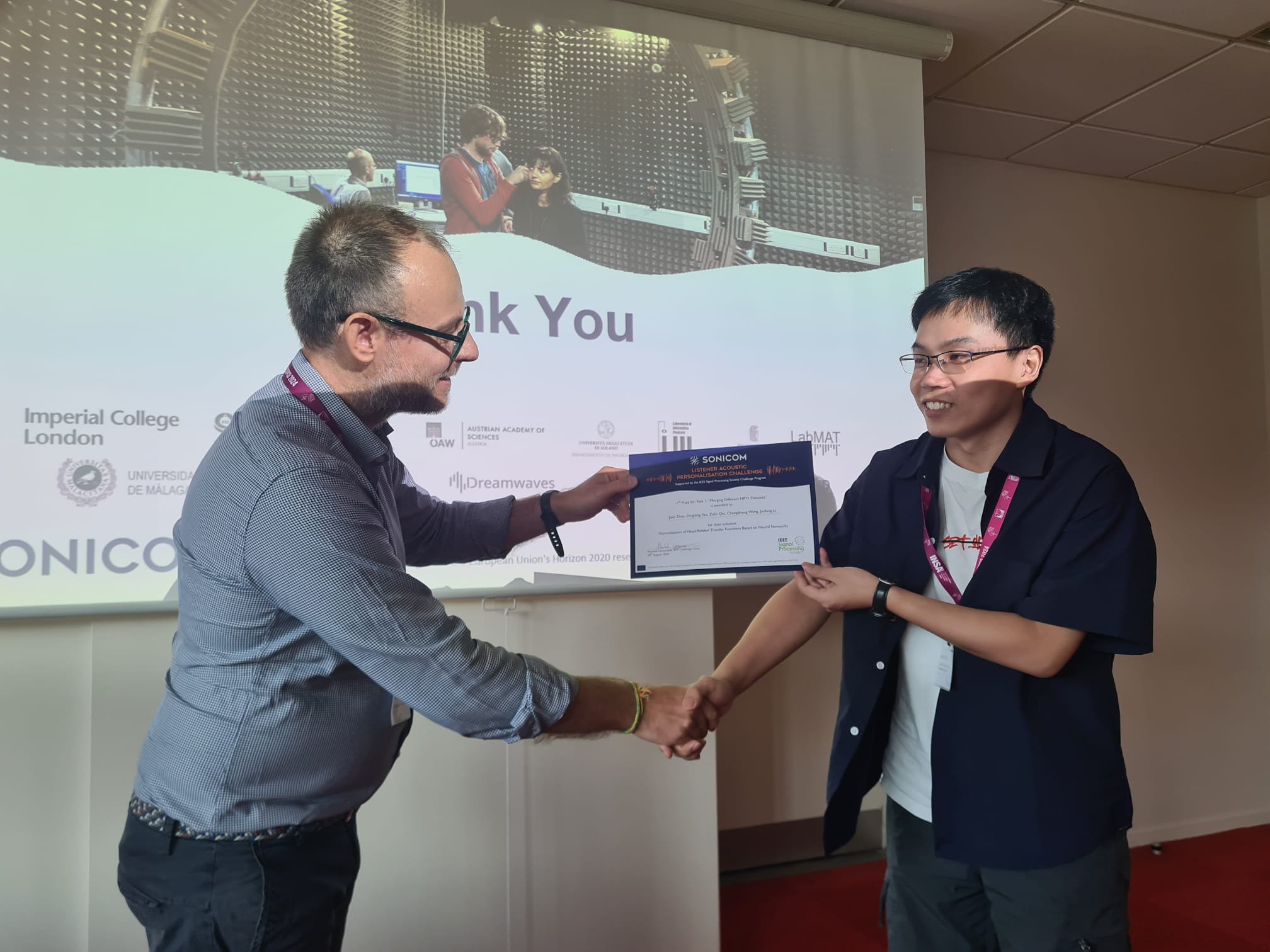
Task 2: spatial upsampling for obtaining a high-spatial-resolution HRTF from a very low number of directions
In this task, teams were given a sparse set of HRTF measurements and challenged to provide a reconstructed HRTF set in high spatial resolution.
The first prize for Task 2 was awarded to Yoshiki Masuyama, Gordon Wichern, Francois G. Germain, Christopher Ick, and Jonathan Le Roux for their solution: “Retrieval-Augmented Neural Field for HRTF Upsampling and Personalisation”.
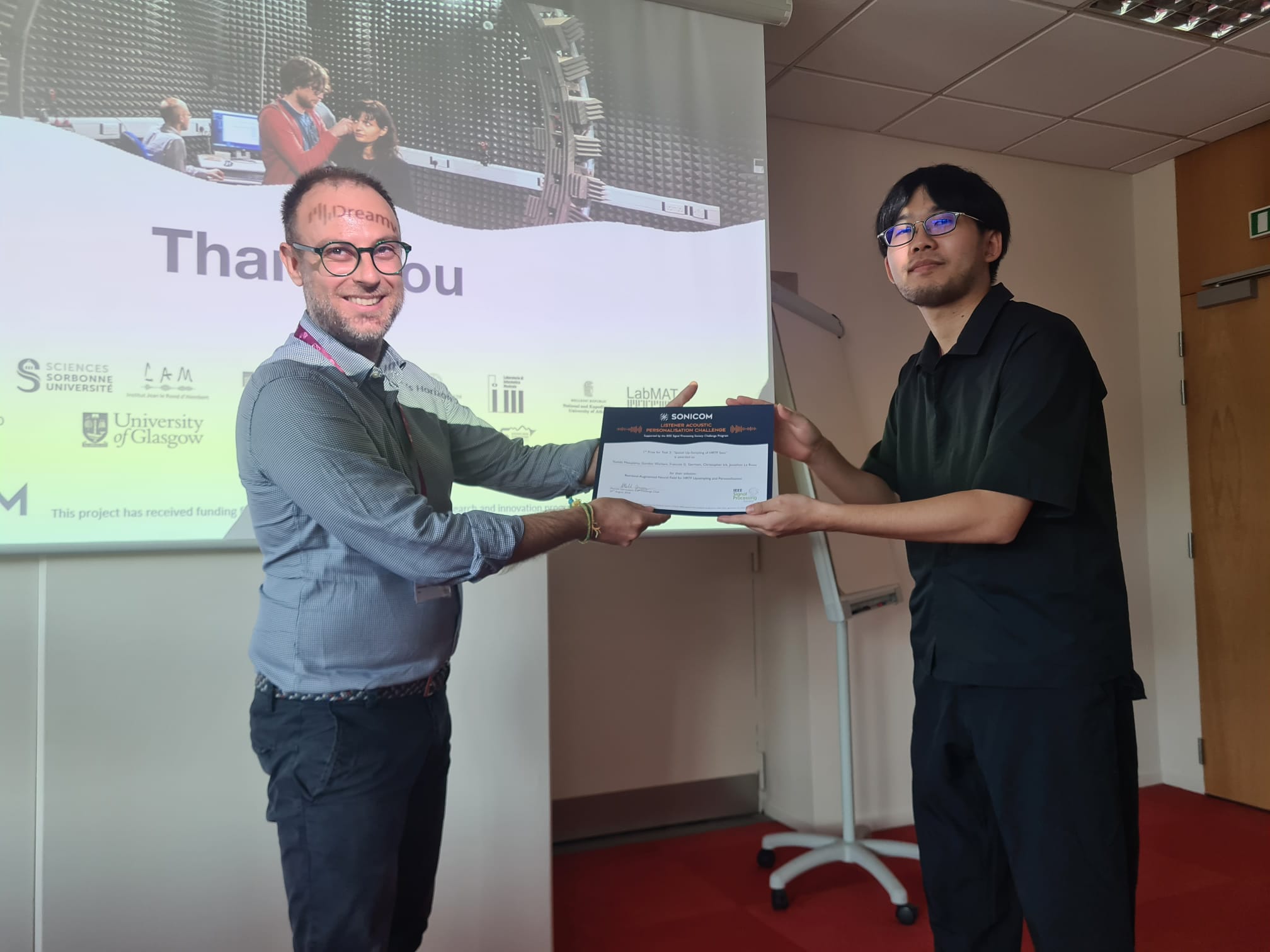
Congratulations to all the winners! A draft technical report covering the full results of the challenge is available here (a complete report and DOI will be available soon): LAP Challenge Technical Report
Organisers
Chair: Michele Geronazzo, University of Padova, IT, and Imperial College London, UK
Co-chair: Lorenzo Picinali, Imperial College London, UK
Chair of the Implementation: Roberto Barumerli, University of Verona, IT
Chair of the Website and Dissemination: Aidan Hogg, Queen Mary University of London, UK
Fabian Brinkmann, Technische Universität Berlin, DE
Glen McLachlan, University of Antwerp, BE
Stavros Ntalampiras, University of Milan, IT
Johan Pauwels, Queen Mary University of London, UK
Katarina Poole, Imperial College London, UK
Rapolas Daugintis, Imperial College London, UK
Our Sponsors