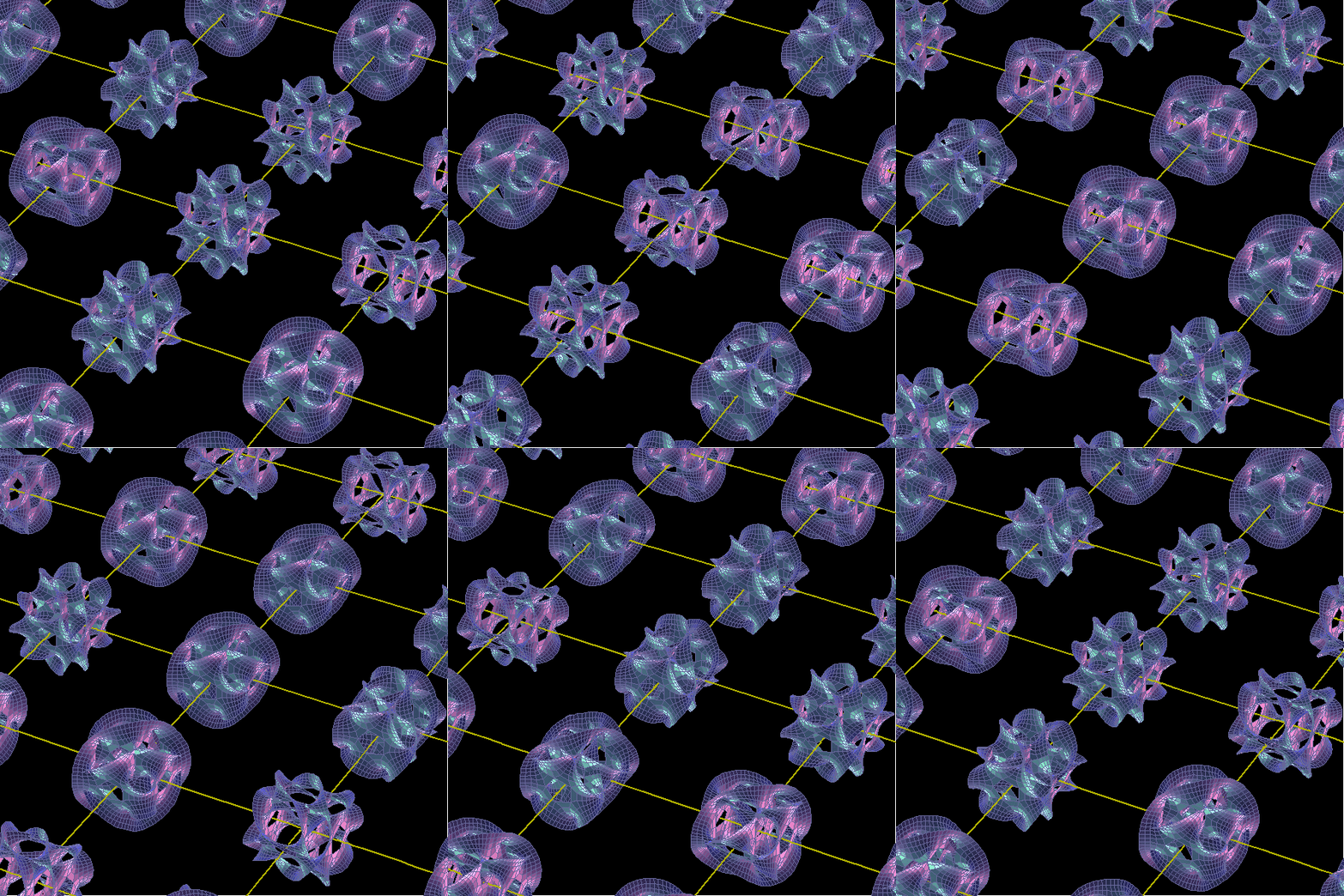
Two of the greatest theories in physics: Einstein's General Relativity and quantum mechanics, are individually spectacularly successful. But when combined together they predict that General Relativity has to be embedded into a more fundamental quantum framework. String theory, and its deeper incarnation, M-theory, offer the most developed and mathematically rich framework for doing so. The Salam Centre hosts one of the world's strongest string theory group.
Holography
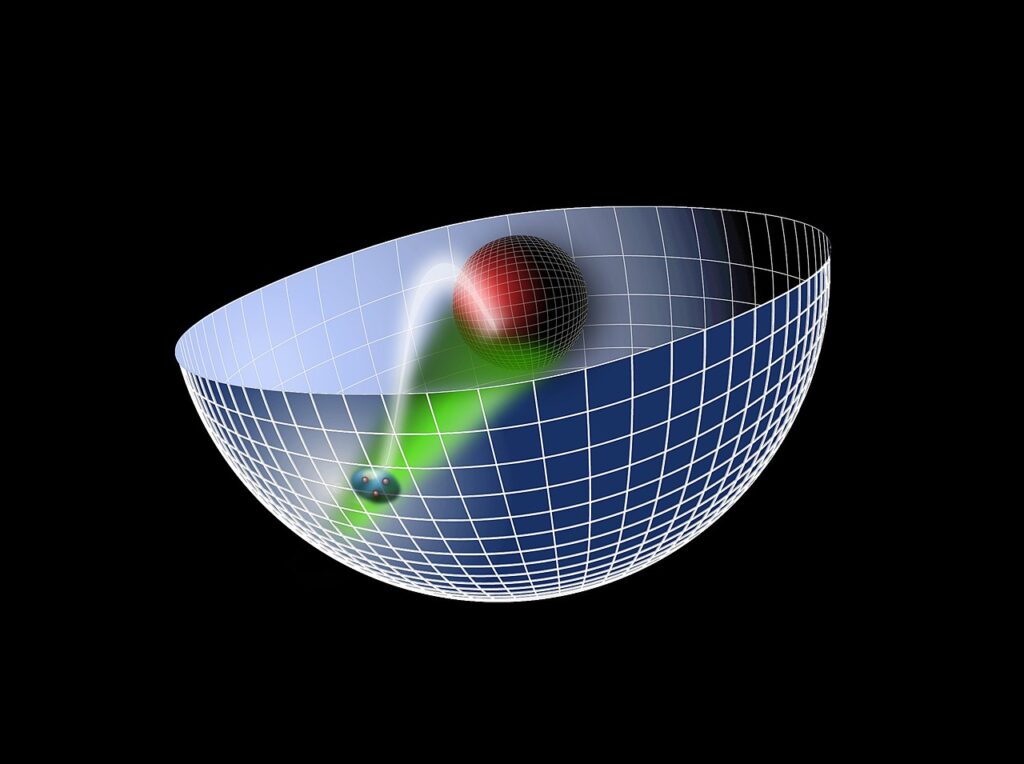
One of the most profound insights to emerge from string theory in the past three decades is the AdS/CFT correspondence, the discovery that a theory of quantum gravity in a d-dimensional Anti-de Sitter (AdS) spacetime is exactly equivalent to a conformal quantum field theory (CFT) living on its lower (d-1)-dimensional boundary. This "holographic" duality has transformed our understanding of quantum gravity, black holes, and strongly coupled quantum matter.
Members of the Centre have been at the forefront of holography for over two decades. Recent work has opened several new research directions from branes wrapping spindles to equivariant localization in supergravity and new geometric frameworks, including the Gauntlett-Kim (GK) geometry.
In parallel, research at the Centre focuses on the geometry of the duality, particularly using Generalised Geometry. Recent work has related CFT structures to Geometrical Invariant Theory and has used new cohomological tools to calculate the spectrum of deformations and more generally the moduli of flux backgrounds. The Centre is also leading the analysis of consistent truncations to lower-dimensional supergravity theories.
Novel research directions at the Centre have pioneered a wide range of novel AdS/CFT tools, including developing a new string worldsheet description of large-N theories to uncover novel holographic dualities between matrix integrals and supergravity backgrounds, thereby pushing the frontier of what one can actually compute non-perturbatively in theories of quantum gravity.
Black Hole Entropy
Another great success of string theory is the microscopic derivation of black hole entropy following Bekenstein and Hawking's insight in the 1970s that a black hole has an entropy proportional to the area of its event horizon.
An outstanding question though is what are the microscopic states that are being counted? In the holographic framework, the entropy of an AdS black hole is equal to the logarithm of the number of states in the dual CFT - but computing this precisely is a longlasting challenge.
The Centre’s leadership on equivariant localization and GK geometry gives a powerful new tool for computing the entropy algebraically without explicit knowledge of the supergravity solution. Recent work by members of the Salam Centre gave the first statistical derivation of the entropy of black holes and black strings in 6- and 7-dimensional AdS and of a very general class of spindle-geometry AdS4 accelerating and rotating black holes.
M-theory and Tracking Quantum Corrections
String theory is formulated in 10 dimensions, but its deepest incarnation: M-theory, contains an 11-dimensional limit and includes not just strings but also higher-dimensional objects called membranes. The Centre hosts some of the founding fathers of modern string theory and M-theory, who prompted the second superstring revolution. Understanding the quantum properties of these objects is central to understanding M-theory beyond the supergravity approximation.
At the Salam Centre, the expertise on supergravity and superstring theory of some researchers Centre span five decades and include the original formulation of the supermembrane, the discovery of the Weyl anomaly in curved spacetime, pioneering work on Kaluza-Klein supergravity, and early foundational contributions to M-theory and the web of dualities that unified the five string theories.
Recent breakthroughs on the generalised symmetries of gravitational theories at the Centre have enabled the discovery that the conserved charges for the dual graviton theory arise from generalised Killing tensors, giving magnetic-type charges for the graviton and an interpretation of the graviton as a Goldstone field for a generalised symmetry.
In parallel, important progress has been made in formulating a New Superstring Field Theory Action, unveiling a formalism that has diffeomorphism symmetry and is background independent and so can be applied to any spacetime.
The Centre also leads a major programme on the semi-classical quantization of membranes in curved backgrounds, using holography as a tool. A central mystery of membrane theory is why its quantum corrections appear to be well-defined despite its apparent non-renormalizability. The Centre has explored the possibility that this is due to hidden symmetries of the membrane theory, drawing an analogy with the TTbar deformation of integrable two-dimensional models.
This direction also directly relates to two-dimensional massive gravity. The Centre recently proved that this theory is equivalent to a TTbar deformation both the classical and quantum mechanically, and therefore to be exactly solvable and to enjoy a well-defined non-perturbative description.
The Landscape of Supersymmetric Theories
A central challenge in strongly coupled supersymmetric quantum field theories (SQFTs) and their related mathematical structures is understanding the moduli space (ie the space of all vacuum states of the theory). The Centre tackles this challenge in multiple ways, relating it to the mathematics of tropical geometry, cluster algebra and Hasse diagrams in a programme covering the landscape of all theories with 8 supercharges.
In parallel, the introduction of Magnetic Quivers at the Centre has solved a long-standing strong-coupling problem that arises in special 5-dimensional and 6-dimensional Higgs branches of theories. By relating the problem to a brane system, this direction provides important new non-perturbative tools.
Conformal Bootstrap
The conformal bootstrap is one of the most powerful ideas in modern theoretical physics. The Centre has recently gained world leadership in the application of bootstrap methods with applications spanning from condensed matter physics to string theory.
For example, using the bootstrap in combination with supersymmetric localization, new holographic correlators were recently computed in super-Yang-Mills theory and related to three-dimensional theories. These correlators encode the quantum corrections to string and M-theory scattering and have provided the first prediction for the correction to the M-theory S-matrix, a significant step towards a deeper understanding of M-theory beyond the supergravity approximation.
Bridging the gap with Numerical Methods
The Centre also hosts unique world-leading expertise in numerical strong gravity methods providing critical insights to problems in string theory, black hole physics and strongly coupled systems. Members of the Centre have pioneered the first techniques to find static and stationary black holes in exotic settings such as extra dimensions, found the first Ricci-flat metrics on compact Calabi-Yau manifolds, and initiated the use of lattice gauge theory to test holography. Recent work at the Centre includes geometric flows of static extremal black holes as a notion of distance in moduli space, and new machine learning approaches to approximating metrics on Calabi-Yau manifolds.
Connecting with Swampland Conjectures?
The Swampland programme makes specific conjectures on how low-energy gravitational theories should behave based on string compactification and black hole thermodynamics. These conjectures have been remarkably powerful at separating out between classes of admissible theories but proving them from first principles has remained challenging. The Salam Centre has made significant progress towards identifying when Swampland Conjectures can be proven and under which underlying fundamental assumptions.
On the one hand, the Centre has shown that loop corrections from light fields typically introduce small levels of negativity in scattering amplitudes, subtly spoiling any direct proof of the Weak Gravity Conjecture from unitarity, analyticity and causality alone. Work on near-extremal black holes further sharpens this connection, suggesting a profound link between the consistency of quantum gravity in the UV and the structure of black holes in the IR.
On the other hand, work at the Centre has shown that under very mild assumptions the Swampland Distance Conjecture necessarily holds for all locally symmetric moduli spaces. This allows one to also map out the landscape of such theories that satisfy the stronger Emergent String Conjecture.
In parallel, the members of the Centre are also connecting with novel conjectures by using AdS/CFT duality to translate swampland conjectures into statements about CFTs, and then using CFT methods to prove them.
Dual-resonance theory as precursor of String Theory
Constructing S-matrices that simultaneously satisfy unitarity, analyticity, crossing symmetry, and Regge behavior has been a central open problem since the birth of dual-resonance theory in the late 1960s, a well-known precursor of string theory. By developing novel primal bootstrap methods, members of the Salam Centre are constructing the first explicit class of fully unitary dual-resonance S-matrices using the Veneziano and Virasoro-Shapiro blocks, rigorously establishing locality and Mandelstam's maximal analyticity. Unlike string-loop amplitudes, these amplitudes provide direct control over Regge trajectories and inelasticity, closing a longstanding gap between dual-resonance models and full S-matrix consistency.
This novel framework sets the foundations for a systematic dual-resonance bootstrap programme, leading to new classes of models with potential phenomenological applications.