Project: Baggage Screening
Airports increasingly rely on 3D Xray CT scanners to identify prohibited items inside passengers' luggage. However, today’s screening still depends heavily on human attention and experience. This creates bottlenecks, inconsistent decisions, and high mental workload—factors that can lead to delays and missed threats. This project develops deep learning methods that make CT screening faster, data efficient, and adaptable to new threats.
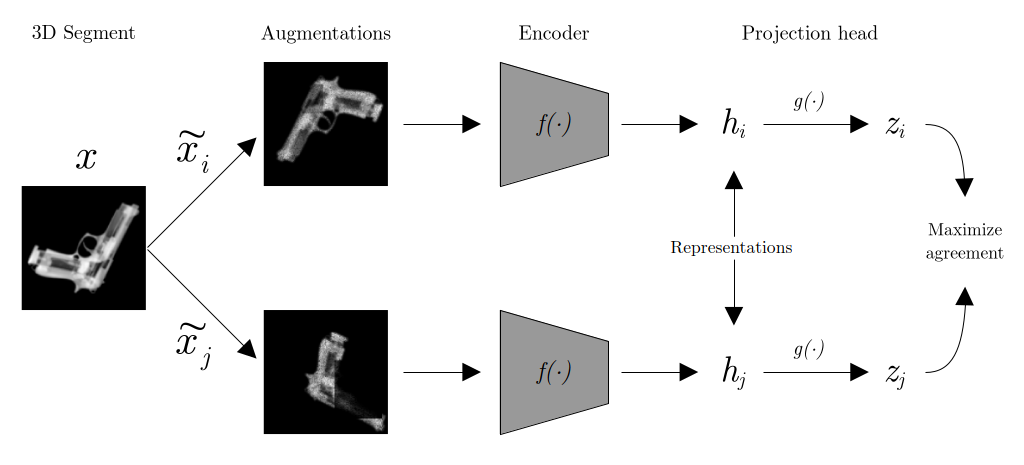
Our methods process the examined bags both as a set of different views, using a vision transformer architecture, pretrained on natural images, and as a 3D volume, using a custom 3D vision transformer architecture we designed. Key novelty of our method is a self-supervised framework we designed, which enables us to train our model on unlabelled data acquired from airports, without requiring any human inspection. As a result, our methods can achieve 99.1% true positive rate on detecting firearms, and 89.9% for knives, while maintaining a false positive rate per bag of 10.4%.
Contact us
ISIM
Centre for Transport Engineering and Modelling (CTEM)
Department of Civil and Environmental Engineering
Skempton Building,
South Kensington Campus
Imperial College London
London, SW7 2AZ, United Kingdom