Imperial is committed to facilitating the flow of ideas, talent and innovation by collaborating and working with partners to tackle grand global challenges. In pursuit of this, Imperial enters into a multiplicity of contracts and agreements (“relationships”) across many centres of activity. The Relationships Policy establishes the process for escalating decisions on proposed or continuing relationships where risks have been identified.
The Policy aims to provide the following benefits:
- The Policy empowers more decision making at a local business level, setting guidelines for decision-making and highlighting the sort of risks that might prompt escalation to a higher decision-making body.
- The Policy establishes a single escalation process that will apply to all institutional relationships.
- A single, standardised set of due diligence pro forma supports the Policy, together with an automated Due Diligence Portal that will capture decision making to reduce duplication of effort across Imperial and maximise efficiency.
- Aligning a number of existing due diligence processes, including the assessment and management of research security risks.
Consideration of the financial, legal or reputational risks associated with a relationship proposal must take place before formally entering into a new relationship or extending an existing relationship.
The Relationships Policy applies to formalised institutional relationships where Imperial intends to, or will, agree a contract with a third party. The Policy is intended to remind all staff of the need to consider the relationships they form, and to be alert to the financial, legal and reputational risks associated; highlight the key considerations through which staff should assess the proposed relationship and decide whether it is appropriate to escalate the decision; and explain how the due diligence, risk assessment and escalation processes should work.
Examples of relationships with third parties that would require approval through the Relationships Policy include:
- Academic collaborations formalised through contractual arrangements;
- Receipt of philanthropic income and other gifts;
- Receipt of research funding and related relationship agreements;
- Receipt of other income, for example, Academic Services or Enterprise collaborations formalised through contractual arrangements; and
- Those non-income generating relationships that are assessed as potentially giving rise to reputational risk to Imperial.
The Relationships Policy was approved by Council in July 2024.
Relationships Policy
- 1. Introduction and Principles
- 2. Scope
- 3. Definitions
- 4. Guidelines for Reviewing all Relationships and Due Diligence
- 5. Relationship Review Committee ("RRC") and RRC Panel
- 6. Process for Escalating Decisions on Proposed or Continuing Relationships Where Risks Have Been Identified
- 7. DMB Level 1
- 8. DMB Level 2
- 9. DMB Level 3: The RRC Panel
- 10. Outcome
- 11. Reporting and Assurance
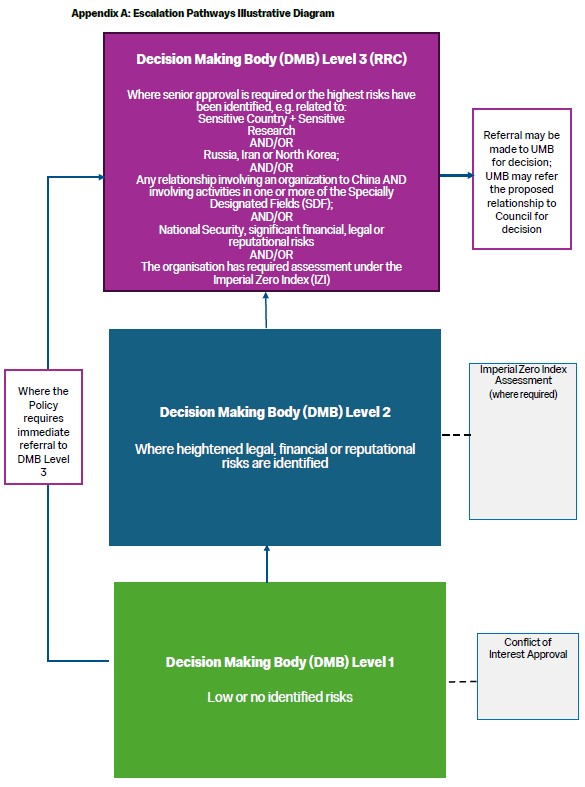
- Appendix A: Escalation Pathways Illustrative Diagram
- Appendix B: List of Sensitive Countries (aligned with the UK Sanctions Regime)
- Policy and Document Control
1.1 Key to Imperial’s Strategy is the advancement of its role as a convenor, collaborator and partner of choice to facilitate the flow of ideas, talent and innovation to tackle grand global challenges. In pursuit of this strategic goal, Imperial enters into a multiplicity of contracts and agreements (“relationships”) across many centres of activity, including Academic Services, Advancement, Enterprise, International Relations and Research.
1.2 It is acknowledged that some of these relationships might carry risks for Imperial because of financial, legal or reputational considerations. It is therefore important that the decision whether to enter into a relationship is made at the appropriate level of seniority within Imperial, that risks and potential mitigations are identified, and that our approach to approving or rejecting relationships is consistent and transparent. All relationships with third parties entered into by Imperial should support and be consistent with Imperial’s mission, strategic aims and objectives.
1.3 When pursuing proposed relationships, all members of staff are expected to comply with the relevant Codes of Conduct that apply at Imperial, and conduct themselves in accordance with the “Nolan” Seven Principles of Public Life (selflessness, integrity, objectivity, accountability, openness, honesty, and leadership: see https://www.gov.uk/government/publications/the-7-principles-of-public-life/the-7-principles-of-public-life--2
Application of this Policy
1.4 This Policy applies to formalised institutional relationships where Imperial intends to, or will, agree a contract with a third party. The Policy is intended to:
a) Remind all staff of the need carefully to consider the relationships they form, and to be alert to financial, legal and reputational risks associated with the proposed and continuing relationships;
b) Highlight the key considerations through which staff should assess the proposed relationship and decide whether it is appropriate to escalate the decision about whether to enter into the relationship; and
c) Explain how the due diligence, risk assessment and escalation processes should work.
1.5 Imperial has in place policies, procedures and regulations which set out the scope of authorities delegated to its staff. Members of Imperial staff must abide by these when forming relationships with third parties. Members of staff also retain responsibility for considering financial, legal and reputational risks associated with their work, and escalating matters where appropriate in accordance with the escalation processes set out in Section 6. Decisions about whether to enter into relationships must be made at the appropriate level of seniority and in accordance with the Financial Regulations Delegation of Authority Schedule: Governance | Administration and support services | Imperial College London
2.1 The scope of this policy includes all relationships with third parties entered into, by or in connection with Imperial (except commercial contracts that are managed through the procurement process or naming decisions approved by the Brand Board), for example:
a) Academic collaborations formalised through contractual arrangements;
b) Receipt of philanthropic income and other gifts;
c) Receipt of research funding and related relationship agreements;
d) Receipt of other income, for example, Academic Services or Enterprise collaborations formalised through contractual arrangements; and
e) Those non-income generating relationships that are assessed as potentially giving rise to reputational risk to Imperial.
3.1 Academic collaboration: relationships that are formalised through contractual arrangements of an academic nature entered into with third parties such as: joint degree programmes, memoranda of understanding, joint institutes or centres, and such similar relationships.
3.2 Research funding and related relationships agreements: agreements that are formalised through contractual arrangements with third parties for: research specific activities, funded and unfunded, including collaboration agreements, research funding agreements, research subcontracts, and all similar arrangements.
3.3 Philanthropic income: income which does not confer full or partial ownership of a deliverable on the funder in return for the funding; this may include income that is in essence (even if not entirely) philanthropic.
3.4 Gifts: includes philanthropic income and other non-financial gifts of a philanthropic nature that are received pursuant to contractual arrangements.
3.5 Other income: the proposed receipt, pursuant to contractual arrangements, of any grants or similar income for purposes related to research, education and academic matters (including income from industry, charity and other sources) which do not meet the UKRI criteria for research. This might include consultancy activities of ICON (Imperial Consulting).
4.1 In considering any relationship, the following guidelines apply irrespective of income source or type of relationship. Those proposing relationships should consider carefully matters such as:
a) The reason for undertaking the activity or engaging in a relationship with the third party(ies): what does each party hope to obtain and might the relationship compromise individuals or Imperial more widely?
b) Is the activity potentially sensitive; is sensitive technology involved; does the proposed relationship open up the possibility of misuse of academic research, including the suppression or falsification of research?
c) Are there any legal considerations to undertake in the proposed relationship; does the relationship arise, in whole or in part, from illegal activity that might include tax evasion, fraud, bribery, the violation of international conventions, for example, on human rights or the environment?
d) Who is/are the partners: do they have good standing; are they in or from a country that has differing democratic standards to the UK?
e) Are there any conflicts of interest or potential conflicts of interest that may arise from entering into the relationship?
f) Are there any legal restrictions that might prevent activity from proceeding with the proposed partner, for example: export controls, GDPR, visa restrictions, sanctions?
g) Might the relationship attempt to require Imperial to deviate from its normal hiring, promotion, procurement and contracting procedures?
h) Might the relationship attempt to require Imperial to provide special consideration for admission to its programmes of study?
4.2 Caution must be exercised to ensure that Imperial’s interests are maintained when reviewing a relationship; for example, those proposing a relationship should be alert to factors that might:
a) Restrict academic freedom and/or lawful free speech;
b) Deter others from supporting or working with Imperial;
c) Cause any other damage, including financial or reputational, to Imperial;
d) Expose Imperial to potential legal liability (above usual approved contractual terms).
4.4 Relationships where the sources of income or funding are difficult to establish require special scrutiny.
4.5 Relationships must comply with economic sanctions imposed by the UK government, and additionally those of other jurisdictions that apply to Imperial (see Appendix B).
4.6 Any relationship involving a government, government body, institution, company or business connected to Russia, Iran or North Korea must be escalated to the Relationships Review Committee (“RRC”) Panel for consideration via RRC@imperial.ac.uk.
4.7 Any relationship involving a government body, institution, company or business connected to China and involving activities in one or more of the Specially Designated Fields (SDF) (contact the Research Office for access to this list), must be escalated to the RRC Panel for consideration via RRC@imperial.ac.uk.
4.8 Where credit checks are carried out on a potential relationship partner, their creditworthiness is one of several risk factors that a decision maker will take into account when deciding whether to pursue a relationship.
4.9 Any proposed relationship with a company involved in fossil fuel extraction must align with the requirements of Imperial’s Zero Index framework; this assessment must be carried out in addition to any due diligence review conducted in accordance with this Policy, before approval is sought.
Due Diligence
4.10 Due diligence is a tool that assists decision making. To assist decision makers a standardised Due Diligence pro forma is available for completion by designated members of Imperial staff. The pro forma is accessed through a bespoke Due Diligence Portal to which relevant teams will be given access. The Due Diligence pro forma must be completed by the team facilitating the relationship e.g. Faculty Research Services, Education Office, Academic Services or the Enterprise and Advancement Divisions. The relevant business area must designate staff who are authorised to use the Due Diligence Portal.
4.11 The Due Diligence pro forma prompts consideration of various factors designed to better identify any risks associated with a proposed relationship. Completing the Due Diligence pro forma is not the decision-making process, but it will assist those who have responsibility to assess a proposal. Some proposed relationships might have such significant financial, legal or reputational risks attached to them such that further due diligence from an independent source might be required; this is likely to be an exceptional step.
5.1 Imperial’s RRC is responsible for setting the strategic approach to relationships, including approving Imperial’s due diligence and relationships approval processes. This includes setting the principles for relationship approvals with Sensitive Countries (or entities based within those countries), where the proposed relationships involve particular types of research (and those companies or institutions where increased risks are identified through the due diligence process). The list of Sensitive Countries found at Appendix B may be updated from time to time by the Research Office.
5.2 The RRC will act through a Panel to perform the role of DMB Level 3. Where required, a Panel of the RRC comprising at least three members of the RRC (to be chaired by the Registrar and University Secretary or their delegate), will consider those proposals that have been identified as carrying the highest levels of risk and decide whether to approve or reject the proposed relationship, or to refer the matter for discussion and decision at UMB (UMB may refer the matter to Council if it assesses the level of risk warrants such oversight). The members of the Panel will be selected by the Chair for their expertise relevant to the proposed relationship(s) under consideration.
5.3 Additionally, the RRC will:
a) Recommend related policies and procedures to UMB and/or Council for approval (such as, Relationships and Gift Acceptance Policies);
b) Provide principles or guidance on how to manage relationships associated with countries on the Sensitive Countries list (Appendix B), and particular industry or strategic partners. This will support DMB Levels 1 and 2 to ascertain whether there is sufficient mitigation or tolerance of identified risks for them to be able to approve a relationship, or whether the decision requires escalation;
c) Set the parameters for escalation of approval decisions;
d) Receive assurance reports from (or about) DMB Levels 1 and 2 (see section 11); and
e) Provide an annual assurance report to UMB and the Audit & Risk Committee on the management of relationships at Imperial.
6.1 There are certain relationships that frequently carry inherently higher financial, legal or reputational risks than others. These include relationships where a potential or existing partner is located within (or has links to) countries that have been identified as having laws, systems and conduct that do not align with UK democratic standards.
6.2 Other relationships that carry elevated risks for Imperial include those involving companies where the nature of their business might not align with Imperial’s Values. Consideration of the financial, legal or reputational risks associated with a relationship proposal must take place before formally entering into a new relationship or extending an existing relationship.
6.3 A proposed relationship with any company involved in fossil fuel extraction must be assessed under Imperial’s net zero framework, Imperial Zero Index. Relationship proposals that require an assessment under the Imperial Zero Index framework should also be referred directly to DMB Level 2 by DMB Level 1 (the business area conducting the due diligence process).
6.4 It is incumbent upon the relationship lead at Imperial to keep such risks under review during the tenure of the relationship. Where appropriate, a decision whether to enter into a relationship should follow the escalation process.
6.5 Imperial has three levels of approval for transactions, described in sections 7 to 9. To align with the Delegation of Authority Schedule in the Financial Regulations (Governance | Administration and support services | Imperial College London), and to share the burden of risk, a DMB should comprise a minimum of two members of Imperial staff of appropriate seniority (see below).
6.6 As noted above, any relationship involving a government, government body, institution, company or business connected to Russia, Iran or North Korea must be escalated to the Relationships Review Committee Panel for consideration via RRC@imperial.ac.uk. Any relationship involving a government body, institution, company or business connected to China and involving activities in one or more of the Specially Designated Fields (SDF) (contact the Research Office for access to this list) must be escalated to the RRC Panel for consideration via RRC@imperial.ac.uk.
7.1 Level 1 is the “business as usual” entry level where no, or very low risks that can be mitigated or tolerated, have been identified using the due diligence tool. DMB Level 1 will hold responsibility for the lowest level of risk. Those who may perform the role of DMB Level 1 will usually be designated individuals in the relevant Division carrying out the due diligence work, e.g. Faculty Research Services, Education Office, Academic Services, or Enterprise and Advancement Divisions.
7.2 To ensure robust decision making is in place, decisions about whether to approve a relationship where any risks have been identified should be taken by two members of staff. The relevant business area must designate staff with sufficient seniority as authorised decision makers in this process, and approval of financial levels must be made in accordance with the Delegation of Authority Schedule in the Financial Regulations: Governance | Administration and support services | Imperial College London. It is incumbent upon those individuals deciding whether to approve relationships – and the Divisions – to maintain a record of why decisions were made, especially if any risks have been identified through the due diligence process; this will be facilitated by the automated Due Diligence Portal to which designated staff will have access (the relevant business area must designate staff who are authorised to use the Due Diligence Portal). Internal audit checks of DMB Level 1 decisions will be conducted periodically to ensure consistency of approach across Imperial.
7.3 Should any decision to approve be conditional (i.e. approved subject to something being done), DMB Level 1 must record whether that condition has been met. No relationship may proceed until any condition has been recorded as met.
7.4 When DMB Level 1 considers that a proposed relationship warrants greater scrutiny and should receive approval at Level 2 or above, the matter must be escalated for approval. The escalation route to DMB Level 2 is automated through the Due Diligence Portal; escalation direct to DMB Level 3 is via RRC@imperial.ac.uk .
8.1 Level 2 is the first point of escalation outside the particular business area leading upon the relationship; it will receive a relationship proposal for approval when the due diligence process has demonstrated that there are risks associated with the relationship that are above designated tolerance, or DMB Level 1 considers the proposed relationship should be approved at a more senior level of responsibility, or the Financial Regulations Delegation of Authority Schedule require escalation because of the level of finances involved: Governance | Administration and support services | Imperial College London.
8.2 Any DMB Level 2 meetings (which should be convened as quickly as possible upon referral of a proposal from Level 1), should be convened by the Dean of the Faculty (or their delegate to manage this process), or relevant University Management Board (UMB) member (or their delegate) for a business area that is outside the Faculty structure, together with the delegate of the Vice-Provost (Education & Student Experience), Vice-President (Advancement), or Vice-Provost (Research & Enterprise), depending upon the lead business area for the relationship. A record of a decision and the reasons for it must be entered into the Due Diligence Portal (and this must be relayed to DMB Level 1). Regular internal audit checks of DMB Level 2 decisions will be conducted to ensure consistency of approach to relationships across Imperial.
8.3 As noted above, a proposed relationship with any company involved in fossil fuel extraction must be assessed under Imperial’s Zero Index and be referred to DMB Level 2 by DMB Level 1 (the relevant business area conducting the due diligence process). DMB Level 2 will determine whether such transactions should be referred to DMB Level 3.
8.4 Should any decision to approve be conditional (i.e. approved subject to something being done), DMB Level 2 must record whether that condition has been met. No relationship may proceed until any condition has been recorded as met.
9.1 Level 3 will usually be the final point of escalation in the process. The RRC Panel is the DMB Level 3. It will receive referrals from DMB Level 2 (or occasionally directly from DMB Level 1), where significant financial, legal or reputational risks have been identified. These risks could relate to:
a) significant reputational risk because of the involvement of particular individuals;
b) high financial exposure for which Imperial’s Authority Matrix requires senior approval;
c) significant research security considerations, or those with national security implications.
9.2 Any relationships associated with countries on the Sensitive Countries list (which may be updated from time to time by the Research Office) and relating to Specially Designated Fields of research must be referred to DMB Level 3. Any relationships involving a government, government body, institution, company or business connected to Russia, Iran or North Korea regardless of the area of research, must be escalated to the RRC Panel. Any relationship involving a government body, institution, company or business connected to China and involving activities in one or more of the Specially Designated Fields (SDF) (contact the Research Office for access to this list) must be escalated to the RRC Panel.
9.3 Proposed relationships that need to be referred to DMB Level 3 should be sent to RRC@imperial.ac.uk, and wherever possible facilitated by systems set up to support due diligence. DMB Level 3 meetings (which should be convened as quickly as possible), will be chaired by the Chair of the RRC and comprise at least two other members of the RRC. DMB Level 3 meetings will be clerked by the University Secretary team who will record the nature of the proposed relationship, identified risks, decision of the DMB Level 3, and its reasons.
9.4 In some cases the RRC Panel might consider that the risks identified in relation to a particular proposed relationship are significant enough to refer the proposal to UMB for discussion and decision (or the terms of the Financial Regulations Delegation of Authority Schedule might require escalation: Governance | Administration and support services | Imperial College London); UMB may refer a proposal to Council for decision if it considers the identified risks warrant such oversight.
10.1 The outcome from a DMB may be:
a) RELATIONSHIP APPROVED. This indicates that Imperial may proceed with the proposed relationship.
b) RELATIONSHIP NOT APPROVED. This indicates that Imperial will not proceed with the proposed relationship.
c) RELATIONSHIP APPROVED SUBJECT TO CONDITION(S).
d) RELATIONSHIP REFERRED TO HIGHER DMB. This indicates that the identified risks warrant consideration of the proposed relationship at a higher level of seniority.
10.2 Should any decision to approve be conditional (i.e. approved subject to something being done), the responsible business area must provide evidence that the condition has been met to the relevant DMB, and evidence of the condition being met must be recorded on the Due Diligence Portal or (where relevant) by the RRC. No relationship may proceed until any condition has been recorded as met.
10.3 All decisions must be relayed to the relevant business area/lead as soon as reasonably practicable after a DMB has made its decision.
11.1 As mentioned, a new system has been developed to support due diligence and ensure the consistent use of a single Due Diligence pro forma. The Due Diligence Portal is an automated system that will record decisions at DMB Levels 1 and 2; users should ensure that reasons for decisions are entered on to the system.
11.2 Periodic internal audit checks of decisions made at DMB Levels 1 and 2 will be conducted to ensure this Policy, the principles and guidelines are being applied consistently. This process will highlight any matters that would benefit from RRC Guidance to assist decision making.
11.3 The University Secretary’s team will compile termly Assurance Reports for the RRC. An Annual Assurance Report will be prepared for UMB and the Audit & Risk Committee by the University Secretary’s team on behalf of the RRC.
11.4 Imperial aims to be transparent about relationships entered into, the parties involved, and the purposes of those relationships. However, there will be cases where anonymity should properly be respected, and Imperial will carefully consider any requests for anonymity. The University will, however, disclose details of relationships where it is required to do so by law, by any applicable governmental or other regulatory authority, or by order of a court.
Any relationship involving a government body, institution, company or business connected to Russia, Iran or North Korea must be escalated to the RRC Panel via RRC@imperial.ac.uk
Any relationship involving a government body, institution, company or business connected to China and involving activities in one or more of the Specially Designated Fields (SDF) (contact the Research Office for access to this list) must be escalated to the RRC Panel.
Additionally, where the following countries are involved in the proposed relationship, if the areas of research are listed in the Specially Designated Fields (contact the Research Office for access to the list), they too must be escalated to the RRC Panel. This list may be updated from time to time by the Research Office:
| Afghanistan | Guinea Bissau | Somalia |
| Belarus | Haiti | South Sudan |
| Bosnia Herzegovina | Iraq | Sudan |
| Burma | Lebanon | Syria |
| Burundi | Libya | Venezuela |
| Central African Republic | Mali | Yemen |
| Congo | Nicaragua | Zimbabwe |
| Guinea | Saudi Arabia |
Additionally, when contemplating entering into a relationship, due regard must be given to other sanctions regimes that affect the University, such as US, EU or United Nations requirements, which might not exactly mirror UK sanctioned countries.
UK sanctions list: https://www.gov.uk/government/publications/the-uk-sanctions-list
USA sanctions list search: https://sanctionssearch.ofac.treas.gov/
UN sanctions list search: https://scsanctions.un.org/search/
Imperial’s borrowing covenants require us to comply with the following:
Imperial must not and must not permit any Controlled Entity to (a) become, own or control a Blocked Person or any Person that is the target of sanctions imposed by the United Nations, the European Union or HM Treasury, or (b) directly or indirectly have any investment in or engage in any dealing or transaction with any person or entity if such investment, dealing or transaction would be in violation of, or could result in the imposition of sanctions under any U.S. Economic Sanctions Laws applicable to Imperial (or Controlled Entity), except, in the case of (b), to the extent that such violation or sanctions, if imposed, could not, individually or in the aggregate, reasonably be expected to have a Material Adverse Effect, provided that for the avoidance of doubt, nothing in (b) restricts Imperial from recruiting students, receiving fees from students, recruiting academics, research activities or doing anything else in the ordinary course of its usual business with any country that is the subject of U.S. Economic Sanctions or any Blocked Person.
| Policy Owner | Registrar & University Secretary RRC@imperial.ac.uk |
| Policy Approved by | Council |
| Date of Policy | 12 July 2024 |
| Next Review Due by | 11 July 2026 |