Highlights
- 2025 - New accurate Mn I energy levels and wavelengths
- 2025 - First-ever AI for term analysis
- 2025 - Public outreach at Imperial Lates 2025
- 2025 - PhD opportunity starting October 2026
- 2025 - We welcome two new PhD students
- 2024 - New accurate Nd III energy levels and wavelengths
November 2025
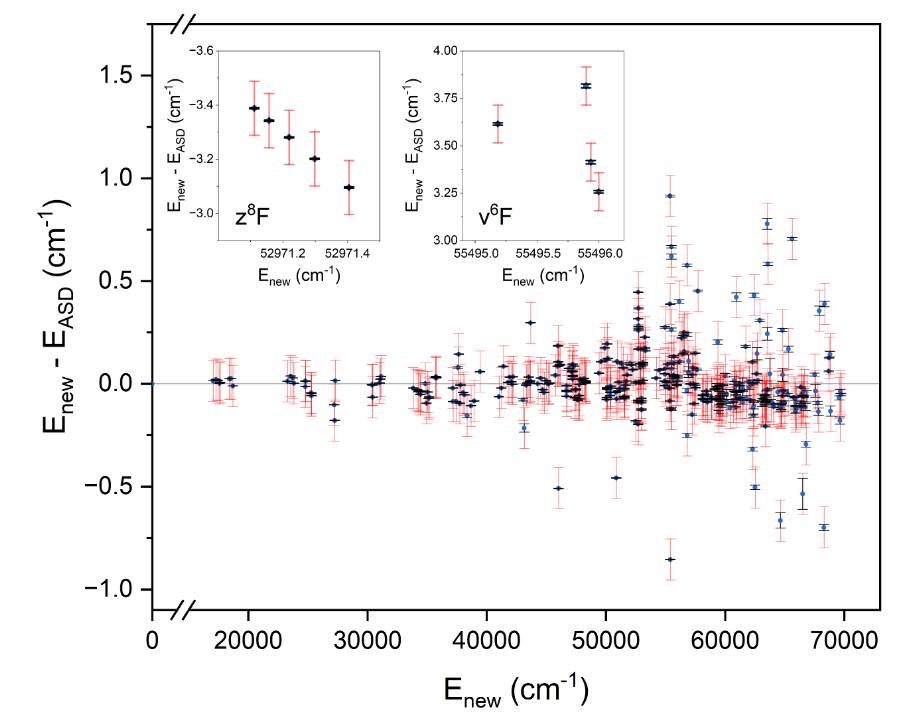
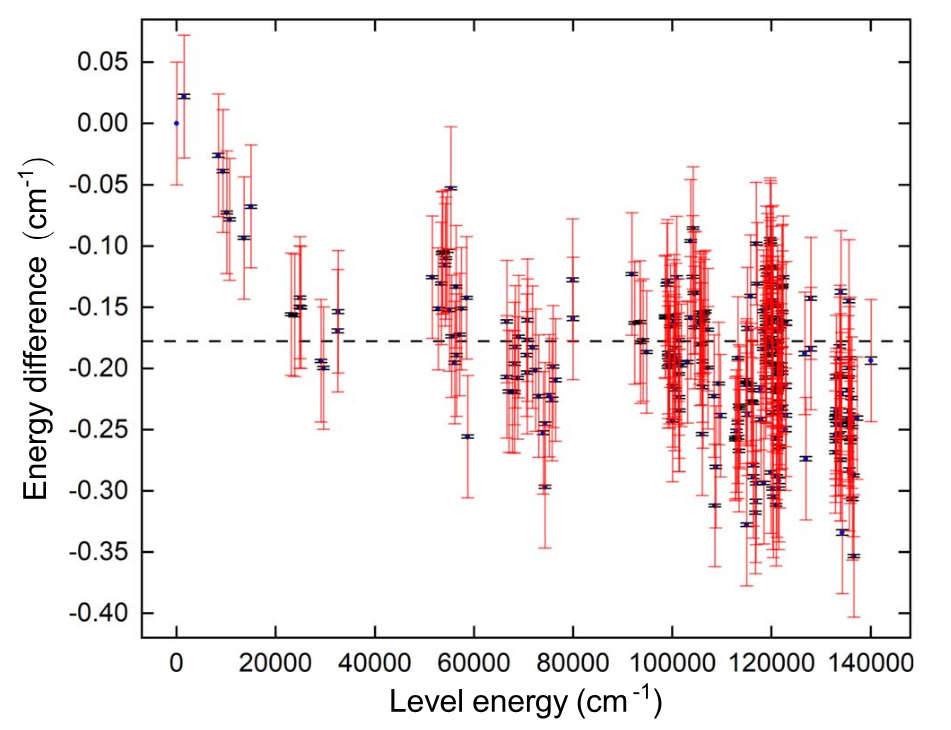
We have carried out the most precise large-scale analysis to date of the atomic spectrum of neutral manganese (Mn I), an element that plays a key role in tracing stellar nucleosynthesis and galactic chemical evolution. Using high-resolution Fourier transform spectroscopy (FTS) combined with complementary grating spectroscopy, we measured over 24,000 spectral lines spanning the ultraviolet to infrared (151–5112 nm). Our measurements achieve uncertainties at least ten times lower than previous work (see figure below), enabling a major refinement of manganese’s atomic structure. From these data, we classified 2,187 transitions, optimised 384 existing energy levels, and discovered 18 new levels, producing a definitive set of 402 Mn I energy levels. This level of precision is essential for astrophysics: manganese is a key diagnostic for understanding processes such as supernova yields and chemical enrichment in stars and galaxies, and our improved dataset will allow researchers to model these environments with far greater accuracy.
October 2025
Term analysis is the reconstruction of an atomic energy level system using observed spectral lines (level energy). This procedure is arguably the most time consuming component of our science research, on average taking PhD students 2-3 years per ionisation stage per element. Dr Milan Ding, after enduring a similar fate in his PhD, has decided to improve effectiveness by investigating the potential to apply AI methods to this analysis with the recent great advances in artificial intelligence.
Dr Ding worked with Dr Darvariu of the Oxford University Robotics Institute to create a system for term analysis applicable for reinforcement learning. The AI and machine learning implementation is an adaptation of Google DeepMind's Rainbow DQN, where a graph neural network is used in place of a convolutional network, since levels and lines are conveniently organised as a graph, but the action space is dynamic and can reach 100. Similar to most reinforcement learning research, the reward function was a great challenge, for which a very small neural net was trained to score actions based on past human term analysis decisions. An overview is shown in the diagram below:
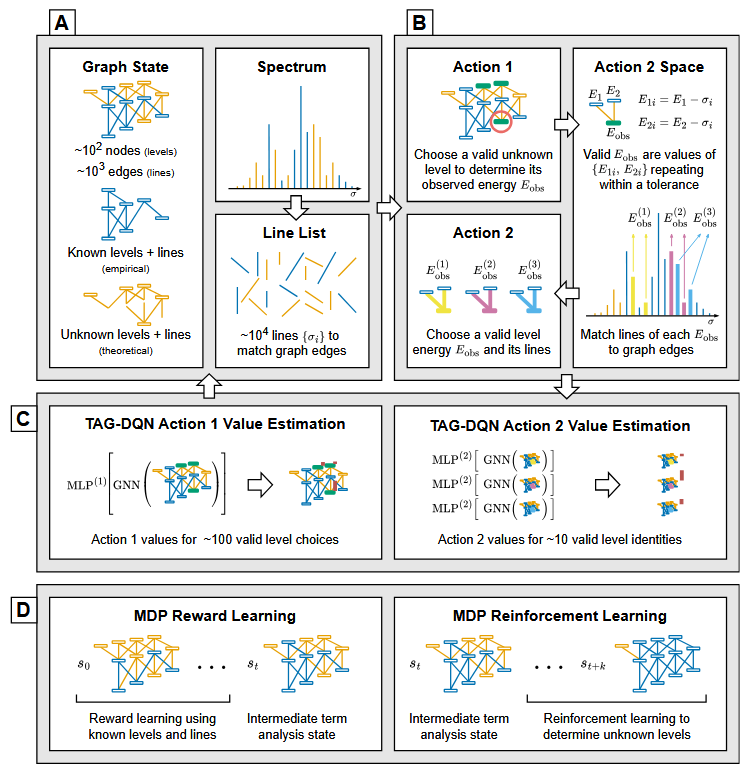
Results are presented in our paper (preprint) "Ding et al, Accelerating Atomic Fine Structure Determination with Graph Reinforcement Learning", is capable of achieving hundreds of energy level identifications overnight, as opposed to weeks and months of human effort. The accuracy is somewhat worse compared to humans, so to produce reliable reference atomic data for astrophysics, we still manually check and refine each level identity using our experience. However, the task has now shifted towards double-checking results of unknown energy levels, rather than the searching process itself, which boosts efficiency tremendously. This work, submitted and under review, is expected spark the beginning of the AI-driven era of atomic fine structure analysis.
October 2025
We were excited to run our spectroscopy "Build your own spectrograph" interactive event again, this time during the "Lights, Colour, Action" Imperial Lates event. All of AMSG, and several enthusiastic PhD students from the Space, Plasma, and Climate community, contributed to this outreach event.



October 2025
We are open for PhD applications for October 2026, please refer to this page and feel free to contact us!
October 2025
Ruijie Chen and Lucy Thornton-Sparkes have joined us from Oct 2025 in our mission to address the world's atomic data demands. Ruijie aims to innovate spectral analysis techniques by evaluating and extending our advanced supervised and reinforcement learning methods, while Lucy is looking to tackle the most spectroscopically complex atomic species we have ever investigated - Gadolinium (Gd, Z = 64).
December 2024
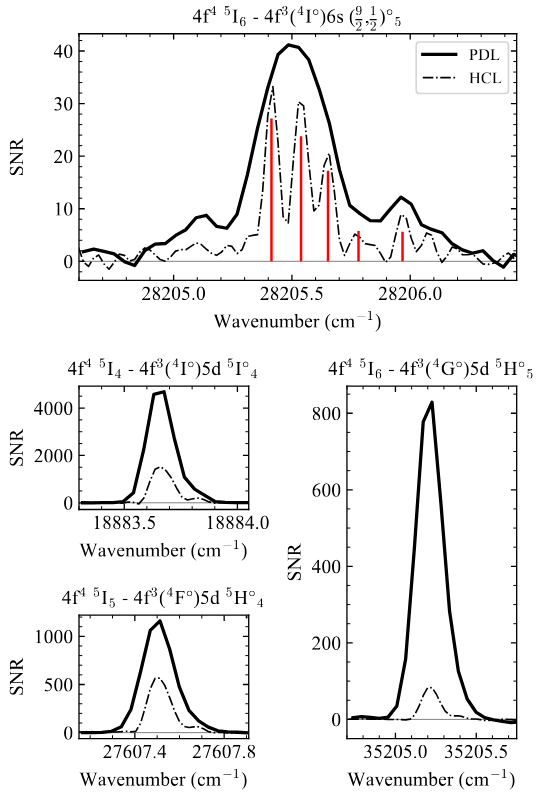
Results from Dr Ding's ground breaking study of doubly ionised neodymium have recently been published. This collaborative project involved novel laboratory experiments in the Imperial College Spectroscopy Laboratory and challenging analysis of the resulting spectra to yield new atomic data, particularly atomic energy levels.
We collaborated with Dr Alexander Ryabtsev and Dr Tatiana Ryabchikova (Russian Academy of Sciences, Moscow), who carried out demanding atomic structure calculations to provide theoretical support for the study as well as the use of stellar spectra to provide additional confirmation of the new spectral line identifications from the laboratory measurements. The new atomic data is particularly important in applications in astronomy, ranging from understanding the origins of heavy elements to interpreting the light seen from colliding neutron stars, whose signals are being detected by gravitational waves.
All News
- 2025 - Paper published on neural network line detection in line-rich Fourier transform atomic emission spectra
- 2025 - Anne Thorne PhD Thesis Prize
- 2024 - Invited keynote talk at ICAMDATA on Challenges in Atomic Spectroscopy of Low-Ionisation Stage Heavy Elements for Astrophysics
- 2023 - STFC Futures Grant awarded: 'A New World Class Infrared Spectrometer for Fundamental Atomic Data for Astrophysics'
- 2023 - 'Build your own spectrometer' as part of White City science outreach packs
- 2023 - Invited keynote talk at ASOS on 'Atomic Data Measured Using High Resolution Spectroscopy'
- 2022 - Paper published on new accurate wavelengths and energy levels of singly ionized nickel (Ni II) measured using Fourier transform spectroscopy
- 2022 - Great Exhibition Road Festival Spectroscopy Stall
- 2020 - Paper published on new atomic data for hyperfine structure of Co II for accurate stellar abundances
July 2025
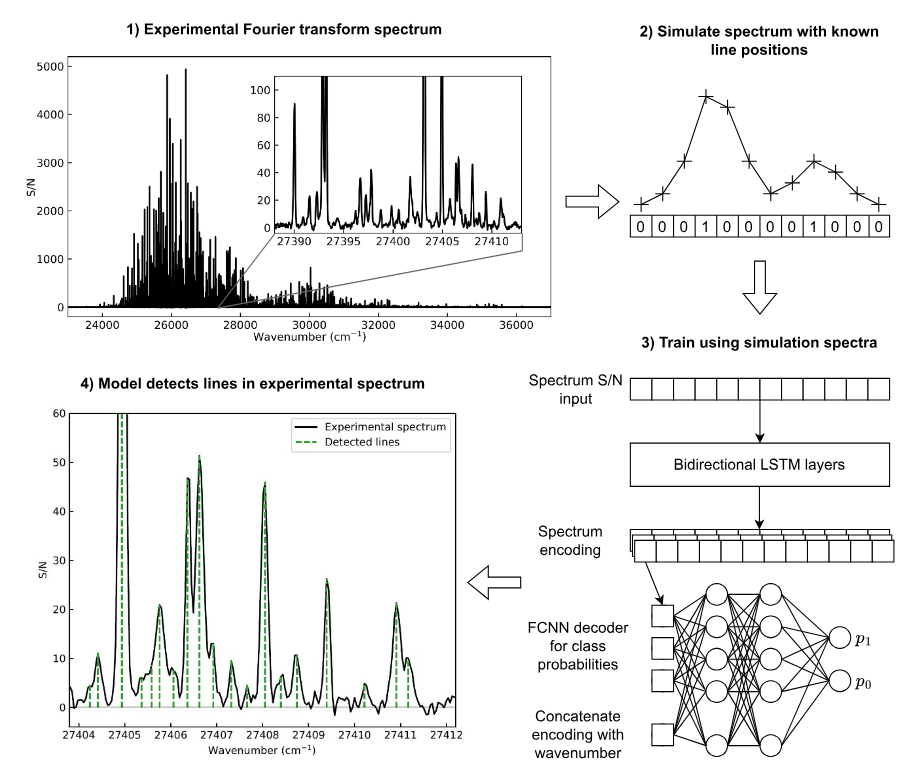
Dr Ding worked with two exceptional summer UROP students, Sean ZJ Lim and Xiaoran Yu, to tackle the challenge of automated line detection in our Fourier transform spectra of the open d- and f-subshell elements. Our spectra are 1-D arrays of signal-to-noise with approximate dynamic range of 10,000 and length 1,000,000, within which we observe thousands of spectral lines - just for one element. The challenge, of course, is to extract the transition wavelengths (and areas under the lines which are a measure of intensity) associated with these lines efficiently and accurately - usually, this task takes several weeks of labour for one set of spectra!
We applied supervised learning with Long-Short Term Memory networks using simulated spectra. As expected, the most challenging aspects were the data processing and simulations. Nevertheless, the trained neural nets were able to identify lines missed previously by humans and our traditional line detection routines! Moving forward we will continue to apply this approach to line detection in the creation of our spectral line lists to maximise efficiency.
February 2025
Our PhD graduate, Dr Milan Ding, has won the Physics Departmental 2025 Anne Thorne PhD thesis prize! This prize is given annually to the best experimental physics PhD thesis, and we are very proud for his achievement. During our laboratory closure during the COVID-19 pandemic, Milan undertook the extensive analysis of Co II hyperfine structure. With this foundation, he then went on and carried out our first successful investigation of an open 4f-subshell (lanthanide/rare-earth) atomic species with extremely complex spectra, doubly ionised neodymium (Nd III). This work required several innovations in laboratory and analysis methods. Dr Ding's contributions greatly boosted our capabilities, and set the foundations for tackling atomic fine structure of the lanthanides.
A summary of Dr Milan Ding's PhD research is given in the following link: Link to the thesis summary can be found here
September 2024
Dr Milan Ding, Research Associate in the Imperial College Atomic and Molecular Spectroscopy Group (AMSG) gave an invited keynote talk at ICAMDATA 2024. Dr Ding described the latest research being undertaken in high resolution spectroscopy of heavy elements, lanthanides, giving background on motivation and applications of the new atomic data, and discussing the challenges and how these can be overcome in this research.
The conference paper was published in a special issue of the journal "Atoms" : Atoms, 13(4), 35; https://doi.org/10.3390/atoms13040035
December 2023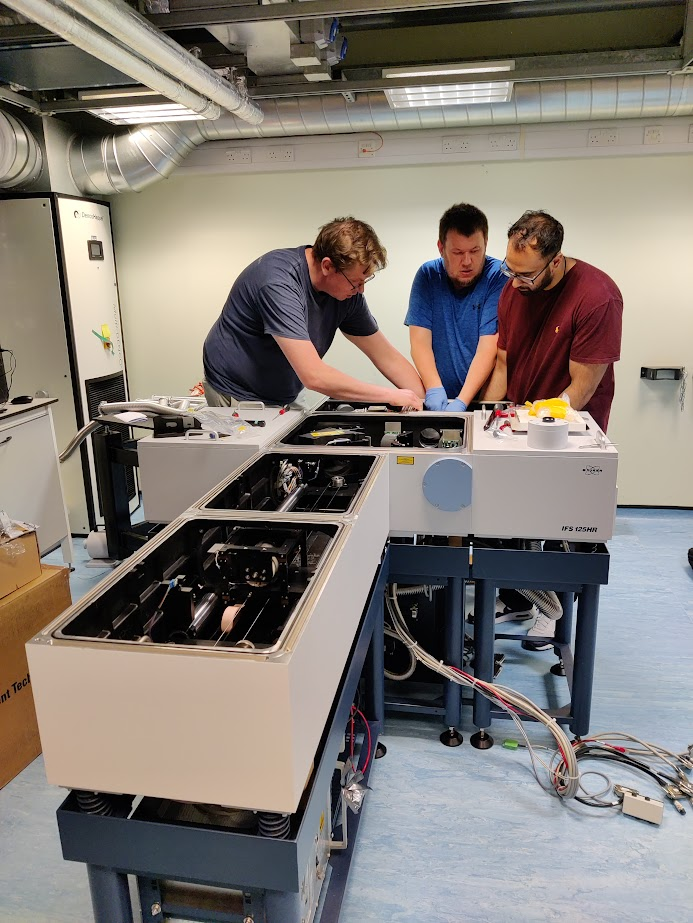
Our new IR-visible spectrometer (Bruker), funded by the STFC (grant ST/X005100/1) now joins our visible-VUV spectrometer in our Spectroscopy Laboratory, broadening our access to high resolution spectra across a much wider wavelength range. The new IR spectra we will observe will improve our measurement capabilities of key atomic data needed to interpret astronomical spectra from stars to quasars, exoplanets to colliding neutron stars.
December 2023
Our PhD student, Milan Ding, participated in the White City outreach science packages sent to thousands of local families, where he and the public engagement team of Imperial crafted a magazine article detailing what inspired him to undertake a PhD in laboratory astrophysics and atomic spectroscopy. Our "make it yourself" CD spectrometer template was attached as an activity.
The outreach article can be found at the bottom of our Public Engagement page
July 2023
Dr Christian Clear, Research Fellow in the Imperial College Spectroscopy Group gave an invited keynote talk at the 14th International Colloquium on Atomic Spectra and Oscillator Strengths for Astrophysical and Laboratory Plasmas (ASOS 2023) conference in Paris. Dr Clear described the latest research being undertaken in the group, giving background on motivation and applications of our atomic data and recent highlights.
Dr Clear's slides can be found at the ASOS14 conference website
August 2022
We have published new atomic data for wavelengths and atomic energy levels of singly ionised nickel, Ni II. Analyses of thousands of spectral lines of singly ionized nickel (Ni II) in nickel spectra measured using Fourier transform spectrometers in the region 1800–70,000 cm−1 (5555 – 143 nm) has led to a new understanding of the atomic energy levels in Ni II. This work has yielded at least an order of magnitude improvement in the accuracy of line wavelengths and energy levels compared with previously available data for Ni II. 283 previously known energy levels are improved, and 25 levels are found for the first time. Eigenvector compositions of the energy levels have been calculated using the Orthogonal Operator Method, and were an important aid in the analysis of the level structure. This research enables broader, more reliable and accurate application of Ni II data in astronomical chemical abundance analyses.
These new wavelength and atomic energy level data are important in ongoing studies of stellar spectra, in particular identification of Ni features and elemental chemical abundance determination.
This study is, to the best of our knowledge, the most accurate to date for Ni II wavelengths and energy levels. The project continues with future publications in preparation on higher lying energy levels in Ni II and transition probabilities.
June 2022
During the weekend of 18-19 June 2022 at the Great Exhibition Road Festival, our 'Make your Own Spectroscope' workshop provided hundreds of children and adults with the tools to make their own spectroscope: using just card and a CD!
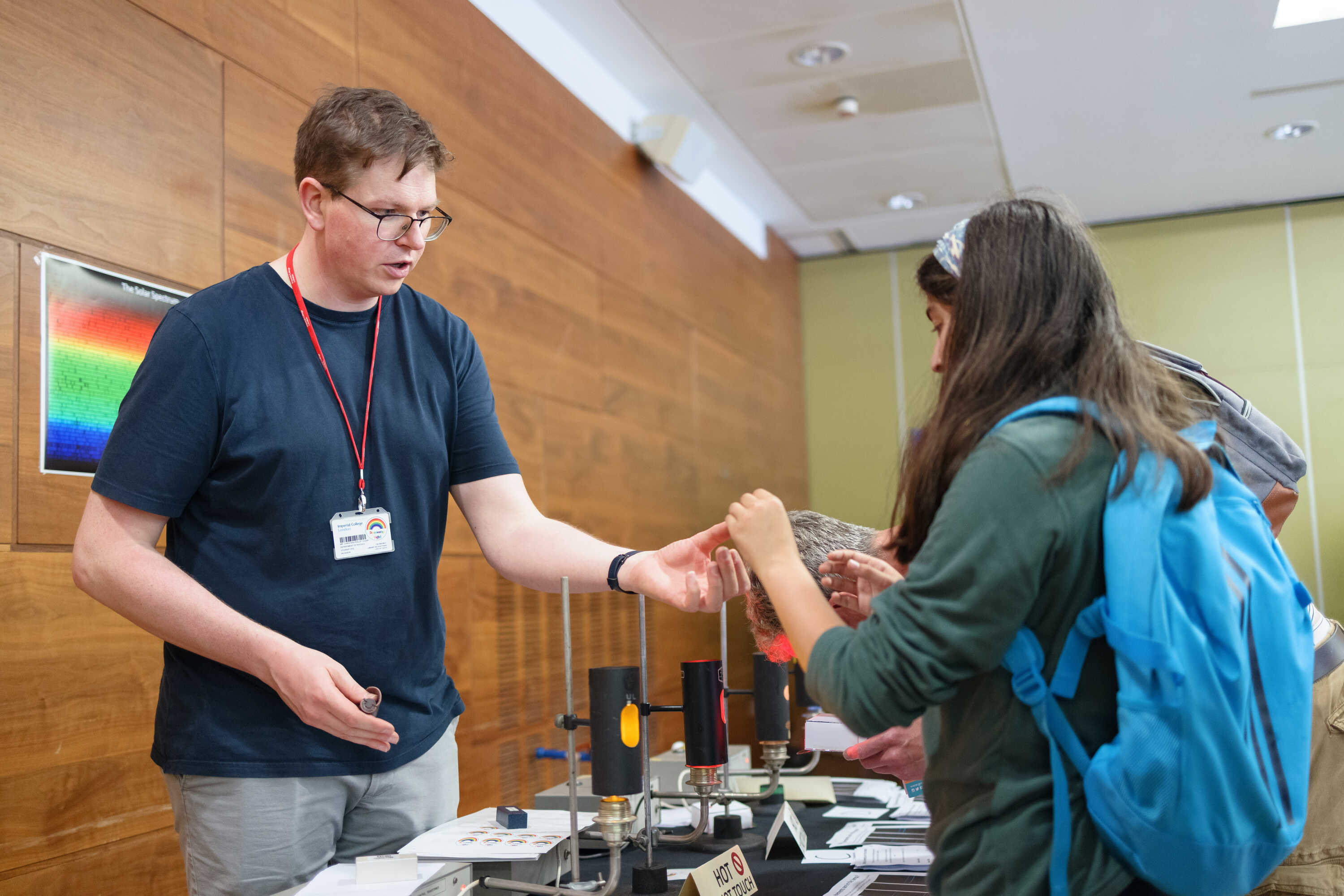
At this workshop, four lamps each containing a different element were on display, but with their labels hidden, the elements in each lamp remained a mystery! Using their newly made spectroscopes, members of the public played detective and identified the neon, sodium, helium and cadmium in each lamp by comparing their observations with reference spectra. The unique 'fingerprint' spectra of these lamps could be seen by the children using their own spectroscopes. Many people entered the prize draw, with the winner gaining a pocket diffraction grating spectroscope!

December 2020
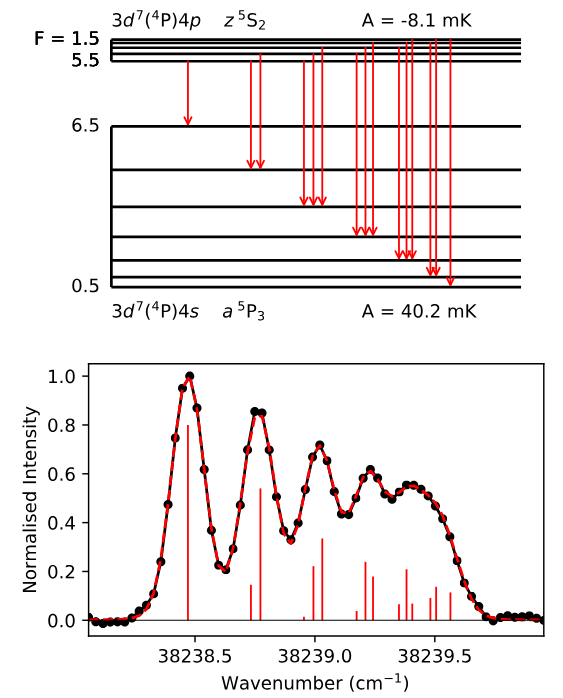
We have published new atomic data for hyperfine structure of singly ionised cobalt, Co II. Analyses of hyperfine structure constants of singly ionized cobalt (Co II) were performed on cobalt spectra measured by Fourier transform spectrometers in the region 3000–63,000 cm−1 (3333 – 158.7 nm). Fits to over 700 spectral lines led to measurements of 292 magnetic dipole hyperfine interaction A constants, with typical uncertainties between ±0.4 mK and ±3.0 mK. The number of Co II levels with known A values has now increased tenfold, improving and enabling the wider, more reliable, and accurate application of Co II in astronomical chemical abundance analyses.
These new hyperfine structure atomic data are important in ongoing studies of stellar spectra, in particular elemental chemical abundances. Cobalt is an iron group element, one of the odd-Z nuclei, where production of these elements in stars is less well understood. Hyperfine structure broadens spectral lines observed in stars, and if it is not understood, or measured in the laboratory it can lead to very significant errors in determining strengths of stellar spectral lines, which in turn leads to errors in the relative abundance of cobalt determined from these lines.
This study is, to the best of our knowledge, the most comprehensive of any iron group (3d) element in terms of new hyperfine structure splitting factors being found for the majority of known energy levels.