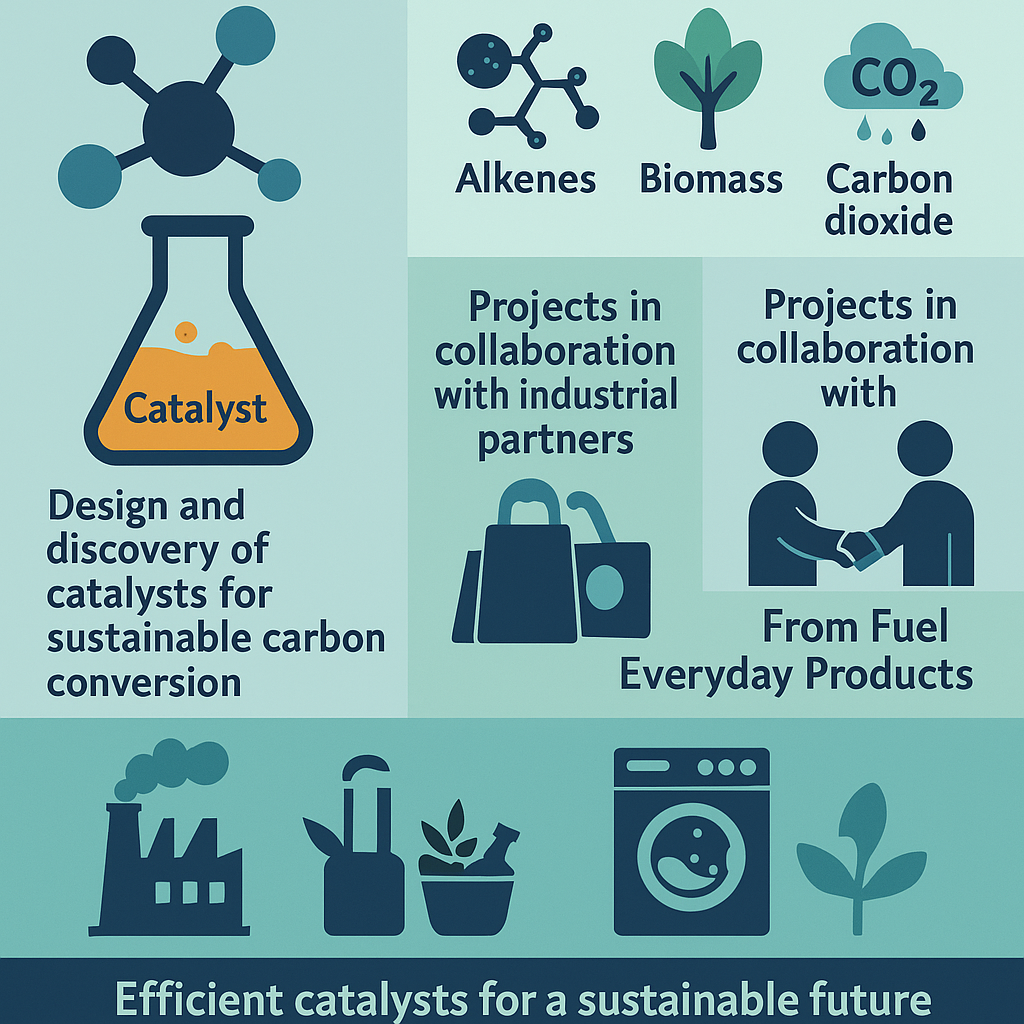
Research Interests
Prof. George J. P. Britovsek’s research focuses on inorganic and organometallic chemistry, with particular emphasis on catalysis for sustainable chemical transformations. A central theme of his work is the design of transition-metal catalysts—especially Ru, Cr, Fe, and Ni complexes—for the activation and conversion of simple carbon feedstocks such as CO, CO₂, and biomass-derived molecules. Through reactions including hydrogenation, carbonylation, and dehydrogenation, his group aims to support decarbonisation, carbon utilisation, and low-carbon manufacturing.
A second major area of interest is olefin oligomerisation and polymerisation, where Britovsek develops catalysts that precisely control ethylene conversion to produce valuable α-olefins. His group also investigates polymer sustainability, including degradable polyethylene, functionalised polyolefins, and composites integrating renewable fillers like nanocellulose. This connects catalytic science with real-world challenges in plastics recycling, materials performance, and sustainable polymer design.
Complementing his applied focus, Britovsek leads extensive work in fundamental organometallic mechanism, examining metal–ligand interactions, ligand effects, and light-driven transformations such as oxygen insertion into metal–carbon bonds. Using advanced spectroscopic methods—e.g., LED-NMR—his group elucidates catalytic pathways and reaction intermediates, enabling more rational catalyst development.
Across these themes, Prof. Britovsek’s research integrates mechanistic insight, catalyst innovation, and materials sustainability, contributing foundational and applied advances to modern catalysis and polymer chemistry.
Areas of Interest
- Mechanistic & Fundamental Organometallic Chemistry
- Olefin Oligomerisation/Polymerisation & Polymer Sustainability
- Sustainable Catalysis & Carbon Management
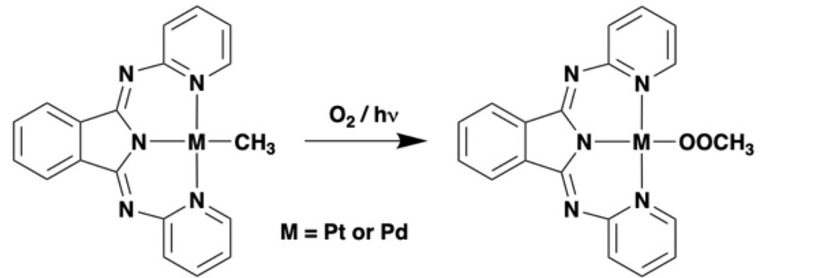
Britovsek also conducts detailed mechanistic research to understand how catalysts operate at the molecular level. This includes studying metal–ligand bond activation, light-driven reactions, and oxygen insertion into metal–carbon bonds. His group uses advanced techniques—such as LED-NMR, kinetic studies, and computational modelling—to probe catalytic pathways, determine intermediates, and map out energy profiles. Such mechanistic insights are critical for rational catalyst design, helping explain why certain ligand frameworks give rise to specific reactivity patterns or selectivities. By combining experimental and theoretical approaches, this theme deepens the understanding of organometallic processes and supports the development of more efficient, selective, and robust catalysts across his broader research portfolio.
- Ho, S.K.Y., Ezeorah, C., Chari, S., Britovsek, G.J.P. Monitoring light-driven oxygen insertion reactions into metal–carbon bonds by LED-NMR spectroscopy. ChemPhotoChem, 2023, 7, e202200290.
2.
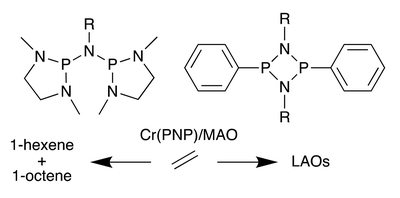
A large part of Britovsek’s research focuses on ethylene oligomerisation and polymerisation, where catalysts determine chain length, branching, and product distribution. His group investigates how ligand structure, oxidation state, and reaction conditions influence selectivity toward valuable α-olefins (e.g., 1-hexene, 1-octene). Beyond catalyst design, the group studies polymer sustainability by creating functionalised or degradable polyethylene, blending renewable fillers, and designing polymer composites incorporating materials such as nanocellulose. This enables polymers with improved recyclability, enhanced mechanical performance, or controlled degradation. Together, this theme links fundamental catalyst design with real-world polymer challenges, including waste reduction and advanced materials development.
- Lo, Q., Pye, D., Gesslbauer, S., Sim, Y., García, F., White, A. J. P. & Britovsek, G. J. P., Single- and double-bridged PNP ligands in chromium-catalysed ethylene oligomerisation, Catal. Sci. Technol., 2022, 12, 4544–4551, DOI: 10.1039/D2CY00550F.
2. von Goetze, R., Aljaber, A., Lee, K.-Y., Hill, G., Wallis, C. & Britovsek, G. J. P., “Towards degradable polyethylene: end-functionalised polyethylene (PE-X) and PE-I/LDPE blends from iron-catalysed chain growth of ZnEt₂ with ethylene”, Polym. Chem., 2022, 13, 6377–6385.
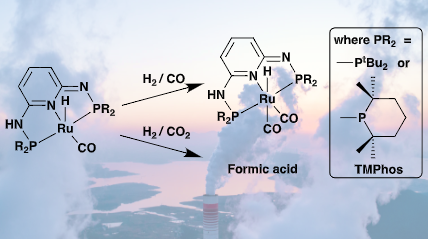
Britovsek’s work strongly engages with the development of efficient, selective catalysts that transform simple carbon-based molecules—especially CO, CO₂, and syngas—into useful chemicals. This includes designing metal complexes (e.g., Ru, Cr, Ni) with tailored ligands that can drive reactions such as hydrogenation, carbonylation, oxidation, and dehydrogenation. A major goal is to support low-carbon chemical manufacturing by enabling the use of abundant, low-cost, and often waste carbon sources. His research also explores catalytic routes for converting biomass- or lignin-derived substrates, aiming to integrate renewable feedstocks into mainstream chemical production. Ultimately, this theme aligns with global interests in decarbonisation, green chemistry, and establishing a circular carbon economy through catalytic innovation.
- Morton, M. D.; Tay, B. Y.; Mah, J. J. Q.; Nobbs, J. D.; and Britovsek, G. J. P. “Hydrogen activation with Ru-PN³P pincer complexes for conversion of C₁ feedstocks.” Inorg. Chem., 2024, 63, 3393–3401.
Our Industry Partners
Contact
Prof. Dr. George Britovsek FRSC
Director MRes Catalysis & Engineering
Tel: +44 (0)20 7594 5863
Email: g.britovsek@imperial.ac.uk
Department of Chemistry
Imperial College London
Molecular Sciences Research Hub
White City Campus
80 Wood Lane
London W12 0BZ
United Kingdom