As single photon sources and optical nonlinearities essential for photonic information processing, promising candidates are the organic dye molecules [1]. Trapped indefinitely on the solid state substrate, they are versatile substitutes to cold atoms and trapped ions without the need for complex cooling and trapping apparatus. Out of a few options of solid state emitters, single molecules hold promise because they can be easily deposited on top of pre-fabricated photonic structures. This opens up a practical route to make a quantum optical device because various established structures from nanophotonics and integrated optics can be directly used for any imaginable configurations [2]. Specifically, we intend to build quantum photonic circuits with single molecules and waveguide networks on chip, so that entanglement and interference of multiple photons can be exploited in a parallel fashion [3].
There are two main goals: to produce a source of identical photons needed for linear quantum logic gates, and to facilitate the nonlinear optical interaction between these photons necessary for nonlinear logic gates, all on chip. Integrated optical waveguide circuits will be designed and fabricated for this purpose based on the single strip waveguides optimized for molecular coupling. The waveguide chips deposited with molecules will be inserted into a liquid Helium bath cryostat. Cryogenic measurements below 2 K temperature are necessary to ensure the indistinguishability of the emitted photons and large scattering cross section necessary for nonlinear interaction. We generate identical photons by exciting individual dye molecules by coupling excitation light to a waveguide. Quantum Phase Gates are to be implemented by constructing a Mach-Zehnder interferometer using waveguide directional couplers and a single molecule as a nonlinear medium. The change of the polarisability of a molecule caused by one photon will alter the self-interference pattern of the other photon through the interferometer. By interconnecting multiple phase gates and multiple photon sources, we aim at a hybrid scheme of linear and nonlinear quantum computation methods on a scalable architecture.
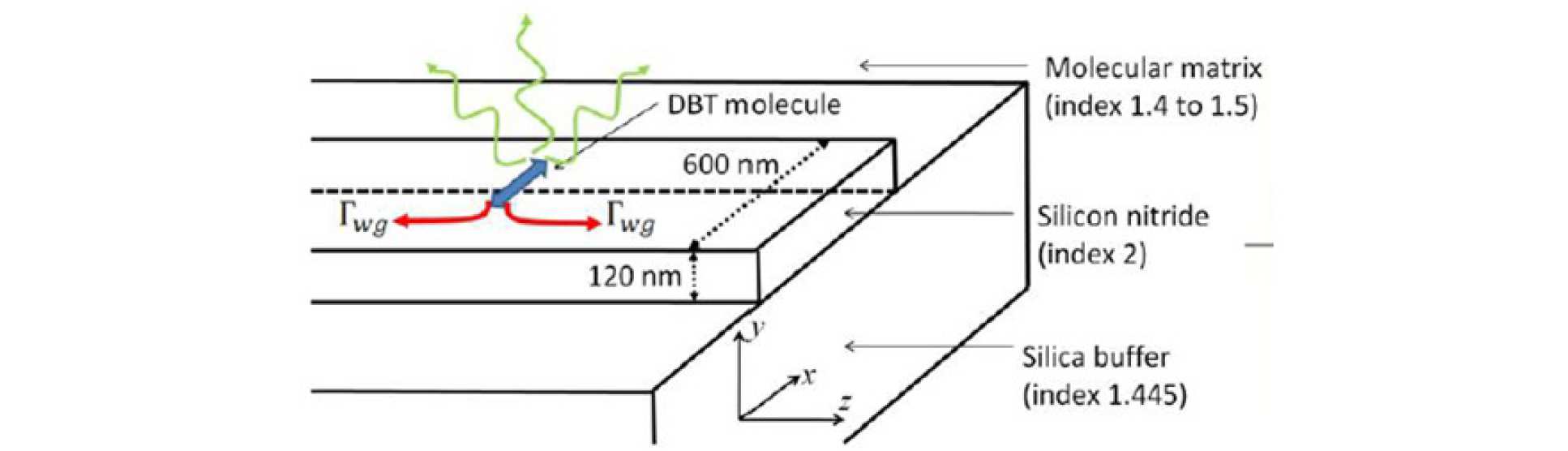
Above: Thin silicon nitride waveguide will be fabricated on silica buffer, and anthracene crystal doped with DBT (dibenzoterrylene) molecules will be deposited. DBT molecules on the proximity of the waveguide mode will preferentially emit into the waveguide mode.
 Right: Single organic dye molecules are deposited on dielectric nano photonic structures to be used as on-chip single photon sources and nonlinearities. This figure shows a waveguide design to enable a single molecule to emit single photons in a unidirectional manner.

Left: Envisioned nanoscale waveguide quantum circuit. Organic molecules are used as sources of indistinguishable photons and nonlinear switches. Cavities are integrated inside the chip to enhance the photon-molecule interaction. Detectors and feedforward can be integrated in one substrate.
[1] “A Single-Molecule Optical Transistor,” J. Hwang, et al. Nature 460, 76 (2009)
[2] “Progress in Atom Chips and the Integration of Optical Microcavities,” E.A. Hinds, et al. Proc. IQOLS, 272 (2008)
[3] “Dye molecules as single-photon sources and large optical nonlinearities on a chip,” J. Hwang and E. A. Hinds, New Journal of Physics, 13 085009 (2011)