Single photons are the essential building blocks for photonic information processing. Single organic dye molecules at cryogenic condition can serve as efficient source of indistinguishable single photons. Compared to other solid state emitters, single molecules are especially attractive because they can be easily deposited on top of pre-fabricated optical chips [1]. Recently, microscale optical waveguides on a chip have attracted the attention of researchers as a practical quantum optical platform where entanglement and interference of multiple photons can be exploited in a parallel fashion. However, single photons are currently generated outside the chips and the operation is limited to a few photons. Figure 1 shows a way to extend it to many photons. The green dots represent organic dye molecules directly deposited at the input of each waveguide, which can provide an arbitrarily large number of indistinguishable single photons. In order for each photon to launch deterministically and uni-directionally into the waveguides, a cavity formed by the mirror coated on the waveguide facet and spherical micro-mirrors on a separate chip will enhance the emission process [2,3]. Electrodes will be fabricated around each molecule so that the degree of indistinguishability
Electrodes will be fabricated around each molecule so that the degree of indistinguishability among the photons can be controlled via Stark shift [4].
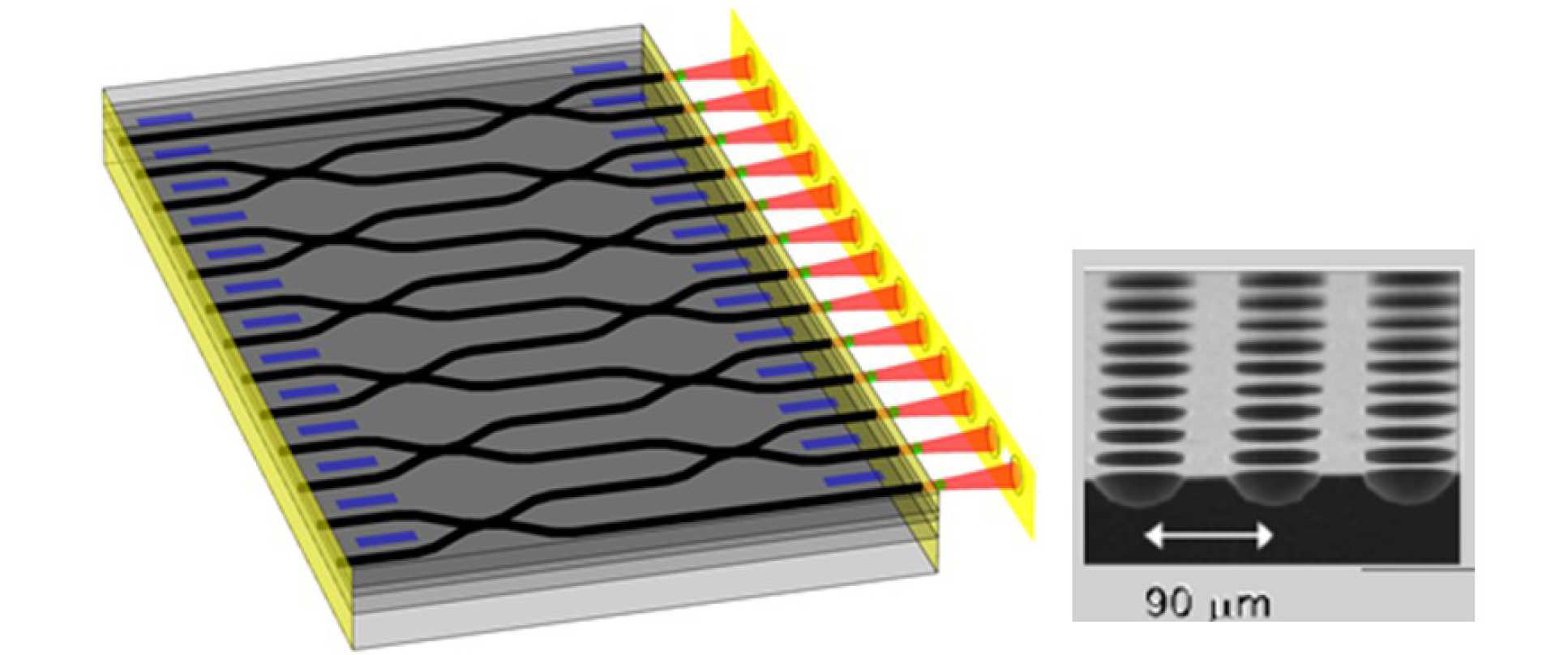 A schematic of the proposed quantum optical circuit (left). The black lines represent optical waveguides in silica on a silicon substrate. Each crossing of any two waveguides effectively act as a beam splitter. The green dots represent organic dye molecules deposited on the waveguide inputs. Cavities are formed by Bragg mirrors (yellow surfaces) around them to enhance the single photon emission into the waveguides. Right hand side picture shows a silicon chip with spherical mirrors that will oppose the input facet of the waveguides chip.
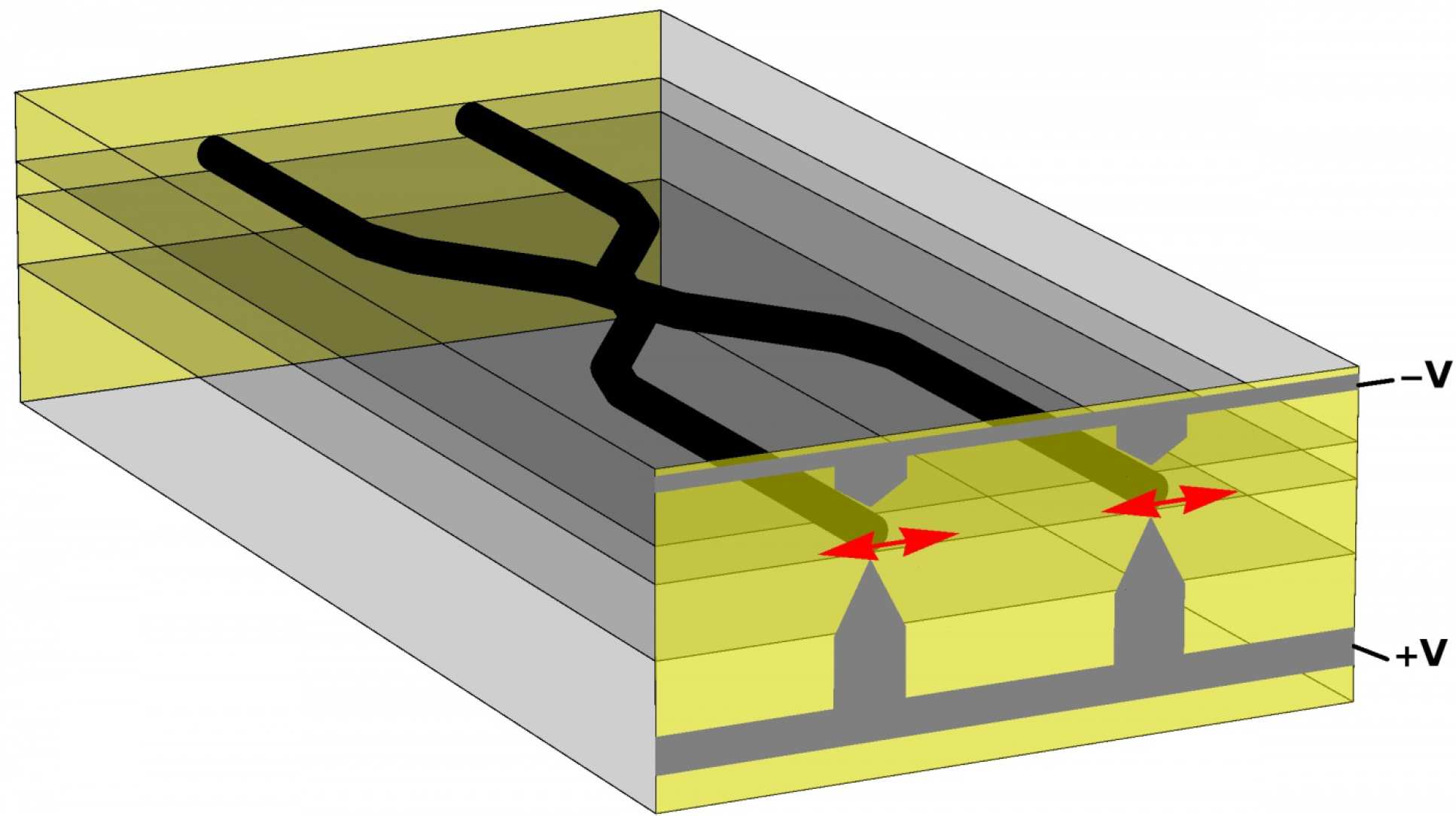
Above: A schematic diagram of coupling of individual dye molecules on the facet of the waveguide. The facet of the waveguide is coated with dielectric mirror, and Stark electrodes are deposited on top to control the emission frequency of the molecules (red arrows)
[1] “A Single-Molecule Optical Transistor,” J. Hwang, et al. Nature 460, 76 (2009)
[2] “Atom detection and production in a scalable, open optical microcavity,” Phys. Rev. Lett. 99 063601 (2007)
[3] “Arrays of waveguide-coupled optical cavities that interact strongly with atoms,” G. Lepert , et al NJP, 13 113002 (2011)
[4] “Dye molecules as single-photon sources and large optical nonlinearities on a chip,” J. Hwang and E. A. Hinds, NJP, 13 085009 (2011)