
Focus groups
Focus groups provide many of the advantages of a one-to-one interview, but with the important difference that they yield a collective rather than an individual view. In a focus group, participants interact with each other rather than with the interviewer, and it is from the interaction of the group that the data emerge: hence the dynamics of the group are important (Denscombe, 2014; cited in Cohen et al., 2018, p. 532).
Focus groups are therefore appealing for researchers who seek to study the interactions and communication dynamics of groups and, owing to their practical utility, are an increasingly popular method of data collection among qualitative researchers (Savin-Baden and Howell Major, 2013, p. 374). However, they do present particular challenges (particularly in terms of data analysis and the management of group dynamics) to which careful consideration needs to be given at all stages in the process.
"The ‘contrived’ nature of focus groups is both their strength and weakness: they are unnatural settings yet they are structured and structured and very focused on a particular issue and, therefore, will yield insights that might not otherwise have been gained from a straightforward interview; they are economical on time, often producing a large amount of data in a short period, but they tend to produce less data than interviews with the same number of individuals on a one-to-one basis."
Cohen, Manion and Morrison, 2018, p. 532.
VPW
Focus groups - Effective introductions
Conducting educational research focus groups: Effective introductions (3’ 36”)
This video outlines key elements of an effective introduction to a focus group, including welcoming participants, clarifying consent and confidentiality, setting expectations, and reassuring that all contributions are valued.

Focus groups - Effective introductions
Facilitating a focus group: What does an effective introduction look like in practice?
Conducting educational research focus groups: Effective introductions (3’ 36”)
This video outlines key elements of an effective introduction to a focus group, including welcoming participants, clarifying consent and confidentiality, setting expectations, and reassuring that all contributions are valued.
What does an effective conclusion of a session look like?
Facilitating a focus group: What does an effective conclusion of a session look like?
Conducting educational research focus groups: Effective conclusions (2’ 23”)
This video demonstrates examples of effective and poor practice when concluding a focus group, including inviting final comments, thanking participants, and outlining next steps.
What does effective facilitation look like?
Facilitating a focus group: What does effective facilitation look like?
Conducting educational research focus groups: Effective facilitating (4’ 05”)
This video illustrates effective and poor practices when facilitating focus groups, highlighting how the facilitator’s role can shape participation and group dynamics.
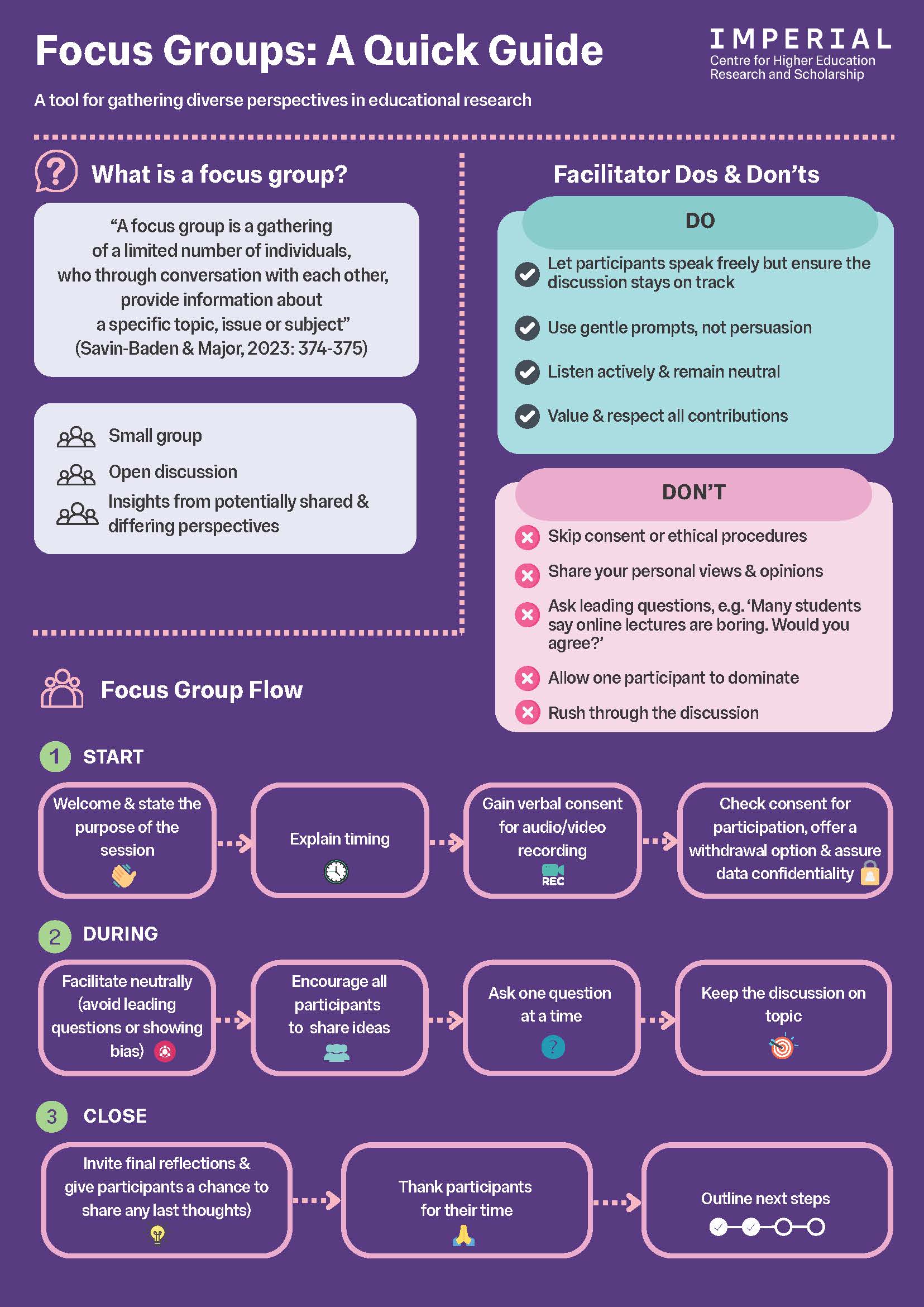 Focus Groups: A Quick Guide
This focus groups summary infographic provides an overview of how to facilitate and conclude focus groups effectively, with key do’s and don’ts for facilitators.
Other points to consider:
- When devising your focus group questions, it is important to plan appropriately for the time you will have available. For example, in a one-hour session, you will usually only get through a handful of questions, especially if you want to allow time for follow-up questions based on participants’ responses. Download this example of a focus group question schedule that was prepared for a one-hour focus group discussion.
- Think carefully about the order of your questions too. To ease your participants into the session (i.e. to help them relax and start feeling comfortable to contribute), it is advisable to begin with more general questions before moving on to more complex or sensitive discussions.
- Be prepared to manage group dynamics as sometimes one or more participants may dominate the conversation (perhaps without even realising), so you will need to ensure everyone who wishes to speak has the chance to do so.
Educational research at Imperial
 Dr Mike Streule
Department of Earth Science and Engineering (now Director of Education & Student Experience Strategy - Engineering)
'My project was focussed around the general term of ‘teaching excellence’. This idea partly burgeoned from the inception of the Teaching Excellence Framework (TEF) and the various debates around this government policy framework. However, being in a very student-focussed department I wanted to research to gain a better understanding of the student’s perspective on this term. Anticipating that any discussion on teaching excellence would inevitably extend to discussing teaching staff, I also extended the project to understand students’ measures of teaching esteem in HE.
Focus groups were selected as I was not wanting or expecting students to offer their understanding of teaching excellence and measures of teacher esteem in simple terms. Having a focus group would allow students to ‘bounce ideas’ around and develop an interesting narrative around the terms.
Managing focus groups with participants that were unknown to me was challenging, as I reached out beyond my department to the Faculty of Engineering. I could probably do a better job of managing the focus groups now! The main piece of advice I would give is to think about your target research participants and how knowing or not knowing them has an impact on your research question…and consequently on the challenges this may consequently present at the data collection phase.'
Further reading
Cohen, L., Manion, L. & Morrison, K. (2018) Focus groups. In: Cohen, L., Manion, L. & Morrison, K. (eds), Research Methods in Education. 8th edition. Abingdon, Routledge, pp. 532-533.
Savin-Baden, M. & Howell Major, C. (2013), Focus group interviews. In: Qualitative Research: The Essential Guide to Theory and Practice. Abingdon, Routledge, pp. 374-390. BMJ 1995
Qualitative Research: Introducing focus groups BMJ 1995
Making sense of focus groups [pdf] Medical Education 2005