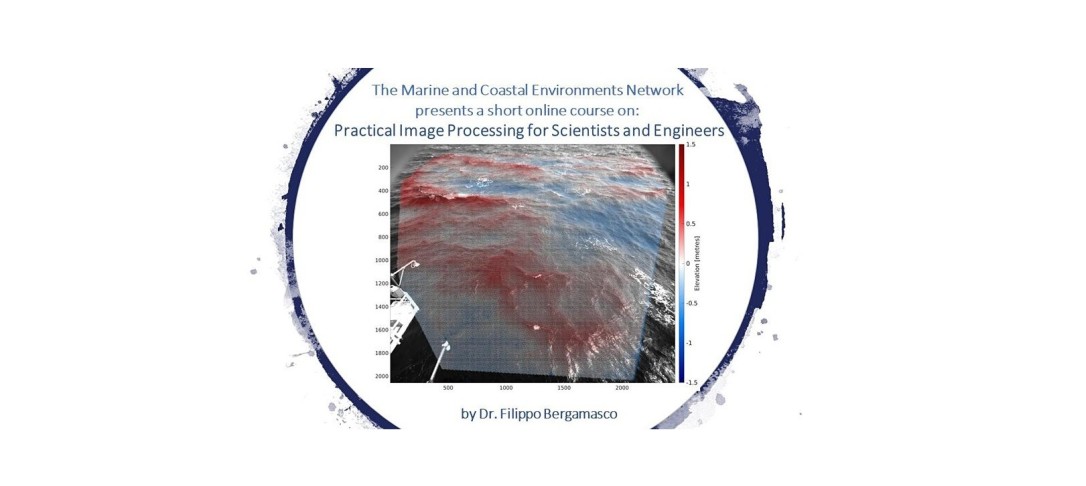
The Marine and Coastal Environments Network at Imperial College presents a short online course on: Practical Image Processing for Scientists and Engineers.
The aim of vision systems is to build a model of the environment based on the analysis of one or more images. This short online course provides a practical introduction to principles and fundamental algorithms used in order to create artificial vision systems. The course develops in a bottom-up fashion, starting from the fundamental concepts of “early vision” and progressing with the classical image processing methods to extract interesting features from images. Each lesson comprises practical examples to better frame the studied concepts to typical real-world scenarios.
The event is open to all Imperial staff and students, but may be of particular interest for PhD students and postdocs.
The course
Duration
5 Lessons (10 hours total). Each lesson lasts 2 hours, including questions. Classes will be delivered online using ZOOM. Details will be sent to registrants the day before the event.
Lecturer
Dr Filippo Bergamasco, Ca’ Foscari University of Venice, Italy
Programme
All classes to begin at 10.00 BST
Lesson 1 – Introduction – September 7
- Light and visible spectrum
- The imaging process
- Sampling and Quantization
- Intensity transformations: Negative, Gain/Bias, Log/Gamma
- Image histogram
- Histogram equalization and matching
- Image thresholding
Live demo: Histogram matching
Objectives: Understand how digital images are acquired, how to judge (and possibly enhance) their quality.
Lesson 2 – Spatial filtering & Morphological image processing – September 8
- Mechanics of spatial filtering
- Correlation and convolution
- Template matching
- Noise models
- Smoothing spatial filters
- Min/max/median filters
- Sharpening and Laplacian
- Grayscale morphological image processing
Live demo: Top-hat filter: removing a galaxy from a starred sky
Objectives: Understand how to remove noise from images and/or increase the sharpness
Lesson 3 – Colour vision – September 9
- Colour fundamentals and human vision
- Colour matching
- Colour spaces
- Chroma keying compositing
Live demo: Filming with green screen: practical chroma keying compositing.
Objectives: Learn to discriminate objects according to their colour.
Possible applications: Colour-based object detection.
Lesson 4 – Edge and Corners – September 14
- Features in computer vision
- Edge models
- The image gradient
- Derivatives and noise
- Marr-Hildreth edge detector
- Canny edge detector
- Harris corner detector
Live demo: Realtime Harris corner detector
Objectives: How to extract interesting features from an image, like edges or corners.
Possible applications: Object shape and boundary detection, feature tracking
Lesson 5 – Pinhole camera – September 15
- Camera obscura
- The pinhole model
- Finite projective camera
- Image of points on a plane
- Vanishing points and lines
- 2D projectivities
Live demo: Plane rectification from vanishing lines
Objective: Understand the geometric relations between the 3D scene and its projection onto the image plane.
Possible applications: Recovery of the camera motion, planar objects measurement, perspective distortion correction
Referral texts
[1] R. C. Gonzalez, R.E. Woods. Digital Image Processing (3rd edition). Pretience Hall
[2] R. Hartley, A. Zisserman. Multiple View Geometry in Computer Vision (2nd edition). Cambridge University Press, New York, NY, USA.