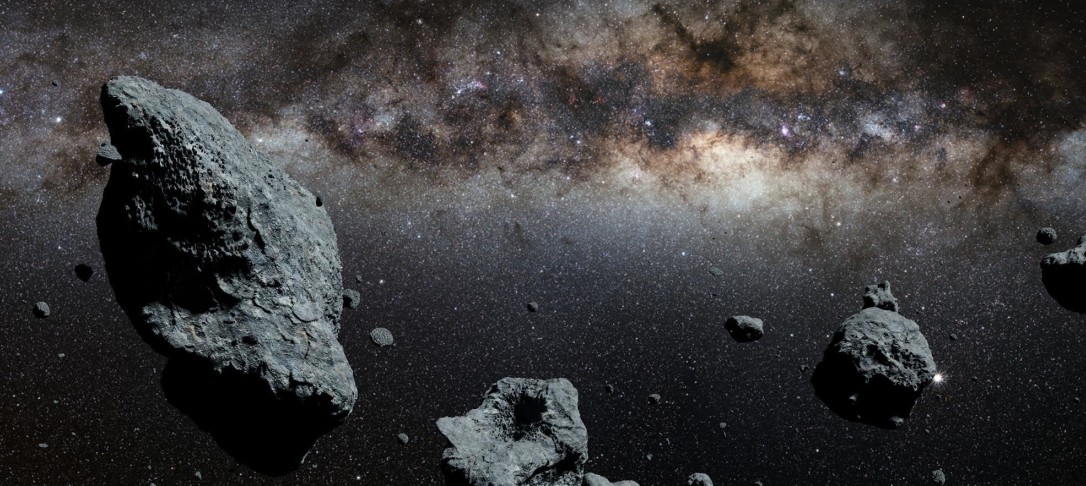
Dr Christian Potiszil will deliver the ESE Departmental Seminar on 17 November 2022, “The asteroid Ryugu: An organic geochemical perspective”
Join us in room G41 – RSM Building – on Thursday 17 November 2022 at 12h15.
Or on Microsoft Teams: Christian Potiszil Seminar
Abstract
Asteroids and comets represent the material that remained behind after the formation of the planets. Such bodies would have formed from protosolar nebula material and thus preserve clues about the processes that operated during this period of the Solar System. While meteorites have elucidated much about the early solar system, for organic cosmochemists in particular, interpretations concerning the organic inventories of early solar system bodies have been limited by the influence of terrestrial contamination. The recent Hayabusa2 mission to the asteroid Ryugu thus represented an exceptional opportunity to study an almost pristine (in terms of terrestrial contamination) primitive asteroid. Aliquots of several Ryugu particles, weighing no more than 1-2 mg, were analysed for the organic matter compositions as part of a comprehensive geochemical investigation of the Ryugu return samples. The results were published alongside those of other geochemical analyses as an entire issue within the Proceedings of the Japan Academy, Series B, entitled “On the origin and evolution of the asteroid Ryugu: A comprehensive geochemical perspective”. A number of α- and β-amino acids were identified, revealing that complex organic reactions were commonplace during the aqueous alteration that formed the CI chondrite-like mineral assemblage of the Ryugu samples. As some of the amino acids identified were proteinogenic in nature, it can be assumed that at least some of the protein forming amino acids in meteorites should be indigenous, as many studies have argued. Furthermore, the spatial distribution of N-containing heterocyclic compounds across the surfaces of the particles were recorded and showed a heterogenous distribution, similar to carbonaceous chondrite meteorites. However, the types of N-heterocycles present within the Ryugu particles were found to be different to those in the Orgueil (CI1) carbonaceous chondrite, which has a similar mineral assemblage. As such, while Ryugu is very much similar to the Orgueil carbonaceous chondrite in terms of its mineral assemblage and records similar amino acids, there are some differences in the organic inventories of these two extraterrestrial specimens, which may indicate differences in their parent body processing conditions or their accreted organic matter. Lastly, particles collected from an artificial impact crater were found to differ, in terms of the CH2/CH3 of their insoluble/macromolecular organic matter, to those collected from the very surface of the asteroid Ryugu. The CH2/CH3 ratio of the probable subsurface particle was similar to that of Orgueil and primitive carbonaceous chondrites, but the surface particle recorded a distinct ratio, which may represent the effects of solar irradiation. In agreement, Raman spectroscopy indicated a slight difference in the nature of the organic matter between surface and probable subsurface particles. In summary, the findings indicate that Ryugu is both similar and different to the CI chondrite Orgueil in terms of its organic matter and shed light on the effects of both internal and external asteroidal processes.
About the speaker
Christian Potiszil studied geology at the University of Bristol, obtaining a MSci integrated masters degree, before undertaking a Ph.D. at Imperial College London in organic geochemistry. After a short postdoctoral study at Imperial College London and a brief stint as a publishing editor at the Royal Society of Chemistry, Christian moved to Japan for a postdoctoral position at the Institute for Planetary Materials, Okayama University. During this time, he developed new analytical techniques to study small sample sizes, such as those to be returned from the asteroid Ryugu. Later, Christian became an assistant professor on the tenure track scheme at the same institute and analysed the organic matter within the Ryugu samples. Christian is a cosmochemist who specialises in understanding the formation and evolution of organic matter within the Solar System. He is especially interested in spatially characterising organic-mineral relationships and biologically relevant compounds, such as amino acids and nitrogen heterocycles. A specialist in both spectroscopic and mass spectrometric techniques, Christian believes a multi-analytical approach often yields the best results.