PLEASE NOTE:
- This seminar is IN PERSON ONLY in room RSM 2.28, Level 2, Royal School of Mines at Imperial College London’s South Kensington campus.
- Refreshments and the opportunity to network will take place after this seminar in RSM 3.24.
GUEST SPEAKER:
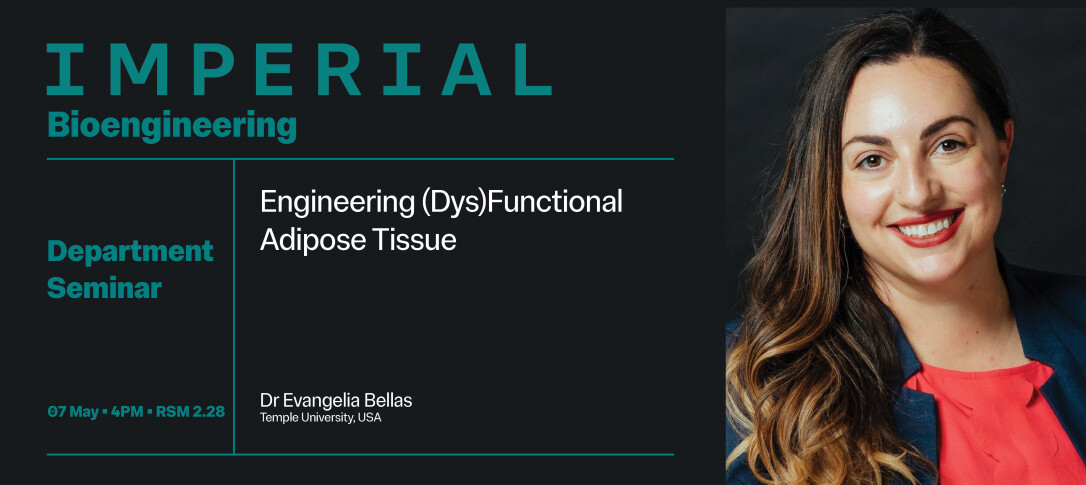
Dr Evangelia Bellas, Associate Professor of Bioengineering at Temple University
SEMINAR TITLE:
Engineering (Dys)Functional Adipose Tissue
ABSTRACT:
Adipose tissue was once seen as a static, storage unit for energy, more recently, we have begun to appreciate this dynamic, complex tissue which regulates our metabolic homeostasis. Adipocytes, the primary cell type in adipose tissue, expand and shrink to accommodate energy (lipids) storage and release. This requires a dynamic matrix, which can be easily remodeled. In obese adipose tissue, adipocytes become hypertrophic as they store more lipids, and the vasculature does not increase to adapt to the growing tissue. This results in tissue hypoxia, leading to inflammation and fibrosis, and ultimately causing a vicious cycle of dysfunction.
Our group develops adipose tissue disease models to mimic these dysfunctional states of hypoxia and fibrosis. We employ various bioengineering approaches to build these 3-dimensional engineered adipose tissue models, to study how fibrosis occurs, which pathways are implicated and how it leads to further dysfunction when the cell is physically constrained with pericellular collagen. We have also developed a vascularized adipose tissue model, demonstrating how vascularization is supported by healthy adipocytes and how direct contact between these cells regulates tissue function.
BIOGRAPHY:
Dr. Evangelia Bellas is an Associate Professor in the Department of Bioengineering at Temple University. Prior to joining Temple University, Dr. Bellas was a postdoctoral fellow in Biomedical Engineering at Boston University and Bioengineering at University of Pennsylvania under the mentorship of Dr. Christopher Chen where she developed 3D in vitro adipose tissue disease models. She received her Ph.D. in Biomedical Engineering at Tufts University mentored by Dr. David Kaplan. Her Ph.D. research focused on developing long-term volume stable silk biomaterials for soft tissue regeneration. This work resulted in 2 patents and a start-up. Before starting her Ph.D., Dr. Bellas was at Massachusetts Institute of Technology under the supervision of Drs. Robert Langer and Daniel Kohane, where she worked on biomaterial, drug delivery solutions for prevention of peritoneal adhesions and controlled release formulations for long-term pain management. Her current research focuses on the development of fat-on-chip and (dys)functional adipose tissue models to study how vascularization and interactions with the microenvironment impact tissue health and function and funded by NIH, NASA, NSF, Lipedema Foundation and VentureWell. She is the recipient of the NSF CAREER Award (2021), Biomedical Engineering Society (BMES)- Cell and Molecular Bioengineering (CMBE) Young Innovators Award (2021), Biomedical Engineering Society- Cell and Molecular Bioengineering Rising Star Award (2023) and the American Society for Matrix Biology- Junior Investigator Award (2023).
Dr. Bellas is active in service to her broader professional community, namely in diversity, equity and inclusion efforts and served as the Biomedical Engineering Society’s Diversity Committee Chair (2019-2023) and is the BME Council of Diversity elected vice-chair (2023-2024) and BOLD (Bioengineering Organizations Leading Diversity) elected incoming chair (2024-2025). Dr. Bellas is also an elected member of the BMES-CMBE Council (2023-2025), and the ASMB Council (2024-2028).