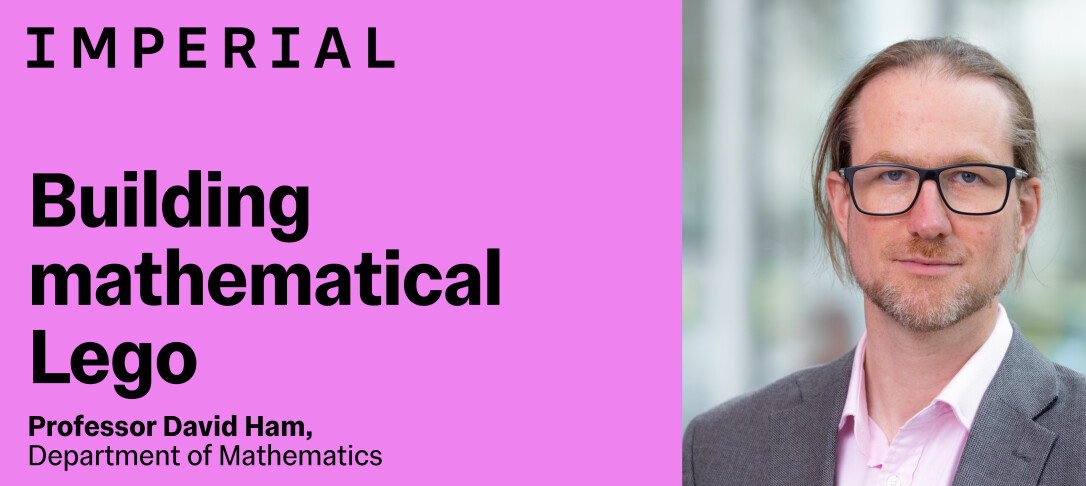
Join Professor David Ham, Professor of Computational Mathematics, to discover how his Firedrake project uses “Lego-like” software building blocks to simulate and understand the world’s most complex natural and engineered systems.
Please register to attend in person. A live stream link for online attendance is available on this page.
We look forward to seeing you on Wednesday 22 October!
Abstract
Continuous physical systems pervade our world. From the air we breathe to the ground we stand on, and all of the complex physical and electronic machinery we build and rely on, our lives and our experiences are full of substances and systems whose behaviour is governed by continuous physical laws. The ability to simulate continuous systems using a computer has emerged as a whole new type of science, enabling us to forecast and understand the behaviour of natural and manufactured systems. Computational weather forecasts have saved countless lives and prevented immense economic damage, while simulation of machines and industrial processes has produced more efficient, lighter and stronger structures and machines. Building the simulation software which makes all of this possible is now its own field of research, and that will be the subject of this lecture.
David Ham is a Professor of Computational Mathematics at Imperial College London. His research focusses on the construction and composition of mathematical software building blocks from which computational simulations are built. His software is employed around the world to simulate a bewildering array of phenomena, including the atmosphere, ocean, ice sheets, convection in the Earth’s mantle, nuclear fusion reactors and to design cooling systems for computer chips, to name but a few.
His research, and this talk, focusses on the Firedrake project, an unconventional approach to creating the tools used for simulation. Rather than the painstaking bespoke creation of complete programs for each simulation task, he employs reusable building blocks that can communicate with each other using standardised interfaces. Just like Lego bricks, these can be easily combined in countless different ways to create a vast array of creations, limited only by the imagination of the scientist or engineer. They can employ pre-built components which would be too complex or expensive for them to create themselves, and new components can easily be switched out for old ones. Just like the famous Danish toy, users frequently find ways of combining the components of which the system designers never dreamed.